Six ways to tend your emotional garden

Emotional wellbeing depends on regular nourishment, not unlike a flower or vegetable garden you cultivate. While vacations, sabbaticals and spa days are great, they’re the emotional equivalent of trying to maintain a garden just on the weekends or at the change of season — things might look okay, but they’re not thriving spectacularly with just that level of care. Most of us require more routine weeding and watering to maintain a high level of emotional wellness.

Thich Nhat Hanh says that our consciousness exists as seeds and as the manifestation of those seeds. We may have seeds of happiness, seeds of anger, seeds of sadness. But it’s the ones we “water” that manifest, and when they manifest they plant more seeds like themselves. Whatever is manifested the most takes up more space in the garden. Do you want it to be weeds or flowers?2016-07-21 16.59.10

You plant seeds during your own life, and also may have inherited seeds from previous generations. You may have a legacy of sadness or anxiety in your family, as well as seeds of joy or peace. Because of this blend of both inherited tendencies, and personal ones, the actions we take make a difference. Can you live in a way that will nurture the positive, healthy seeds rather than the negative ones?

People often overseed their lawns in the fall, so that new grass will come up in the spring and crowd out the weeds. So should we look for ways to overseed with the more positive emotional states that we desire, or as  Thich Nhat Hanh says, build “a strong storehouse of healthy seeds” to help us during times of trouble. Here are some ways to do that:

  • Have a place (a sort of safe space) that you go to regularly to re-generate. A special room in your home, a park, a church, a meditation space. I often regard the yoga studio this way – someplace where the outside world does not intrude, and the surroundings are peaceful.
  • If you are lucky, you’ll have at least one person in your life that you can confide in without judgment or recrimination. Sometimes we need to express things that are painful, shocking, or even hateful. Just because you have nasty emotions sometimes doesn’t make you a nasty person. It helps to have a space where you can rid yourself of these weeds.
  • If you don’t have such a person, or even if you do, you can also engage in expressive writing for health. Writing your story, for your eyes only, can be very healing. There’s some recent research from John Evans showing positive benefits.
  • Practice acts of kindness toward others. Seeing yourself in the eyes of someone you help or treat with love, feeling their gratitude, will scatter more seeds of love and kindness in your life and the lives of those around you.
  • And as for those around you, to the extent possible, surround yourself with people who are positive and loving. Yesterday, when I started to write this, I got a call from a friend who is one of the friendliest, most positive people I know. We made a plan to meet later in the week. When the call was ending, she said, “You’ve made my day!” but I was thinking, “No, you made my day.”
  • Practice living more mindfully and being present to the people and opportunities around you. Even when you are with loving friends and family, it’s important to be with them mindfully. Thich Nhat Hanh advises us to “practice full awareness in each precious moment” you are together, so that your friend isn’t just “ameliorating your suffering” but also planting a strong image in your mind that you can call upon to sustain you later on when you are not with her.

These practices become even more important when we are surrounded by so much turmoil 4-Co. Kerry-Killarney NP (10)and angry rhetoric in our world. The volume of that discourse could easily fertilize the seeds of anger, hate and misunderstanding within us if we let it. Change has to begin within each one of us, planting seeds of love instead. Remember Gandhi’s words, “There is no path to peace. Peace is the path.”
 

Warning: This could be habit forming

There are many people I know who subscribe to the belief that if you want to establish a particular daily habit, it’s best to do it as soon as you get up in the morning. A teacher of mine has the habit of writing first thing in the morning, my husband insists that exercising in the morning is the only way to make sure he does it, and most regular meditators say that it’s important to establish that practice upon rising. You could say it’s the Nike model: Just do it.

But here’s my typical morning when I don’t have to rush out: get up, drink a cup of coffee while reading the newspaper, eat breakfast with a second cup of coffee, have more coffee while doing the crossword puzzle…you get the idea. Can I possibly get into a different morning routine that allows me to accomplish more?

It’s tough to change habits. What we forget when we talk about establishing a “good” habit is that we usually have to eradicate a “bad” habit first. As a health educator, I’m frequently advising people on healthy eating, exercise and stress management, but even though they may have an intention to change, their habits of mind get in the way. If I examine my own life, and think about changes I’ve wanted to make, how often have I made progress? How often have I achieved my goal? And how often have I done that on my first try? Rarely, if at all.

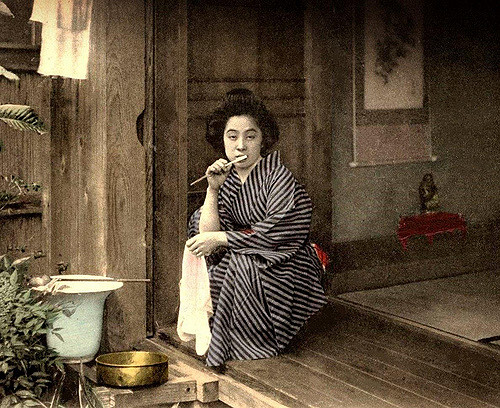
Research has shown that as much as 40% of our daily activity is performed in exactly the same way each day. In other words, much of our time is spent acting automatically. This is great, in the sense that you don’t have to think about how to brush your teeth every time you do it, but it makes it tough if you actually do want to change how you brush your teeth!geisha

We have two parts of our minds competing against each other. One is the intentional mind, which is goal-directed. This is the part we want to activate if we’re trying to lose weight, finish a project, or train for a marathon. The other part is the habitual mind, and it operates mostly outside of our awareness, helped by neurochemicals in the brain that allow habits to take over. We need the goal-directed part to be in charge long enough to get a new behavior established, then hope that the habitual mind kicks in and makes the behavior automatic. But how can we accomplish that?

According to social psychologist Wendy Wood, we first have to derail the existing habit and create an opening for a new one to take root. Because habits form through associative learning, a change in environment can often be a way to derail an old habit because  the cues for the behavior disappear. Some examples might be moving, changing jobs or hanging out with a different group of people.

What are some of the things that cue behavior? Many smokers say that they always have a cigarette when they have a drink. The drink is the cue for the cigarette – take away the drink, and maybe they are less likely to smoke. For others, watching TV is a cue to start snacking. So if you substitute another activity for TV viewing, you derail the snacking habit.

After creating opportunity and letting the intentional mind set a goal, it’s all about repetition. Studies show that it can take anywhere from 15-254 days for a new habit to be established. So repeating the behavior frequently is important, as is creating a consistent context in which it happens. In other words, we need to have new cues in the environment that trigger the new behavior.

It can take a while to figure out the new cues. When I moved a couple of years ago, I found that my writing habit was disrupted because my desk suddenly wasn’t a place where I could write anymore. Only after I began writing at the kitchen table was I able to consistently be productive. Then I could let repetition turn it into habit.chains

The theologian Tryon Edwards once wrote,

Any act often repeated soon forms a habit; and habit allowed, steady gains in strength, At first it may be but as a spider’s web, easily broken through, but if not resisted it soon binds us with chains of steel.

While chains of steel sound a little scary, they’re exactly what our healthy habits need. Unfortunately, they’re also what makes it so hard to break the bad ones.


Finding a new way to share the road

I recently returned from two weeks in Ireland, including a week spent driving on a lot of country roads. Toward the end of the trip, I was reading Rick Steves’ advice on driving in Ireland. One has to remember, he said, that there’s no “my side” and “your side” on the narrow, twisting roads, there’s just “the road”. 

What a metaphor for a lot of life’s encounters! We spend so much time jockeying for position, trying to gain the upper hand in work, in relationships, and yes, while driving, when we might benefit from remembering that we’re all in this together. Being flexible, knowing when to give and take, even yielding to someone else is often the wiser course of action. 

Just as there’s an inherent conflict in two cars driving in opposite directions on a road that’s only wide enough for one or one and a half, many of life’s struggles often appear impossible to resolve in a win-win sort of way. But sharing the metaphorical road doesn’t mean giving up (although I do admit to just pulling off the road in Ireland at times). It means learning how to approach, rather avoid or attack. 3-Co. Kerry-Gallarus hike (1)

There’s a conflict resolution model called the Thomas-Kilman Mode Instrument that describes five different styles commonly used by people, depending on the situation and on their personalities. They range from avoidance to collaboration, with accommodating, competing and compromising falling in between. While not everyone may use all the styles, they each have appropriate uses, depending on timing and what’s at stake. The two styles that I find most comparable to driving in Ireland are Accommodating and Compromising. 

Accommodating means that you sacrifice your own needs for someone else’s (thereby not being assertive). It is agreeable, friendly and yielding, but also cooperative; and appropriate in these instances:

  • When the conflict is about something that’s not very important to you, but it is important to the other person.
  • When it is necessary, and worth it, in order to maintain the relationship
  • When you turn out to be wrong about the situation
  • When damage would occur if you continued to compete, and you know you can’t win [think Bernie Sanders]. 

The Compromising style falls somewhere between being assertive and being cooperative. Using this style means that you try to find a middle ground where each person gets some of what they want. It is most useful: 

  • When you attach a certain amount of importance to your goals, but not so much that you want to assert yourself fully.
  • When people “of equal status are equally committed”. [Think 2 cars passing on the road.]
  • As a temporary measure in a complicated situation until some better solution is reached.
  • When you need to get resolution quickly in an important situation. 

As we drive through life, we’re often avoiding the narrow roads (being unassertive and uncooperative) or competing to take up the whole road (being aggressive and uncooperative), when we might “gain” more by using the accommodating or compromising styles. Ultimately, the gain comes in reduced stress and more time spent feeling relaxed and enjoying the view. What’s more important? 

Here’s what I learned on my vacation: It’s okay to yield, even to be soft sometimes; not everything has to be a fight to the finish. As Wayne Dyer has said, “Conflict cannot survive without your participation.”


Dealing with obstacles? Think like Pac-Man

The life we hope for is one of smooth sailing, the wind at our backs, and nothing but blue skies ahead. It’s a life where we make plans and carry them out, where we’re successful and satisfied and loved. Unfortunately, things don’t usually work out so perfectly. I’ve heard that President Obama’s mantra as a community organizer was, “Dream of the world as you wish it to be, but deal with the world as it is.” For most of us, the world as it is includes obstacles.

In some ways, modern life sets up to be surprised by obstacles. After all, we have an app for everything. We hear how easy things are if we just use this or buy that. So when we do hit a roadblock, often the first reaction is, “This shouldn’t be happening to me.” Today, for instance, I went running in the park after a bad storm. Some parts of the path were relatively dry and clear; but many areas were engulfed by puddles or covered in mud. I had to decide: which obstacles do I detour around, which do I leap over, and where do I plow right through? Just as the run today required some physical agility, dealing with life’s tougher obstacles often demands mental and emotional agility.

I’m reminded of the old Pac-Man video game where most of the time Pac-Man is outrunning his enemies, but sometimes he has the power to eat them. In life, we obviously try to avoid most obstacles, but sometimes confronting them gets us where we’re going faster. The question is what power pellets do we have that will enable us to confront the obstacles head-on? pacman_wallpaper_by_meskarune-d4a8m3k

Our strongest “power pellets” are past experience and social support. This means that when we encounter an obstacle on the path ahead, we first ask, “How have I dealt with this before?” And then, “Who can help me deal with this?” Change and blockages are inevitable, but it helps if you’ve been there before, or you know that someone can offer you advice or comfort.

The ability to adapt in the face of adversity is the hallmark of a resilient person, and keeping a positive view of your abilities is another power pellet for building resilience. Going through times of trouble can often be an opportunity for self-discovery and growth, and a time to gain a different perspective on smaller problems. It helps you realize that not every mud puddle is a crisis.

Nurturing a positive self-view is also enhanced if you continue to move toward your goals in spite of the obstacles. The other night I went to an event that featured gospel singer Bebe Winans talking about the new musical of his life story. He discussed and sang the title song, “Born For This.” The song grew out of an experience of being rejected, yet realizing that his goal was still valid and his purpose was clear. Knowing that your life has meaning, and keeping your eye on your purpose, is what gets you over the rough, messy patches on life’s path.

So while I wish you a journey free of obstacles, I also offer you this the next time you find yourself stuck in the mud: Don’t resist, don’t personalize. Deal with the world as it is, by asking “What can I learn? What power do I have? How can I creatively respond to this problem?”

Got troubles? Don’t chew them over.

Ruminant animals, such as cows, are known for “chewing their cud” over and over before digesting it. It’s a process that enables them to get maximum nutrients from plant-based foods — they ferment the food in a special stomach, regurgitate it and chew it again. The rechewing allows them to break it down and digest it more easily. It’s easy to see the parallels with the way we humans sometimes think about an unpleasant event over and over and over again in an attempt to process it — in fact, we have a word for that, rumination.

cow chewingUnfortunately, we probably aren’t getting any beneficial nutrients from our rumination process. In fact, when someone tends to chew things over, and also has a pessimistic explanatory style, they are more prone to depression. Such nonstop rumination with no positive action statements not only fuels depression, but has been shown to extend the cortisol release that happens during stress.


Most of the time, I do a good job of keeping myself from rumination (some research does show that women are more likely to ruminate than men are). I’m a pretty positive thinker, I have a lot of distractions to keep me busy and I’m usually good about expressing my feelings to others. Lately, however, I’ve found myself engaging more in rumination after some stressful interactions, getting caught up in a kind of circle game with the same thoughts going round and round in my head. So I’m turning to the experts to help me get back on track.

Martin Seligman has several skills that he recommends for ruminators. Thought stopping is the first one. Literally say, or even yell, “Stop!” You can write it on a card to remind you, or ring a bell — anything to shift your attention away from the recurring thoughts. Because it is the nature of rumination to circle around in the mind, you can even schedule another time to think about it. The purpose of these thoughts is to remind you of the event, so sometimes writing down the thoughts helps too. If they are written down, you no longer need the mental reminder, and you can stop thinking about them.

The use of expressive writing about the stressful event may also be useful. The important thing is that the writing can’t just be ruminative, a regurgitation of the events. It has to be turned into a story, attached to feelings, and ideally, reveal insights into the situation that might move you forward. What are the emotions and feelings that surround the story? Fear, guilt, regret, anger? The RULER method teaches us to recognize, understand, label, express and finally, regulate emotions. Writing about the troubling event can be a healing part of that process because it is an opportunity to take the first four steps (RULE) and attach them to the story.

Several studies have shown that mindfulness reduces rumination. One that was published in 2008 (Chambers, et. al) showed that after a 10-day intensive mindfulness program, participants demonstrated reduced rumination, fewer depressive symptoms and more working memory capacity. Since mindfulness is all about staying in the present moment, this makes sense — it’s hard to think about a past event while staying present. If the unwelcome thoughts come up during mindfulness practice, we learn to just observe them, without judgment, and let them go.

Ultimately, rumination is a desire to control an event that is out of our control — either because it has already happened or it involves other people’s actions, not ours. We all wish we could have do-overs, or make other people do what we want. The techniques that I’ve mentioned here help to distract, heal and re-focus from what is out of our control. Eventually, we may learn to surrender to what is, accept the reality of it, go with the flow, and trust the universe to make it right.

Making your resolutions reality

Debbie Ford wrote that “New Year’s resolutions often fail because toxic emotions and experiences from our past can sabotage us or keep us stuck with the same old thoughts, patterns and regrets.” It can be scary to look closely at ourselves, to acknowledge some of our fears and emotions. That’s why having a plan for dealing with those negative voices boosts the staying power of your resolutions. Here’s part 2 of stress management as a foundation for resolutions:

Live purposefully — What drives you? What are you passionate about? When you combine  your values with the gifts and strengths you offer to others, that synergy helps you feel engaged, connected, and part of something larger than yourself. If, as Sean Johnson suggests, you ask yourself every day, “What is worth my time, attention, prana, love?”, and then follow that path, your actions will bring you an authentic feeling of happiness, rather than anxiety.

Move more — This advice doesn’t have anything to do with a resolution you might have about exercising more. This is movement for the joy of motion. Just move more, even when you don’t exercise. Walk somewhere that you usually drive – you’ll notice different things! Dance when you’re cleaning the house. Go ice-skating. Take the stairs instead of the elevator at least once a day. Movement is what our bodies crave when we are overloaded with the products of stress. It just feels good to move, so do it!Skaters

Practice compassion — starting with yourself! This is probably the most helpful thing you can do for yourself if you are trying to stick to resolutions. Don’t beat yourself up when things aren’t going as planned. Observe your own struggles, and those of others, with compassion. Try this meditation from Jack Kornfeld: “May I be held in compassion. May I be free from pain and sorrow. May I be at peace.” After you have directed these thoughts toward yourself for a while, turn them to others you know.

Learn something new everyday — Knowledge is power. Are you trying to have a healthier diet? Instead of following the latest fads, read some reputable nutrition literature and educate yourself in a way that will make your actions more successful. Try a different source for the news of the day to get another perspective. Read a book about something you know nothing about — it may be a great distraction from the focusing obsessively on what you are trying to change.Laughing woman

Laugh – then laugh again, and again. The other day I found a little collection of comic strips that I’ve cut out of newspapers. Even though I’ve read them many times, they still make me laugh every time I see them. We laugh for all sorts of reasons – sometimes it’s because things are genuinely funny, other times we laugh because a situation is so absurd, often we laugh just so we don’t cry. Like movement, laughter helps us rid the body of stress hormones. It also helps shift perspective, realize that we are not alone, and take the mind off of problems. Remember that your resolutions are supposed to make your life better, so don’t take them so seriously – resolve to laugh more in 2016!

How to revamp your resolutions

So we’re eleven days in to 2016, and the tension might be starting to mount. Will it be the fresh start or the old ways that win out? Just how stressed are you about your new year’s resolutions? Are you wondering why a promise to yourself might be harder to keep than one you make to someone else?

If you’re having trouble, take heart. You’re not alone and there’s still a way to salvage your resolutions for 2016. But change is hard, and stress is a given as we fight against those entrenched habits of mind and body that just want to maintain the status quo. Dealing with the stress of change has to be the underpinning of the other resolutions.

Sydney_69

To help you out, I’ve adapted my top ten stress management tips to relate them to your new year’s resolutions and goals. I’ll share the first five here, and the others next week:

Know what you value — We all have core values, which may include things like health, family, religion or money; and then satellite values that we feel less strongly about. How are those values playing out in the resolutions you’ve made? If your core value is good health, for instance, and appearance is more of a satellite value, then maybe your weight loss resolutions need to be tweaked. Rather than setting a specific weight loss goal so that you can fit into a certain size, a health goal of consuming less sugar might be more aligned with your values.

Nurture your relationships — The support of the people around us can play a major role in the success or failure of our resolutions. How strong are your relationships with the people in your social network? Are there things that need repair in some of your friendships? Have you been supportive of other people’s goals? Think about how turning your attention to someone near you might provide emotional support to you both.

Practice gratitude — When we hit a roadblock, or cheat on a diet, or fall off the wagon, it’s easy to start berating ourselves and feel like we’ve failed. Use those moments to practice gratitude instead. Be thankful that you had five good days of healthy eating before something tempted you. Express gratitude for the sunny day that will allow you to get out and exercise, even if you didn’t yesterday. Say thank you to the employer who is paying for your smoking-cessation program.

Be present — Slowing down and paying more attention in each moment can make us more aware of the choices that precede our actions. When we’re trying to make “better” choices or break “bad” habits, mindfulness makes the choices more conscious, less rote. For instance, when you’re eating, just eat — don’t work, drive or watch TV at the same time. Sit down and look at the food, smell the food, notice the colors, before the first bite goes in your mouth. When we choose food deliberately, eat slowly, and savor each bite, we can feel more satisfied with less, because we have been fully engaged in the process of eating.

Don’t forget to breathe — Breathing mindfully can focus attention in a way that may clarify your resolutions for you. Thich Nhat Hanh has a breath exercise he suggests for bringing the mind back to the body. While slowly breathing in and out, you say “Breathing in, I’m aware of my whole body. Breathing out, I’m aware of my whole body.” If you’ve been living too much in your head, and neglecting your health, this can be a way of turning your attention back where it’s needed, while letting go of any tension that might have built up.

Wayne Dyer says that our intentions create our reality. It’s my hope that these five ways of bringing more intention to your resolutions will help make them your reality.

Out of the holidays, a home

When you think of New York City’s Rockefeller Center at this time of the year, their famous Christmas tree probably comes to mind. It could easily be the most visible holiday tree in the world, because of its size (often close to 100 feet tall), its prominent role in many holiday movies, its presence in New York, and its annual lighting featured on live TV. But its most important role comes after the holidays, when it helps provide affordable housing for one lucky family each year.

Perhaps you’ve heard this story before, but it’s new to me. Every year for the past 9 years, the company who owns Rockefeller Center has donated the lumber from the Christmas tree to Habitat for Humanity for use in building a home. The lumber is marked with the year and “Rockefeller Center tree”. In addition, the company’s employees volunteer their time to work on the build, along with the family who will live in the home, transforming the Christmas tree into a safe and solid shelter. When these families celebrate their own holidays, in new homes far from New York City, they are surrounded by that glorious tree.

Habitat for Humanity estimates that one in four people worldwide lives in poverty housing. For almost 40 years, they have been building, rehabbing and repairing homes for people in need around the world. With the help of 2 million volunteers each year, they have served 6.8 million people in that time period, offering them hope and a chance for stability.

A lack of affordable housing affects people of all ages and races. The MacArthur Foundation is funding $25 million in research to determine what the impacts are, and how best to address the need. Their premise is that “affordable housing may be a ‘platform’ that promotes positive outcomes in education, employment, and physical and mental health…” In other words, if we address the housing issue first, other things may fall into place.

The French philosopher Gaston Bachelard once wrote, “If I were to name the chief benefit of the house, I should say: the house shelters day-dreaming, the house protects the dreamer, the house allows one to dream in peace.”

So how does a Christmas tree live forever?  When it becomes a home, the platform on which dreams are built.

Wishing you peaceful dreams for the new year…

Lessons from an amateur parent

Parenting, for all its joys (and they are abundant) is an endeavor fraught with the potential for second-guessing. When children are young, we ask, “Am I a good enough parent? Will I screw it up? Do I do too much for them, or am I doing too little? Am I too tough, or am I not tough enough?” Later, when they’re all grown up, the refrain becomes, “Should I have done things differently? Would he be happier if I had done X, would she have an easier time if I had done Y?”


You begin your life as a parent fooled by the child’s complete dependency into thinking that you are in control; in reality, almost nothing is in your control. Andrew Solomon, in his book “Far From the Tree” says that we think we are reproducing – making a newer, better version of ourselves – when, in fact, we really are producing someone completely different, whose life story is her own to realize.


Solomon’s book focuses on families whose children have what he calls “horizontal” identities, which sometimes become more important for them than the “vertical” identity of the family. In chapters covering children who are deaf, who have Down’s syndrome, autism or dwarfism, for example, he writes about how, for them, the community of people who share their deaf or autistic identity might be more comfortable or necessary than that of the family. He shares the experiences of dozens of parents who have had to completely change their expectations of what their child would be like.


While Solomon writes that many parents “are unprepared for children who present unfamiliar needs,” we don’t have to be talking about very extreme instances of disability or difference to know what he means.  Those parents just realize sooner than the rest of us how little control they have over the outcome of their child’s story. The beauty of life is that each of us is a unique individual, but that can make us feel like mysteries to each other sometimes, or as Solomon says, “Parenthood catapults us into a permanent relationship with a stranger.” Instead of trying to make the stranger into a copy of ourselves, we need to be brave enough to accept the child as he is.SF trip.Monterey_26


When I was growing up, especially as an adolescent, I didn’t think my parents could see me for who I was at all. I chafed under the strictures of the family, craved independence, felt that I belonged someplace else. During my teens and twenties, I would get irritated when I would hear my mother talking to someone about me, partly because she would sooner brag about me than praise me to my face, and partly because she would invariably get some detail of the story wrong. I moved to San Francisco when I was eighteen, where at the time, the local radio station would sign off from the news by saying, “If you don’t like the news, go out and make some of your own!” That slogan seemed to perfectly convey my own mindset: “Yes, I will write my own story, and it will not be anything like my parents’ story.”


Fast forward to the present. Now I’m not just a daughter and sister, but also a wife and mother. Yes, I have my own story, but I realize that it is inextricably interwoven with the versions other people tell. I can’t ask my mother to get my story right, or not to tell it, because she has her part in it, just as I have my part in my kids’ stories. I try not to cast myself as the hero or the villain of their stories — all I can do now is give them the love and freedom to tell their own version.


I’ve discovered that I can live with the stories as they tell them. When my daughter calls on our anniversary and says, “Thank you for getting married,” or my son acknowledges how much of an influence his father is on him, it tells me that they are comfortable with the identity they got from us, even as they so beautifully establish their own.

Meet the beautiful people

So I’ll confess – I’m kind of addicted to Doctor Radio on Sirius XM. The satellite radio show from the NYU medical center features programs dedicated to different medical specialties, with opportunities for calling in and talking to medical experts. But there are two programs that I don’t listen to – the plastic surgery show, and often the dermatology show – because they make me start obsessing too much about my appearance.

Screenshot 2015-11-19Recently, however, I did listen to a dermatology program because the topic was about beauty and our perception of it. One of the guests had done research using before and after photos of facial rejuvenation patients, to see if people rated the faces differently on a list of perceived personality traits. Basically, the question was, what do others think your face says about you? That discussion led to talk of other research showing that people who exhibit positive traits, such as honesty and helpfulness, are perceived as better looking. People who are smiling are perceived as more attractive than people who have neutral expressions.

It’s not news that our expressions and behaviors affect people’s perceptions and judgments. But have you thought about them as what makes you beautiful to someone else? One of the themes of the show was about investment in beauty, not by having plastic surgery or buying cosmetics, but by thinking about what’s shining out of us. Do you smile? Are you kind? Do you look people in the eye? Are you healthy and rested and compassionate?

After listening to the program, I started thinking about some of the truly beautiful people I know, and what makes them beautiful. There’s my sister-in-law, who is unfailingly encouraging and hopeful, with a wonderful, infectious laugh. There’s the friend I met at yoga class a few years ago, who chatted with and befriended literally every person who walked through the doors of the yoga studio. There’s my son’s childhood friend, who never wavered from being kind, even in adolescence when most kids are jerks at least some of the time. There’s my sister’s husband, who will help anyone with anything, at any time; whenever he comes to visit, he fixes something in my house or brings me something he thinks I need. There’s my painter, who had a casual conversation with my neighbor months ago about something that wasn’t working in her apartment; last week, when he came back, he brought her something to fix it.

These are just a few examples of people who are beautiful because of the positive traits they exhibit on a daily basis: kindness, friendliness, helpfulness, integrity and honesty.

A few weeks ago, I met a woman while I was working who was very beautiful, physically. She had lovely skin, beautiful hair and stylish clothes; I couldn’t help admiring her. But then I heard her ask a co-worker to do something that clearly wasn’t the co-worker’s job. The “beautiful” Spain-Barcelona (9)woman was exercising the power she had due to her position in the office hierarchy. My admiration for her was immediately diminished because of her behavior.

My dictionary defines beauty as “The quality that gives pleasure to the mind or senses and is associated with such properties as harmony of form or color, excellence of artistry, truthfulness, and originality.” While people who possess physical beauty may give pleasure to the senses, the people I know with true beauty give pleasure to my mind. They have a harmony of spirit, and values, that transcends anything on the exterior. People often talk of inner beauty, but I would argue that it can’t exist alone; anyone with inner beauty has a beautiful outer light that shines on everyone they meet.