Waste in abundance

How much food will you throw away today? Will you even notice it?

The Natural Resources Defense Council, in a new report, estimates that we throw away 40% of our food supply in America every year. Food is wasted at every step in the supply chain, starting at the farm and ending in our kitchens and trash cans. Food now represents the biggest part of the solid waste in our landfills.

Last night, I was congratulating myself on the nice meal I made from ingredients I happened to have on hand – some leftover tomato, farro and onions from my pantry, basil from my garden, and a chunk of Parmigiano that I bought a couple of weeks ago. No waste!

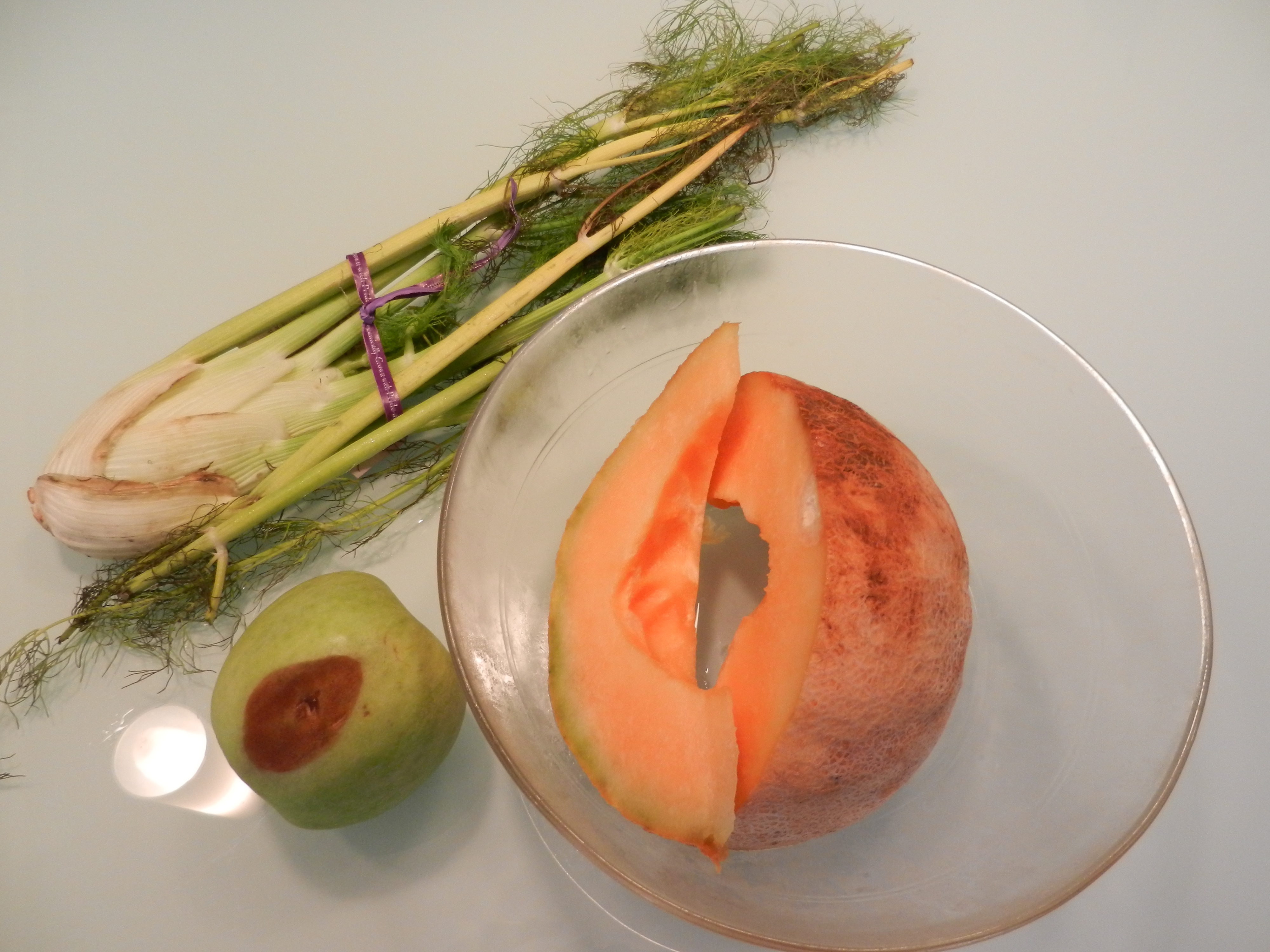
But today I took stock of the food in my refrigerator that I will have to throw away. There is the cantaloupe I bought because my son has recently discovered he likes it – but then he didn’t eat it. There’s the fennel I bought because I needed some of the fronds for a recipe – but I didn’t have a use for the rest of it. There’s the apple someone bought and no one ate – because the summer fruits like peaches and berries are so much better!

As it turns out, fresh produce is the worst food group for waste.

When we personally throw away food, we may only think about the money that we wasted on it. But in reality, the waste is much broader. The NRDC is concerned with the other resources wasted, such as the water and energy to grow and transport it and the pollution caused by its production. They calculate that just a 15% reduction in waste could feed 25 million people a year.

While the issue of food waste is a big one that will require big solutions by government, the agriculture industry, food manufacturers, retailers and restaurants, there are steps that we as individuals can take to reduce our waste.

  • Don’t buy more food than you realistically will eat. People have a tendency to load up their shopping carts because of the bargains offered at warehouse stores, the relatively low cost of food in the U.S., and the convenience of shopping less frequently. But we may have to re-think our ways of shopping to reduce our waste.
  • Don’t bite off more than you can chew. As portion sizes have increased in recent years, so has food waste (a 50% increase since the 1970s). Ordering smaller restaurant portions or taking home the leftovers will reduce waste there. Then don’t forget to eat the leftovers so they don’t end up in the trash at home!
  • Consider composting if you have a yard. At my house, all of our fruit and vegetable scraps go into our compost bin (along with leaves and grass). Although our county frowns on this because they say the food attracts animals, it is not a problem as long as you don’t put any animal products in the compost. We benefit by reducing our trash volume, and by having rich compost to add to our garden.
  • Get involved with a gleaning group. To glean means going in after a crop has been harvested and gathering the small amounts of fruit or vegetables that remain. Farmers will often invite charitable groups to come in for gleaning after the profitable part of the harvest is over. The produce is then donated to groups that feed the needy.
  • The next time you look in the refrigerator and say “There’s nothing to eat”, challenge yourself to make a meal using what you have on hand, instead of going out to buy more that might just be thrown away.

Finally, eat with mindfulness and appreciation. Thich Nhat Hanh has written, “When we sit down to dinner and look at our plate filled with fragrant and appetizing food, we can nourish our awareness of the bitter pain of people who suffer from hunger…Doing so will help us maintain mindfulness of our good fortune, and perhaps one day we will find ways to do something to help change the system of injustice that exists in the world.”

Be kind

“Be kind, for everyone you know is fighting a harder battle,” says the Plato quote that is on the plate displayed in my kitchen. “Be kind…be kind…be kind…” Why is it so hard to keep that mantra in my head?

For instance, I’m always baffled by how quickly after finishing a yoga class I can sometimes be not nice to someone! Whether it’s swearing at another driver, or snapping at a store clerk, it seems that my mellow mood evaporates as soon as I walk out the door. Why is that?

Like compassion, kindness is easier when the recipient is someone we love, or someone vulnerable, or someone clearly suffering through no fault of his own. It is much more difficult to practice when the other person is a stranger, or someone unlikeable, or someone who has clearly done something wrong. Being kind in that situation requires a degree of mindfulness and intention that needs to be cultivated purposefully in most of us.

Emotions like anger or impatience are always preceded by a thought, if only for a split second. That’s the moment when we have a choice of how to respond to a situation. Too often, we get trapped by our notions of how things should be, and our “choice” of response is harsh and unkind. Strangely, though, we don’t usually feel better after yelling at someone, but we do have feelings of well-being after acting kindly.

Olpin and Hesson have developed a framework of “levels of responding.” At one end of the spectrum are attachment, rightness, judgment, blaming, resistance and complaining – responses that are usually not effective and result in negative emotions. At the other end are observation (noticing without judgment), discovery (seeking to learn and understand), acceptance and gratitude – responses that are more effective and result in positive emotions. Studies conducted by Sonja Lyubomirsky  and others also show that people who practiced a variety of random acts of kindness experienced an increase in happiness.

It’s so easy to make every situation personal. Why did she do that to me? Why did that person cut me off? Why is he so mean to me? It might not have anything to do with me. It might be accidental, it might be that the person is having a bad day; it might be that the person is in pain. When we stop judging, stop personalizing, and start trying to understand, it becomes a lot easier to respond with kindness, or at least with acceptance.

Kahlil Gibran wrote, “I have learned silence from the talkative, toleration from the intolerant, and kindness from the unkind; yet strange, I am ungrateful to those teachers.” Plato’s reminder in my kitchen makes me realize that kindness is not something to master, but something to practice. Luckily, I meet someone every day who gives me the chance to do just that.

Something to teach, something to learn

Today I learned that my new yoga teacher is about to be a high school senior. I knew she was young, but not that young. She had just led us through a vinyasa flow class that was challenging, yet gentle; energetic, yet calming. Everyone thought it was great.

I am amazed by the grace and composure of this 17-year-old. When I think back to myself at that age, I can’t imagine even doing what she does, let alone doing it so well.

What makes a good teacher? Passion, confidence, knowledge? Along with those attributes, I believe that a good teacher cares deeply about her students, demonstrates it, and has the wisdom to know that there is as much to learn from them as there is to teach to them.

We benefit most as students when we let go of any expectations we have about what our teacher should be. Age, sex and size don’t define a talented yoga teacher, just as degrees and credentials don’t define talent in a college professor. Losing the words “should”, “ought”, and “must” from our vocabulary opens the door to invaluable experiences, and prevents a lot of the stress that comes from the belief that situations have to evolve in a certain way. Opening that door prepares us to engage, learn and make the most of what life, and our teachers, offer.

Certainly I used to be more rigid than I am today. From my children, I learned to be patient and adaptable. From my older relatives, I learned about dignity. From my friends, I learned to be compassionate and understanding. From my neighbors, I learned about community. From difficult people, I learned to forgive and let go.

Perhaps the most self-discovery comes when the lines between teacher and student blur, and we realize that there is something to be learned from everyone we meet. Every interaction is an opportunity to uncover something we already knew, but weren’t seeing. I only hope that I am able to touch other people the way my new yoga teacher touches me.

Seize the day

Good time management can help most of us avoid a lot of stress. Setting goals, planning out the day ahead of time, and working during our most high-energy hours can lead to greater productivity, less time pressure and a calmer life. Sometimes, though, it’s best to let serendipity win out over planning.

Case in point: yesterday was a gorgeous day. It was one of those days where the sky is a completely cloudless, brilliant blue. The day was warm, but the humidity was low. It was the best day we had had, or were going to have, this entire week.

So when my friend said to me after a morning yoga class, “What are you doing today? Let’s get something to eat and then take a long walk – it’s so beautiful today!” I barely hesitated. It’s true that thoughts of my to-do list, and the vague commitments I had for the day did cross my mind. But I quickly realized that there was nothing so pressing that it couldn’t be done later in the day, or even the next day.

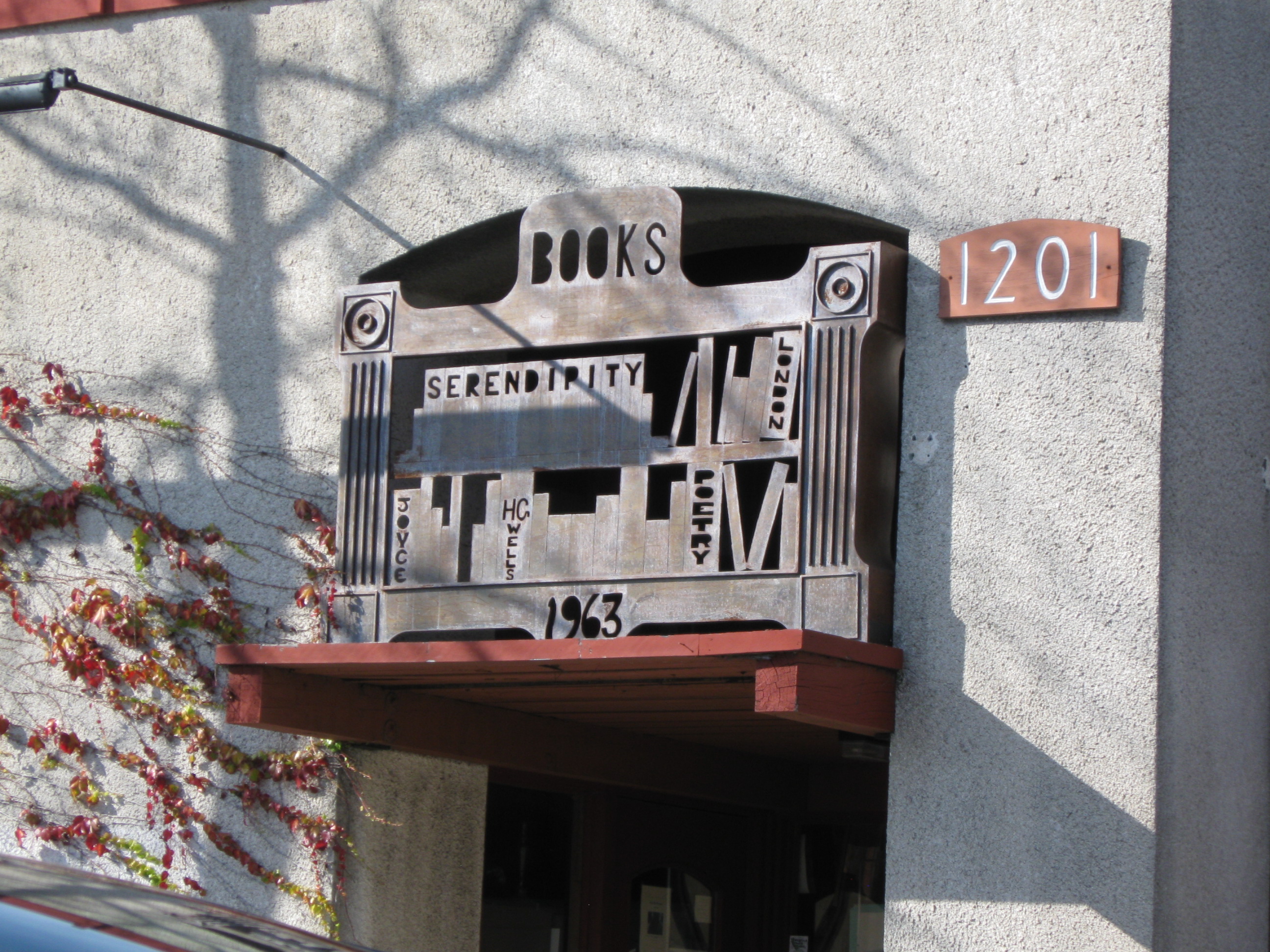
The word “serendipity” is a difficult one to define and translate, but it essentially means discovering something by accident while looking for something else, or finding something wonderful when we weren’t looking for it at all.  It’s possible to let serendipity play a role in daily time management, just by being aware of, and open to, the opportunities and beautiful moments that might turn up in the course of the day. Michael Olpin and Margie Hesson, in their text on stress management, suggest ‘split-page scheduling’ – dividing your planner page with a line down the middle, listing your plans, activities and appointments down the left side, and leaving the right side blank until the end of the day. Then you use the right side to record the unpredicted moments that arose during the day, such as “a new acquaintance, a fresh idea, a child’s question, an unexpected opportunity, a friend’s need, a chance meeting, a beautiful sunset.”

By opening ourselves to a certain amount of spontaneity in the day, we have the possibility of becoming more creative, experiencing life more fully, and even choosing to take new directions. We allow ourselves to enjoy the journey more, while not losing sight of the destination.

Yesterday, I spent a few lovely hours with my friend, walking and talking. We learned more about each other, enjoyed the fresh air and exercise, and came home hungry and tired. Even with my sore feet (lesson learned: don’t walk 4 miles in flip-flops), I still felt invigorated when I got home. I was able to get some of my work done, I enjoyed the process of preparing dinner more than usual, and I slept well. It felt like a day well-lived.

Look to this day!

For it is life, the very life of life.

In its brief course

Lie all the verities and realities of your existence:

The bliss of growth;

The glory of action;

The splendor of achievement;

For yesterday is but a dream,

And tomorrow is only a vision;

But today, well lived, makes every yesterday a dream of happiness,

And every tomorrow a vision of hope.

Look well, therefore, to this day!

“Kalidasa,” ancient Sanskrit poem

Cicada vs chain saw

Sounds I hear while meditating:

Cicadas

The hum of something – traffic? A lawnmower?

Yipping of a small dog

A hammer

A chain saw

My breath

There’s something incredibly comforting about the sounds I hear on an average day in my neighborhood: the insects, the birds, construction on a neighbor’s house, the sound of children playing. Like a baby who becomes accustomed to its mother’s voice while in her womb, these are the sounds that tell me everything is “normal”, life goes on.

But when I sit down to meditate, these sounds can also serve as a focal point. Following the breath in mindfulness meditation is very popular, but sometimes I find it difficult to stay focused on the breath. So what I like to do is to just sit and experience the sounds in my environment, especially in the spring and summer. If the windows are open, I can hear a lot of sounds from outdoors, both natural and manmade. Today, with the windows closed and the air conditioning on, most of the sounds were distant and muffled. My house was silent; I couldn’t hear appliances, air conditioning or computers from where I was sitting. So I became very aware of what was happening outside.

Most of the time, we don’t focus on the sounds around us, unless they are exceptionally pleasant or irritating. Sound just becomes a background for whatever we are thinking or doing at the moment. But when I stop and listen to each sound separately, it’s easier to find the quiet spaces between them. Deepak Chopra has said that, “Meditation is not a way of making your mind quiet. It’s a way of entering into the quiet that’s already there.” Although it seems counterintuitive, paying attention to sound helps me find silence.

While there aren’t many rules for meditating, having a passive attitude (nonjudging) is recommended. One way to achieve this is by becoming the observer rather than the thinker: I am not my thoughts, so I can note them and watch them pass with a sense of detachment. Observing the sounds around me helps with this, because they seem so remote and apart from me. The sound of the chain saw is no worse or better than the sound of the cicada; they both merely exist.

Heightening my awareness of sound, and observing it passively, can lead, I hope, to becoming a less judgmental observer of myself and others. Can I apply that kind of awareness to my own emotions and attitudes, learning to see and identify them before I act on them? The Dalai Lama says that “It is really a matter of habit…the more habituated you are to this awareness of the rising of emotion, the awareness in itself creates a separation between you and the emotion…”

So I listen to the sounds of my neighborhood, and hope to create a habit.

Aftermath

One of my favorite sayings is, “When you change the way you look at things, the way things look changes.” But is the opposite true as well? When the way things look changes, do we look at things differently?

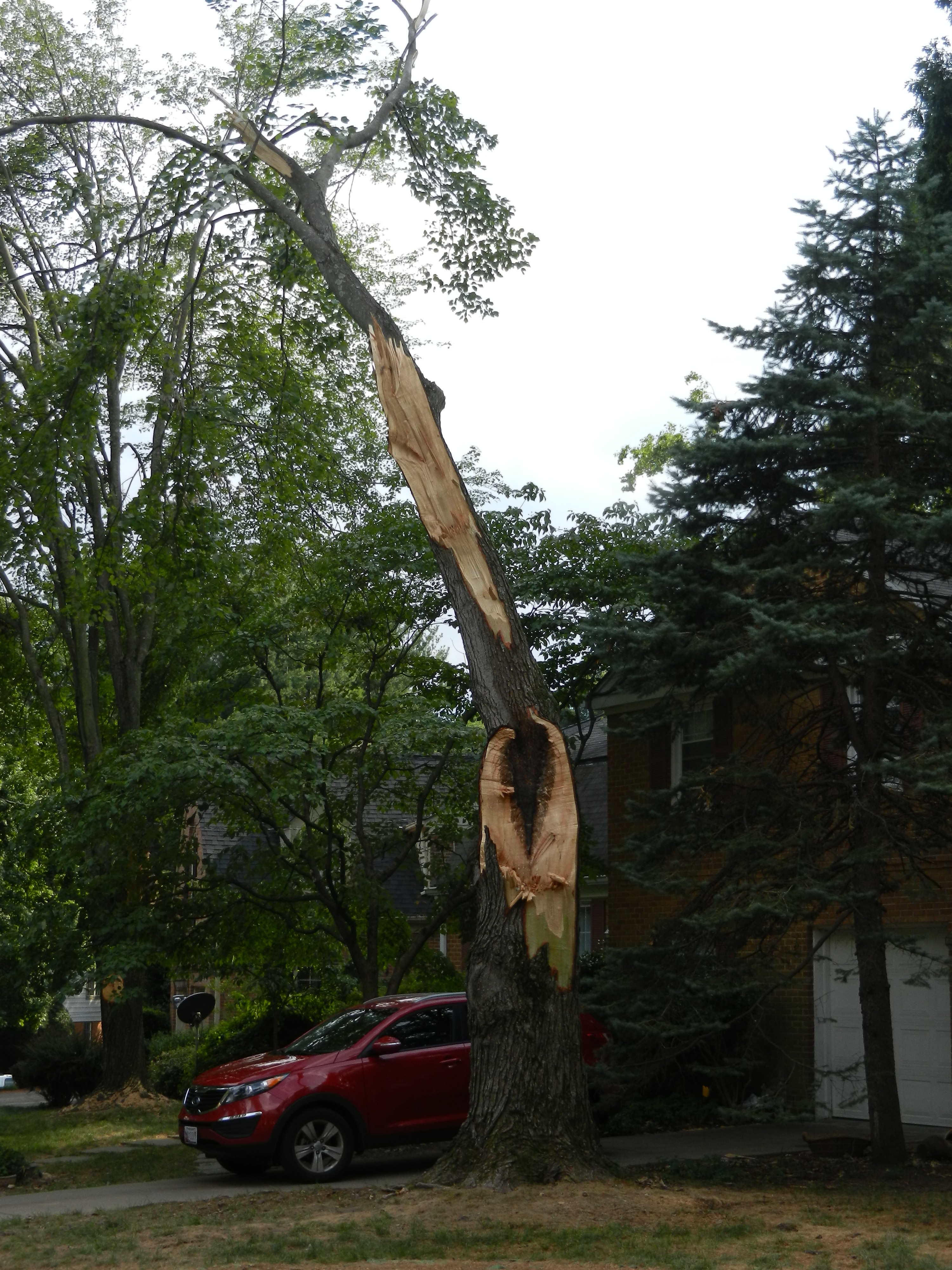
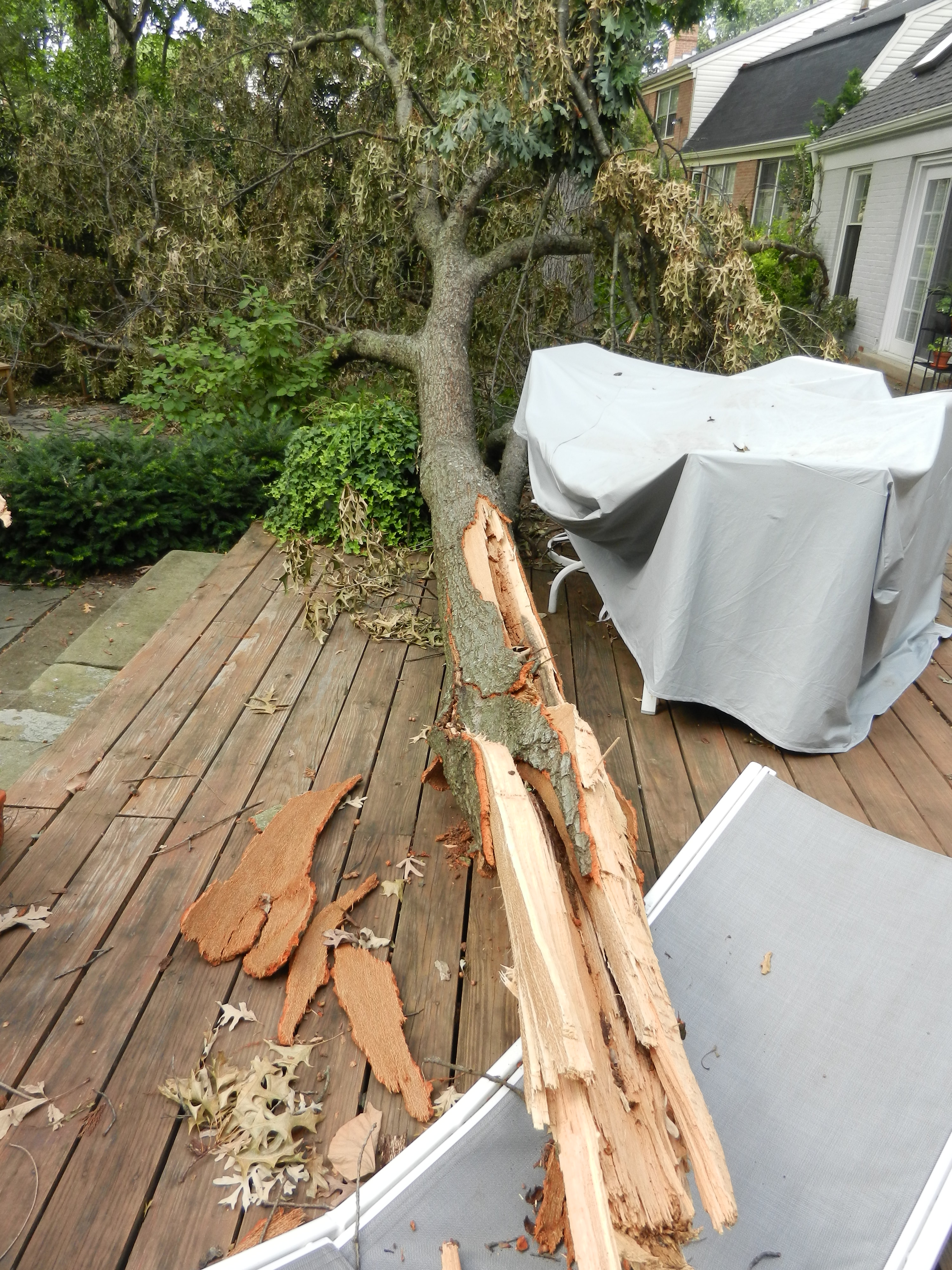
Ten days ago, a powerful storm brought down thousands of trees and caused widespread, prolonged power outages in the area where I live. Initially, everyone’s concerns related to the lack of power – the unremitting 100 degree heat, the spoiled food, the reduced communication ability, and the traffic delays. But now that the power is back on, this week we are dealing with the damage. So many trees snapped in half in my neighborhood that our vistas will permanently change.

The leaves on the fallen limbs have quickly turned from green to brown. The birds are finding strange new places to alight, close to the ground. Every morning we wake to the sound of chain saws and mulching machines. Some tree trunks are still standing, but they will have to be removed later because the trees aren’t salvageable. Now we have sun where there used to be shade, open views where there used to be tree canopy, and exposure where there used to be protection.

It’s hard to know how to feel about this change in perspective. There’s a certain sense of disorientation from the light and the openness. I’m reminded of the David Byrne song, “Once in a Lifetime”, where he says, “You may tell yourself, ‘This is not my beautiful house’”. There’s an unreal quality to the new view.

It’s hard to see benefits and opportunities while we’re spending hundreds of dollars to clean up broken trees. But if I try to change the way I look at it, I can welcome the light. I can look forward to growing sun-loving flowers instead of shade plants. I can expect fewer leaves to clean up this fall. I can picture myself sitting under the festive outdoor umbrella that I’ve never needed before.

Everything changes, and we don’t always get to choose how or when. Marcus Aurelius wrote, “Frightened of change? But what can exist without it? What’s closer to nature’s heart?…Can any vital process take place without something being changed?”

Everything changes. When I accept that, I can begin to see the beauty in my new view.

My week with sea turtles

For most of the year, I don’t willingly get up before sunrise. But for one week every summer, I gladly rise before dawn and leave the house while everyone else is still sleeping. I do it for the sake of sea turtles, serving on the volunteer turtle patrol at a South Carolina beach.

For me, being on turtle patrol means that I get up when it’s still dark, walk two miles along the beach, meet interesting people who also care about wildlife, watch the sun come up, and just maybe, give a few turtles a head start in life. That’s worth getting up early for.

Sea turtles are endangered, due to loss of habitat, fishing activity, predation and being hit by boats. In response, natural resource agencies and beachfront communities around the world have developed programs to give baby sea turtles a helping hand. Think of it as leveling the playing field to make up for the human role in their endangerment.

In my community, volunteers go out each morning during nesting season to look for mother turtles’ tracks and mark where their nests are laid. Then the hatching patrol takes over, checking the nests each morning to make sure they are undisturbed, and looking for signs of hatching when the time draws near.

This morning I was practically alone on the beach when I went out. It had been raining all night, but it stopped just as I got to the beach. As I walked along, I saw deer bounding through the dunes and ghost crabs scurrying into their holes. There were no signs of predators near the nests, but crabs, raccoons and coyotes are all potential threats to the sea turtle eggs.

As the nests hatch, the baby turtles have more hazards to overcome on their way to the ocean – they can be eaten by birds, fall into holes people leave in the sand, and go in the wrong direction toward  lights from houses.  Many don’t survive the trip across the beach to the sea.

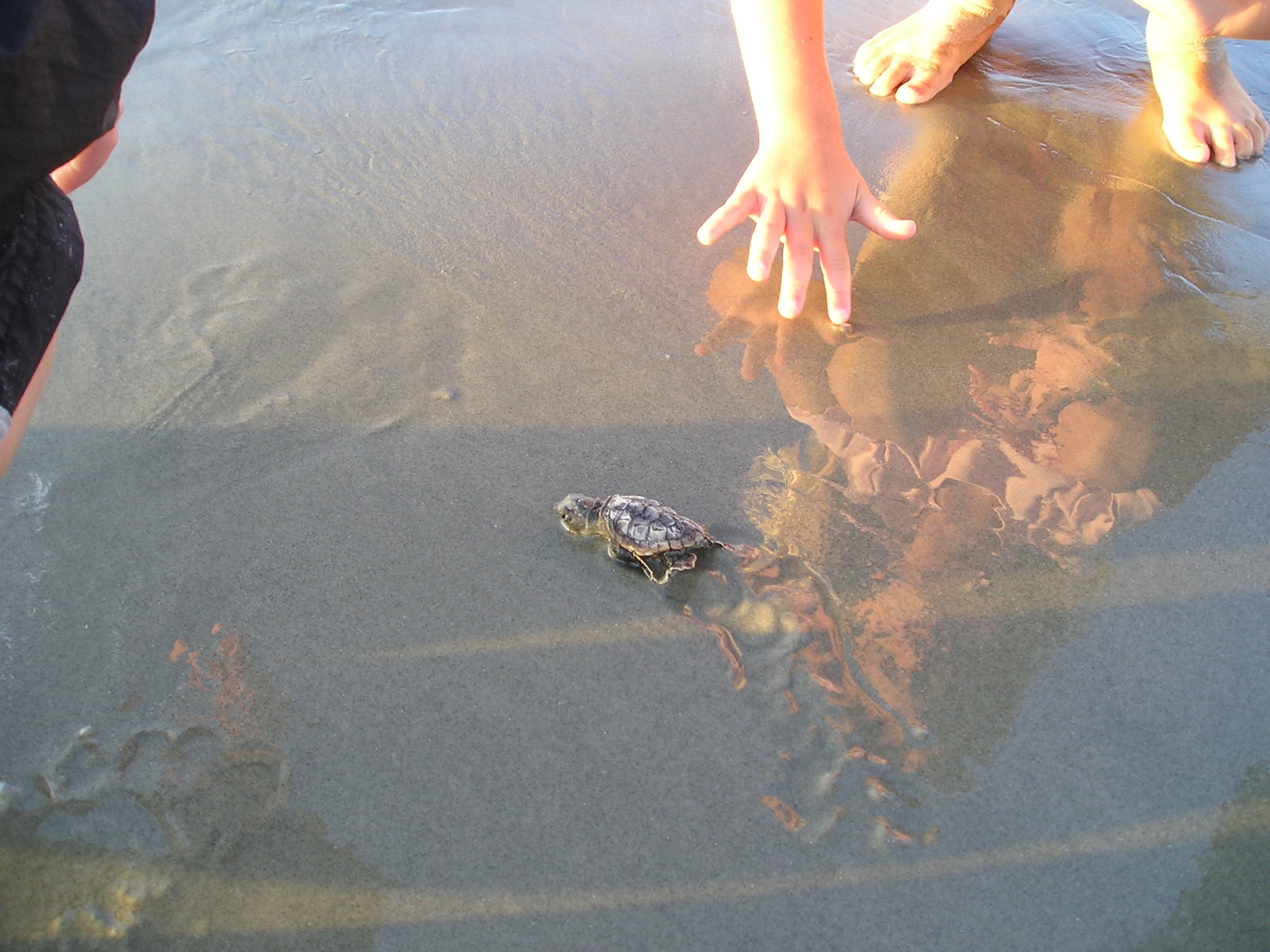
After we see that a nest has hatched, we wait three days, and then dig down into the hole to see how many eggs hatched, and if any live turtles are still inside, perhaps too weak to dig their way out. Volunteers take these turtles down closer to the water, and let them crawl out until a wave catches them and they start swimming. Usually a crowd of people gathers, and everyone clears a path for the turtles, shoos away the birds, and cheers when the turtles finally swim away with their little heads bobbing up for air.

It’s impossible to start the day with anything but a smile after witnessing something like that. I head back to the house where others are just beginning to stir, ready for coffee and breakfast, sandy, sweaty and hot, but knowing that I might have just spent the most valuable hour of my day.

Living with uncertainty

“Stress levels increased since 1983,” read the headline in USA Today last week. Not surprised? What’s interesting is why stress is higher for some people than others.

Sheldon Cohen and Denise Janicki-Deverts analyzed three national surveys (1983, 2006 and 2009) that used the same measure of stress. In all three, women’s stress was consistently higher than men’s, younger people had more stress than older people, people with less education reported higher stress than those with more, and people with lower incomes showed more stress than people with higher incomes.

What was different between 2006 and 2009 was that the increase in stress after the economic downturn was almost totally driven by middle-aged, college-educated, white men who were employed full-time. Cohen and Janicki-Deverts theorize that this finding could be related to the “threat of job loss, actual job loss, or loss of retirement funds.”

But what I see is that this could also be about loss of power and control. It’s not news that people who are lower in a hierarchy have more stress than those on top. And since it’s also still true that most of the power in our society is held by white middle-aged men with college degrees and full-time jobs, in some senses those people had the most to lose when the economy turned sour.

The stress levels of women, the young and the poor didn’t increase significantly because their position in the hierarchy didn’t change much. But for white, middle-aged men, the downturn may have been the first time they felt themselves to be on shaky ground. All of a sudden, there were no guarantees.

The Company Men”, a film about the economic downturn, portrays this theme convincingly. The main characters, who thought they had it made, suddenly were experiencing the uncertainty that other groups have traditionally lived with. Depending on their access to coping strategies, they either weathered the storm or were destroyed by it.

Our new reality is that many of us will be living with uncertainty for a long time. So how do we inhabit that reality in a way that doesn’t wear us down and make us sick?

  • Recognize what you can control and what you cannot. The stock market is out of our control. So are the actions of other people. But we can control how we react to events. Focus on what’s present right now instead of worrying about what can’t be predicted or controlled.
  • Be careful of how you talk to yourself. Too often, we limit ourselves by having a negative narrative going on in our minds (I’m not good enough, I’m too old, I’ll be next to lose my job). Practice replacing those negative thoughts with positive statements.
  • Believe in yourself. Easier said than done, right? It takes practice to change how you think of yourself. But if you remind yourself of the way you’ve handled situations in the past, and all the things that you are capable of, your ability to believe and trust in yourself will increase.
  • Write about it. James Pennebaker and others have shown that people who write about their feelings every day for several days can improve their moods and feel better emotionally.
  • Have a sense of humor. It helps us change our perspective on life events and sometimes even turns a potential stressor into something less threatening. Know what kinds of jokes, movies or comics are sure to make you laugh, so that you can turn to them when necessary.
  • Consider the idea of change as opportunity. As Claude Bernard once said, “Man can learn nothing unless he proceeds from the known to the unknown.”


Stories we tell

Every family has stories – usually a mix of the good, the bad and the ugly. Some stories are told over and over, and others get hidden away like skeletons in the closet. But all the stories shape us and our life stories.

Sometimes I stare at the old photos of my great-grandparents, or my dad with his army buddies, and try to figure out who they were. Were their lives mostly hard work and disappointment, or did they experience joy and possibility? How does the answer to that question explain who I am? Did I just inherit my blue eyes and brown hair from them, or does their legacy also include patterns of behavior and ways of looking at the world?

Carl Jung wrote that, “The more intensively the family has stamped its character upon the child, the more it will tend to feel and see its earlier miniature world again in the bigger world of adult life.” In other words, our perspective can be profoundly shaped by our early experience.

People in my family have been farmers, miners, autoworkers, soldiers, teachers and cooks. One was a blacksmith, one a postmaster, and another a mayor. One person has a library named for him, while others lived and died in anonymity. Their stories include poverty, abandonment, infidelity and suicide, as well as pioneering spirit, public service, loyalty and courage.

While I want to embrace many of the values I inherited from them, such as a strong work ethic and sense of responsibility, I sometimes find myself stuck with some of the others, such as a tendency to think small and play it safe – characteristics that probably result from generations who always had to struggle. Can we change our lives enough as adults to establish a broader legacy for our own children? Is it possible to get past the negative self-talk, the family dysfunction, and the habitual patterns of behavior to grow into a more satisfying life while still building on the positive aspects of the past?

Just tuning in and becoming aware of our thoughts and feelings, then being able to label them, are good first steps. In their book Emotional Intelligence 2.0, Travis Bradberry and Jean Greaves define emotional intelligence as “your ability to recognize and understand emotions in yourself and others, and your ability to use this awareness to manage your behavior and relationships.”

Understanding emotions and managing behavior require us to pay attention to them. Sometimes we are so caught up in daily life that we act and react without thought. Keeping a journal (or writing a blog) can help focus the attention on what we are doing and feeling.  Formally practicing mindfulness can also help develop the ability to slow down and pay more attention to our emotional lives. A mindfulness practice can be as simple as sitting quietly and observing the breath for a little while each day. In his book, Peace is Every Step, Thich Nhat Hanh writes about mindfulness that it “enables us to be in touch with life, which is wonderful in the present moment.”

So perhaps that is the legacy I can give my children: a consciousness of my actions, a smile shared in joy, an awareness of how awesome life is right now. If I can do that for myself, and for them, what stories will they tell?


Knowing when to surrender

While doing child’s pose yesterday in yoga, our teacher said that the pose is also called “wisdom pose”. I had never heard this before, but as I thought about it, it made sense. In child’s pose, we need to relax and surrender to gravity, to make ourselves vulnerable like children. And in life, it often requires a lot of wisdom for us to fully surrender and let things be.

Do you ever think about how much energy you use up fighting things? From the mundane fights (traffic, kids’ bedtimes, the cable company) to more important fights (interpersonal conflict, problems at work, health issues), so much of our time is taken up with struggling against things that we sometimes feel like we’re not moving to anything.

Part of what drives us is the need to have and keep control of things in our lives. A feeling of control is important to managing stress; but so is realizing when something is out of our control, or deciding that control just isn’t worth the price it requires. So there might be times when it’s appropriate to “give in”, such as when maintaining a relationship is more important than winning an argument, or when the outcome is clearly more important to the other person than it is to you.

Exercising control is often a response to fear as well. Fear of change, fear of failure, fear of success, fear of facing difficult emotions – all can lead us to fiercely hold onto positions that really aren’t serving us. Bertrand Russell said that “to conquer fear is the beginning of wisdom.” And sometimes surrendering control, allowing events to happen and feelings to rise, is the beginning of conquering fear.

Sometimes when we are over-efforting, micromanaging every detail, too focused on the outcome, it’s easy to lose sight of the big picture. If we take a step back to see things as they are, and just stop trying so hard, we might be more successful in reaching our goals. Soren Gordhamer writes that “we can often make more progress and with less stress not by trying harder but by trying softer. By doing so, there is an ease to our effort…”

Top athletes and other types of performers know how to try “softer”, although they may call it by a different name. They train and practice for hours, but when called upon to perform, they have to let go of thinking through every move, step, or note and just let things flow through them. They have the wisdom to surrender, and to trust what is inside of them.

I just read about a study of centenarians showing that the people who live longest are the most optimistic and carefree, relaxed and upbeat, and notably non-neurotic. They are the people who let go of their stress rather than internalizing it. I don’t know if they are practicing child’s pose, but something tells me that they are also people who have learned the value of surrendering.