Creating an oasis

“We become habituated to the familiar, but the familiar isn’t always healthy,” says yoga teacher Felicia Tomasko. Her words might apply to our relationships, our diets, our jobs, or our surroundings. Sometimes we get so used to living in situations that don’t benefit us that we forget there is an alternative. But look around – is your environment helping or hurting you?

Our minds and bodies are one big source of input, and the saying, “Garbage in, garbage out” seems appropriate. If our senses are bombarded by too much noise, tension, unpleasant colors, harsh light and bad air – if we don’t have someplace to serve as an oasis from all that – if we don’t feel safe and comfortable —  the environment will increase stress and contribute to poor health and lower productivity.

The renowned architect and designer Michael Graves says, “I believe well-designed places and objects can actually improve healing, while poor design can inhibit it.” He doesn’t say that lightly. A recent profile in the Washington Post described how Graves was left paralyzed after an illness, and how his experiences turned his work in a new direction. He has first-hand awareness of how the color of a room can lift or sink one’s spirits, or how a lack of accessibility to perform everyday tasks can lead to feelings of helplessness and hopelessness. He is now taking on projects that rethink hospitals, senior living centers and housing for wounded military.

We can think of the environment on both the macro and micro levels. The term, “built environment” isn’t a household phrase yet, but it is widely used in the public health community. According to the Prevention Institute, the built environment consists of the “physical structures and infrastructure of communities”; it can encompass how land is zoned, how a community is designed, what kind of housing is available, transportation options and access to green space. The Prevention Institute has highlighted some recent projects that have contributed to healthier communities:

  • Building a jogging path through a cemetery in Los Angeles so that people without a park in their neighborhood would have a place to exercise and enjoy green space
  • Organizing a community to obtain a full-service grocery store in their area
  • Starting a project in Boston for lead-safe backyards for children to play in
  • Turning vacant lots into community gardens
  • Redesigning an unsafe intersection to make it more pedestrian and community-friendly
  • Engaging a community to create murals that improved the aesthetics of their Philadelphia neighborhoodNew York (2)

By changing the macro environment in even small ways, people may feel safer, may be able to eat more healthy foods, may enjoy more social support from the community and may have more opportunity to exercise. When a community buys in to projects like these, and uses the assets it has to bring them to fruition, the first project can often serve as a catalyst for on-going improvements to the environment.

Our micro environments, on the other hand, are sometimes easier, or at least quicker, to alter. With fewer people to please, it becomes simpler to take pro-active steps to create a healthier space. Think about how you feel in certain rooms. Are there particular places that you associate with stress? Are there others where you feel more calm or creative? What is it about the space that provokes those feelings? Is it the activities that take place there? Is it the design or usefulness of the area? Does it feel light or dark, cluttered or spacious? What can you change to make your space more conducive to health and well-being? Some things to consider are:

  • Having sources of natural light and good ventilation
  • Bringing nature indoors – with flowers, a plant, or even a picture of nature
  • Rearranging furniture, or even room uses, to better suit how you live and work
  • Painting your rooms in colors that please you, or calming colors like blues and greens
  • Creating sound that is pleasing – music, water, wind chimes
  • Setting aside a place in the home, even a small one, that is free of work, tension and dissension

Philip Johnson has said that “all great architecture is the design of space that contains, cuddles, exalts, or stimulates the persons in that space.” Even without a great architect, can we create those places of contentment for ourselves?


How high do you bounce when you hit bottom?

Humans may be unique among species in our potential to be resilient in the face of change. Biological imperative drives most species to persevere in a programmed way even when circumstances become dire. The sea turtle returns to the same beach no matter how much development or predation occurs there. The monarch butterfly’s route to a certain Mexican forest is encoded in its DNA and it flies as if on auto-pilot. The salmon will swim upriver to spawn even when a dam is in its way.

OLYMPUS DIGITAL CAMERAPerseverance is necessary for our success too, and sometimes it’s enough. But today, more than ever before, the world is changing at a breathtaking pace and we need something more than drive and diligence. We need resilience.

Resilience is the ability to adapt to change, to bounce back from losses and hardship, to thrive anew after experiencing adversity. Our resilience benefits us in small ways every day, but especially when life throws a big curveball our way. Think job loss, natural disaster or personal tragedy.

Resilience is about having inner strength, but it’s not about being a Lone Ranger kind of tough guy. In fact, one of the hallmarks of a resilient person is being socially connected: having supportive relationships, working collaboratively with others, and asking for help when necessary.

Our ability to be resilient isn’t fixed — it’s not even something we’re really born with. According to This Emotional Life, resilience develops as people grow up. We gradually gain more knowledge and experience, and that enhances the belief that we can cope with new situations. Ideally, we also learn self-management skills such as how to express emotions. And if we enjoy supportive relationships with our family and community, they help us gain trust and optimism.

Of course we’re all born with different kinds of temperaments, and most of us don’t grow up in that kind of ideal environment. So it comes as no surprise that many of us aren’t all that resilient. We become rigid in our beliefs, resistant to change, and unwilling to look for silver linings. We dig in our heels, deny that change is necessary and hold on to the status quo as long as possible.Detour

See, decide, believe. That’s how someone who resists change can change himself. Like any behavior change, first it’s necessary to see that you might not be so resilient, then decide you want to change. After that, start telling yourself that you are resilient. Believing it helps make it so, because brain research suggests that resilience depends on communication between the logical, prefrontal cortex part of the brain, and the limbic system, which is the seat of emotions. So what we say, what we think, the story we tell about ourselves, helps make the reality.

Other tips for building resilience come from the Mayo Clinic and the Centre for Confidence:

  • Try to see change as a meaningful challenge, and make each day have purpose
  • Learn from experience, and use it to build problem-solving strategies
  • Nurture connections with others; try to resolve any persistent conflicts with family or co-workers
  • Stay positive and hopeful
  • Know that you cannot control all events, but you can control your reaction to events
  • Take care of yourself – being physically, mentally and spiritually well prepares you to adapt to change.

Nothing lasts forever, change is a given and there are no guarantees. The headline of a piece in the Harvard Business Review said it best: “Surprises are the new normal; resilience is the new skill.” Be ready.

How to take a time-in

My breath slowed as I rolled out my mat and sat down to await the start of yoga class. I looked around at the mostly-young group of people there for the 5 pm class. Had they left work early? Do they have flexible hours? Do they work part-time? Were they going back to work later?

As I silently congratulated all of us on taking time out of the day to do something good for ourselves, I realized that it wasn’t really a “time out” – it was very much a “time in”. It might even have been the most time I’d really spent “in” and engaged all day.

What is “time in”? It’s not just time spent looking inward, though that could be a part of it. It’s time being fully present, and in the moment. It’s time when our brains get a rest from the over stimulating environment that we’re exposed to most of the day. It’s time when we pay attention to our senses, stop multitasking, and regain focus and concentration.

Spending time in meditation, for instance, leads to a restful, yet awake, state where we have more alpha wave activity in the brain. This brings greater mental clarity, fosters creativity and enhances memory. Research shows that regular meditators can stay on task longer and are less distracted even when they are in a multitasking situation.

Less formal meditative experiences happen in yoga, where the sequence of postures commands focused attention, or in exercise such as running, when the sounds of the breath or footfalls become a focal point. Such activities have a beneficial effect on the brain, making us alert to what’s happening in the moment, and sometimes opening a window to better directions or opportunities.

I’m continually surprised by the way that an idea will just pop into my head when I’m in a yoga class or out for a run. Even when I’ve been blocked creatively about something for days, allowing some mental space from it and taking “time in” almost always helps. That must be why companies such as Google, Nike, Ben & Jerry’s and Zappo’s have on-site meditation classes or nap rooms for their employees. Resting the brain can have surprisingly productive results (like new ice cream flavors!)

Being able to bring intense focus and concentration to a project is a necessary element of what is called a “flow” experience in positive psychology. Flow is “a joyful state” that we experience when “we are actively involved in trying to reach a goal, or an activity that is challenging but well suited to our skills”. During “flow”, we lose track of time and self-consciousness. People who are “high-flow” generally demonstrate better performance, commitment to goals, and greater long-term happiness. Without the motivation or ability to focus, however, high-flow activities seem too hard. We choose the easier low-flow activities (like watching TV) that might provide immediate gratification but don’t really lead to long-term satisfaction. That’s why it is so important to well-being that we strengthen the capacity to focus through “time in” pursuits.

Instead of saying we don’t have time to meditate or exercise, we should be saying there’s no time to waste before starting. Shawn Achor, author of The Happiness Advantage, says that “Our daily decisions and habits have a huge impact upon both our levels of happiness and success.” Maybe today’s decision to spend “time in” will be the start of a recurring pattern for you – one with a far-reaching effect on your fulfillment in life.

She rises still

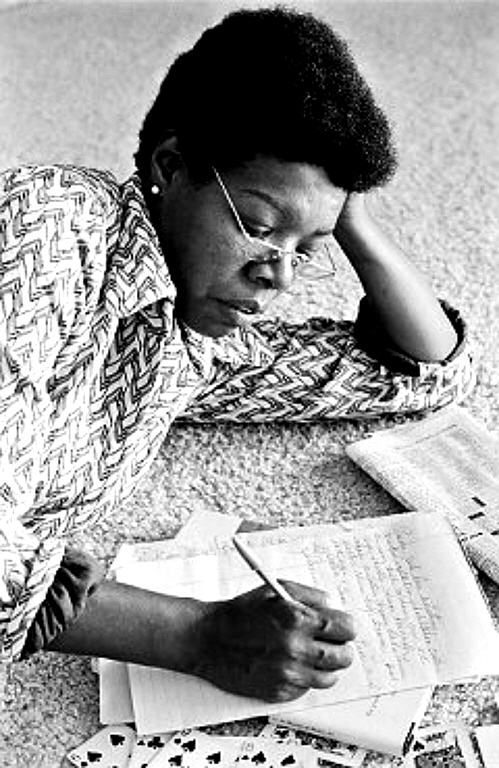
I rose today and found out that Maya Angelou had died, but in her beautiful words I found inspiration and an intention for my days:

My great hope is to laugh as much as I cry; to get my work done and try to love somebody and have the courage to accept the love in return.

Maya Angelou wrote frequently about courage. She realized that it takes courage to love and be loved, it takes courage to express empathy, it takes courage to avoid making the same mistakes twice, and it takes courage to see ourselves for who we are. Like Aristotle, she thought that courage was “the most important of all virtues. Because without courage, you can’t practice any other virtues consistently.”

600full-maya-angelouWithout courage, it is difficult to have faith in the unseen and unknown; without courage, hope becomes a struggle; and without courage, it is nearly impossible to fight for justice. For most of us, courage is a word that we use to describe other people, not ourselves. We think that someone who is courageous faces danger all the time without any fear. But Maya Angelou seemed to know that being courageous is about embracing fear with resolution, and acting in spite of it. A courageous person has the self-possession that allows her to live life fully. Courage can be quiet too.

To be courageous is to accept risk and uncertainty. In the absence of such courage, we often resist, as Sally Kempton says, “not only life’s difficulties but also life’s potential sweetness.” We deny ourselves the pleasure of opening to love or to personal growth because it might upset the delicate balance of life as we know it.  But Maya Angelou was not afraid to disturb or to change. She experienced abuse, poverty and segregation, and still embodied hope, faith and courage. She was a dancer, poet, author, actor, mother, and activist. She was not caged by any label, any role or any experience.

How do we become courageous? Eleanor Roosevelt said that, “You gain strength, courage, and confidence by every experience in which you really stop to look fear in the face…we must do that which we think we cannot.” We become brave by practicing courage one day at a time; by saying “Yes, I can”; by letting go of fear, and moving toward love.

The “Habitastic” way to deal with stress

It’s fairly well known that practicing generosity can be an effective way of alleviating stress. Acts of kindness and volunteer work get us out of our heads and out of the “I’m the center of the universe” trap by forcing us to focus on something or someone else for a while. All of a sudden our problems don’t seem so big or overwhelming when put in the perspective of another person’s.

Sweating through a morning of hard work at a Habitat for Humanity home-build this week showed me that there are even more benefits to lending a helping hand on a regular basis. Besides the distraction from our own problems, there is the self-esteem and self-efficacy that comes from learning to do an unfamiliar job and doing it well. I can proudly say that I helped build a roof today, and that feeling of accomplishment helps to dislodge any negative thoughts about myself that might be causing stress.

imageThe hard physical work is also so unlike what most of us spend our days doing that our monkey minds shut off for a while and we are able to stay focused on the task at hand. When operating a table saw or lifting heavy trusses atop a house, keeping everyone safe and doing it right take precedence over worrying about the project at work or the problems of our children.

There’s also the camaraderie of working as a team, whether it’s with perfect strangers, co-workers, or family members. We learn about each other, strengthen existing bonds, and are reminded of the need to be good communicators. Most people very quickly fall into a rhythm of working together for the common goal.

I don’t know what brought all these people together to build a house for an unknown family. There was the young woman getting married in two weeks, stressed over wedding plans, but taking the day to build instead. There was a group of people who work in the same office given the day off for the project. Two sisters, a mother and daughter, people on vacation. Was it for fun, stress relief, a belief in the cause? Does it really matter?

Jacques Cousteau said that, “It takes generosity to discover the whole through others. If you realize you are only a violin, you can open yourself up to the world by playing your role in the concert.”

Taking the slow road on Earth Day

Okay, I know it’s a bit of an oxymoron — driving on Earth Day. But if we assume the drive is necessary, can it be a mindful celebration of nature?

Driving into the city, I have a choice: Take the busy highway and then the congested main street, or make the journey on the slower parkway that meanders along the water, but gets me to the same destination. Today the road less traveled is clearly the better choice.

It’s mid-afternoon with a light rain falling. The road twists and turns, following nature’s path, not mine. Suddenly I am fully awake to my experience. This is not the time for rote driving; rather, the road grabs my attention and demands that I give it its due.

Thich Nhat Hanh says that any time we use an instrument or a machine, we change. We become something else that is a blend of self and machine. He suggests reciting this verse before driving, to make the experience more mindful:

Before starting the car,

I know where I’m going.

The car and I are one.

If the car goes fast, I go fast.

imageI settle into a steady rhythm as I respond to the organic curves in the road. There are stretches where I can go faster, but being forced to take my time around the curves makes keeping a slower, steady pace more fluid. On the main roads, I would have been speeding up just to stop. Here on the parkway, pauses are fewer, the motion is smoother, and I feel calmer as I drive.

I notice places in the creek where trees have fallen and boulders have piled up, chaotic spots that are reminders of wild winter weather. At the same time, Spring is announcing itself with a full-on burst of color. The bright yellow-green of new growth and the intense magenta of redbud trees flash around every turn. I realize what a gift it is to have this way of coming home.

Thoreau wrote that, “There are moments when all anxiety and stated toil are becalmed in the infinite leisure and repose of nature.” During the thirty minutes I’ve spent on the parkway, it’s been impossible to think about work or worries for very long. Nature has taken over my attention, if only for a little while.

Celebrating Earth Day by driving might not be what environmentalists had in mind when they inaugurated the occasion back in 1970. But before we can care for the environment, we have to notice it, and a mindful Earth Day drive has a way of stirring close observation and appreciation for all that surrounds us.


How to wage peace

Martin Luther King, Jr. said that, “It is not enough to say we must not wage war. It is necessary to love peace and sacrifice for it.”  Each time I pass this banner in front of the Quaker meeting house I’m reminded that our actions for peace have to start in our own homes and lives.image

What are the causes of war but the same things that lead to strife on the micro-level: wanting an advantage over someone else, refusing to forgive a past wrong, holding on to things long after their importance has waned?

A more peaceable life might be within reach if we turned more often to these intentions:

Compromise — The word comes from the Latin meaning a “mutual promise”. Too often we think of compromise as one-sided, only seeing how much we are giving up. But the promise in compromise is powerful, and it shows how much we are gaining from the other side.

Listen first — In the words of a U.N. peacekeeper, “You have to be willing to let each person express their point of view, even if it’s a criticism against you. You have to let them talk first, and then speak. If you don’t let them express themselves, you won’t get any results from the discussion.”

Forgiveness — When we forgive, we can begin to heal the hurt that we feel. Refusing to forgive just lets the hurt fester – and closes down our hearts a little. Gregory David Roberts writes that “every act of love is in some way a promise to forgive,” that love is dependent upon our ability to forgive.

Accept change — Nothing stays the same. And as Frank Jude Boccio writes, “The problem is not that things change, but that you try to live as if they don’t.” We let beliefs about how things should be keep us locked in a struggle with how things actually are. Shedding those habits of mind can drastically shift perspective.

Happiness is a universal goal — In an interview in The Atlantic, Daniel Gilbert talked about it this way:

I think the problem with the word “happiness” is that it sounds fluffy. It sounds like something trivial that we shouldn’t be concerned with. But just set aside the word and think about what the word signifies. You quickly realize that not only should we be concerned with the study of happiness, but that it’s impossible to be concerned with anything else. Pascal says: “All men seek happiness. This is without exception … This is the motive of every action of every man, even of those who hang themselves.”

How could the goal of all human behavior be a trivial thing?

How does your life help to remove the causes of war? We may not be able to solve the problems in the Ukraine or Syria, but if we live our lives in a way that demonstrates the principles of peace — acceptance, forgiveness, compromise, humanity, understanding — maybe we can start a tiny ripple of peace in the world.


Wobbling toward trust

Bob Dylan sang, “Trust yourself …If you need somebody you can trust, trust yourself.” Somehow I think he must have known just how much many of us need to hear that.

Reckless personWhen I wobble in tree pose, or can’t bring myself into a headstand in yoga, it’s not just equilibrium or core strength holding me back – it’s lack of trust in my ability to do it. When the anxiety over my recent move took hold of me, it wasn’t because anything was going wrong — it was my failure to trust myself and my strength. When I worry about one of my kids doing something new, it’s not so much about them, but about me not trusting that I taught them well.

According to Psychology Today, not trusting ourselves often evolves out of being hurt by someone or something we trusted. We become afraid to trust anyone again, and we start to question our judgment. From there, faith in our selves begins to dwindle. So how do we rebuild trust in our own abilities, capacities and judgment?

The magazine offers this simple somatic exercise as a first step to restoring trust in yourself:

“Sit or lie down so that you are comfortable and in a safe place.
Now, how can you make it even more comfortable? Get a blanket, a pillow… whatever will make you feel relaxed and content.
Once you are settled, ask yourself: “How do I know this is comfortable?” This might appear to be a silly question, and perhaps even confusing. However, it is an important one in increasing your skills of building trust.
Continue to explore what sensation you feel that you recognize as comfort. For example, you might think, “I do not feel any pain,” “I breath easily,” or “I feel relaxed.”
You might be anticipating that this feeling won’t last, which is true. We can’t control or grasp on to this pleasurable feeling. It’s only important that you are in the present moment right now, not drifting into thoughts of the future or the past. Thinking of the future can create anxiety; thinking of the past can create depression.
Remain aware of any sounds, the temperature, the light, and your physical sensations. Can you let yourself simply enjoy the moment?
You can practice this exercise for as long as you prefer and as time allows you. Just keep checking in with your level of comfort. What feelings indicate that you are comfortable? With time, you may start to trust your feelings again.”

When we were babies, we learned to trust when our needs for food, safety, warmth and love were satisfied. This exercise takes us back to those basics. If I believe that this warm, comfy feeling I’m experiencing right now is real, then I can have faith that it will come again and I will be able to recognize it.

Great Ocean Road_23.1The other thing worth noting about this exercise is that it is very much focused on present-moment awareness. If we think about trust as the flip side of fear, then the inability to trust is all about fear of what the next moment, or the one after, might bring. By staying focused on the present, we only have to trust what we are experiencing in this moment.

Life is full of surprises, dangers, joys, hurts, disappointment, elation, boredom, passion. In order to have the good with the bad, we need to worry less about what’s around the corner and focus more on everything that is absolutely right, right now. As Thich Nhat Hanh suggests, instead of asking, “What’s wrong?”, we should learn to ask, “What’s not wrong?”

Dalai Lama shares his favorite prayer

“May there be joy in the world with harvest and spiritual rest. May every good fortune come to be and may all our wishes be fulfilled.”

These words, which the Dalai Lama prays every day, were the start of his message to the U.S. Senate yesterday.  What would the world be like if we all started the day with similar intentions?

Flower conservatory at GG Park 1

Can 25 words describe a friend?

My first best friend left my life so long ago that I can barely remember her face. Strawberry blond hair, some freckles, a vague recollection of her smile, and that’s it. But a writing prompt from my Wellness & Writing Connections group has had me trying to conjure memories of her all week.  “Write 25 words that describe a childhood friend.” Can I find 25 words that fully capture Susie and what she meant to me?

yin yangShe was the yang to my yin, bold where I was shy, fearless where I was cautious, loud where I was quiet. With Susie, I tasted independence for the first time, earned my first money, ran away from home, and learned about sex. From the age of 4 until 11, we were inseparable, the sidewalk that ran between our houses a well-worn path.

From Susie, I also learned about loss, not when she died, but when our friendship broke up. I spent a summer mourning her, just as surely as if she had died. I know now that I was just as responsible for the end of our friendship as she was, though I didn’t see it that way back then. It was devastating to me.

Having Susie for a friend taught me to leave my comfort zone in two ways. When we were together, she was often challenging me to do things I wouldn’t ordinarily do. And when we weren’t together anymore, I had to forge bonds with new people outside the comfort zone of her friendship.

Social scientists believe that we tend to seek out friendships with people of similar personalities (the “similarity effect”), but Susie taught me to appreciate a friend who is the opposite of me, one who stretches my view of the world and pushes me toward new possibilities. As Henry Ford once said, “My best friend is the one who brings out the best in me.”

I see glimmers of my first best friend in several close friends who came along later: The ones who were from very different backgrounds; the ones who were bold and outspoken; the ones who were just a little bit wild. I’m grateful to all of them for where they’ve taken me and how they have enriched my life. But I will never be able to thank Susie in person for what she taught me; there will be no re-connection on Facebook, no school reunions, no chance meetings. She died young, and true to form, doing something a little bit dangerous.

So let these 400+ words that describe my childhood friend be my letter of gratitude, my valentine to her.Valentine2