Do you know the lonely one?

The front page story yesterday about how loneliness is “lethal” would lead you to think that we just discovered it. The fact is that scientists have known for some time that loneliness and social isolation put people at higher risk for heart attacks, cancer, Alzheimer’s disease and other conditions. What’s new in the past couple of months is that studies of the genome are yielding information on the specific mechanisms that make it happen.

Because social cohesiveness and cooperation were vitally important in early human history, the brain is rigged to see a lack of strong ties as a signal of danger. Just like any other kind of stressor, that signal puts the body on the alert, even down to the cellular level. In studies of both humans and macaque monkeys, researchers have discovered that social isolation leads to specific genetic changes that turn up inflammatory processes in the body and turn down the production of antibodies against viruses and other pathogens. These genomic adaptations are linked to human evolution, designed for our survival, and are closely related to the body’s stress response.

This heightened fight-or-flight response, activated on a chronic basis, results in increased inflammation and a reduced immune response, leading to significant long-term damage. The mechanism is observed in both directions: a change in gene expression predicts future loneliness, and loneliness predicts future gene expression. In older adults, perceived loneliness leads to an increase of 14% in premature deaths.

Sydney_142It’s worth mentioning that loneliness is not the same as being alone. What matters is whether someone feels connected, and feels satisfied with the connections he or she has. Plenty of people (myself included) relish some solitude on a pretty frequent basis, but that doesn’t equate to loneliness or isolation.

While we often focus on the elderly being socially isolated, loneliness can strike anyone, from the bullied schoolchild to the working adult with social anxiety. In the book “Fear”, Thich Nhat Hanh wrote about original fear and original desire. He says original fear started at birth when we were pushed, helpless, out into the world, unsure whether anyone would take care of us. That fear “was born along with the desire to survive. This is original desire.” Original fear and original desire stay with us as we grow, especially the fear that no one will love and care for us. To me, loneliness is one manifestation of that fear.

You may be reading this and thinking, “I’m not lonely – I don’t need to worry about this.” There’s a bigger picture, however, that might concern you. Analysis of social networks by Nicholas Christakis and James Fowler has shown that loneliness (like obesity, quitting smoking and other habits and trends) is contagious. So the more time that people in your social network, even those on the fringes of it, spend feeling isolated, the more likely it is to spread to others in the network. Over time, there’s a possibility that more of us start experiencing those feelings.

In a world where connection is constant, but often feels unsatisfying, how can we feel less lonely? How can we help others who are lonely? Forced togetherness is not the answer. Interestingly, some research has shown that a mindfulness based stress reduction program is more successful than social networking or community programs are at reducing feelings of loneliness in the elderly. MBSR has also been shown to turn down the pro-inflammatory processes in the body. The focus on present moment may be guiding attention away from the fear of being alone.

Christakis has said that when you help “the people on the margins of the network, you help not only them but help stabilize the whole network.” It would be wise to consider how we can do more to reach those people and offer them positive social connections. Maybe we can light up the network with love rather than fear.Lights

Making your resolutions reality

Debbie Ford wrote that “New Year’s resolutions often fail because toxic emotions and experiences from our past can sabotage us or keep us stuck with the same old thoughts, patterns and regrets.” It can be scary to look closely at ourselves, to acknowledge some of our fears and emotions. That’s why having a plan for dealing with those negative voices boosts the staying power of your resolutions. Here’s part 2 of stress management as a foundation for resolutions:

Live purposefully — What drives you? What are you passionate about? When you combine  your values with the gifts and strengths you offer to others, that synergy helps you feel engaged, connected, and part of something larger than yourself. If, as Sean Johnson suggests, you ask yourself every day, “What is worth my time, attention, prana, love?”, and then follow that path, your actions will bring you an authentic feeling of happiness, rather than anxiety.

Move more — This advice doesn’t have anything to do with a resolution you might have about exercising more. This is movement for the joy of motion. Just move more, even when you don’t exercise. Walk somewhere that you usually drive – you’ll notice different things! Dance when you’re cleaning the house. Go ice-skating. Take the stairs instead of the elevator at least once a day. Movement is what our bodies crave when we are overloaded with the products of stress. It just feels good to move, so do it!Skaters

Practice compassion — starting with yourself! This is probably the most helpful thing you can do for yourself if you are trying to stick to resolutions. Don’t beat yourself up when things aren’t going as planned. Observe your own struggles, and those of others, with compassion. Try this meditation from Jack Kornfeld: “May I be held in compassion. May I be free from pain and sorrow. May I be at peace.” After you have directed these thoughts toward yourself for a while, turn them to others you know.

Learn something new everyday — Knowledge is power. Are you trying to have a healthier diet? Instead of following the latest fads, read some reputable nutrition literature and educate yourself in a way that will make your actions more successful. Try a different source for the news of the day to get another perspective. Read a book about something you know nothing about — it may be a great distraction from the focusing obsessively on what you are trying to change.Laughing woman

Laugh – then laugh again, and again. The other day I found a little collection of comic strips that I’ve cut out of newspapers. Even though I’ve read them many times, they still make me laugh every time I see them. We laugh for all sorts of reasons – sometimes it’s because things are genuinely funny, other times we laugh because a situation is so absurd, often we laugh just so we don’t cry. Like movement, laughter helps us rid the body of stress hormones. It also helps shift perspective, realize that we are not alone, and take the mind off of problems. Remember that your resolutions are supposed to make your life better, so don’t take them so seriously – resolve to laugh more in 2016!

How to revamp your resolutions

So we’re eleven days in to 2016, and the tension might be starting to mount. Will it be the fresh start or the old ways that win out? Just how stressed are you about your new year’s resolutions? Are you wondering why a promise to yourself might be harder to keep than one you make to someone else?

If you’re having trouble, take heart. You’re not alone and there’s still a way to salvage your resolutions for 2016. But change is hard, and stress is a given as we fight against those entrenched habits of mind and body that just want to maintain the status quo. Dealing with the stress of change has to be the underpinning of the other resolutions.

Sydney_69

To help you out, I’ve adapted my top ten stress management tips to relate them to your new year’s resolutions and goals. I’ll share the first five here, and the others next week:

Know what you value — We all have core values, which may include things like health, family, religion or money; and then satellite values that we feel less strongly about. How are those values playing out in the resolutions you’ve made? If your core value is good health, for instance, and appearance is more of a satellite value, then maybe your weight loss resolutions need to be tweaked. Rather than setting a specific weight loss goal so that you can fit into a certain size, a health goal of consuming less sugar might be more aligned with your values.

Nurture your relationships — The support of the people around us can play a major role in the success or failure of our resolutions. How strong are your relationships with the people in your social network? Are there things that need repair in some of your friendships? Have you been supportive of other people’s goals? Think about how turning your attention to someone near you might provide emotional support to you both.

Practice gratitude — When we hit a roadblock, or cheat on a diet, or fall off the wagon, it’s easy to start berating ourselves and feel like we’ve failed. Use those moments to practice gratitude instead. Be thankful that you had five good days of healthy eating before something tempted you. Express gratitude for the sunny day that will allow you to get out and exercise, even if you didn’t yesterday. Say thank you to the employer who is paying for your smoking-cessation program.

Be present — Slowing down and paying more attention in each moment can make us more aware of the choices that precede our actions. When we’re trying to make “better” choices or break “bad” habits, mindfulness makes the choices more conscious, less rote. For instance, when you’re eating, just eat — don’t work, drive or watch TV at the same time. Sit down and look at the food, smell the food, notice the colors, before the first bite goes in your mouth. When we choose food deliberately, eat slowly, and savor each bite, we can feel more satisfied with less, because we have been fully engaged in the process of eating.

Don’t forget to breathe — Breathing mindfully can focus attention in a way that may clarify your resolutions for you. Thich Nhat Hanh has a breath exercise he suggests for bringing the mind back to the body. While slowly breathing in and out, you say “Breathing in, I’m aware of my whole body. Breathing out, I’m aware of my whole body.” If you’ve been living too much in your head, and neglecting your health, this can be a way of turning your attention back where it’s needed, while letting go of any tension that might have built up.

Wayne Dyer says that our intentions create our reality. It’s my hope that these five ways of bringing more intention to your resolutions will help make them your reality.

Out of the holidays, a home

When you think of New York City’s Rockefeller Center at this time of the year, their famous Christmas tree probably comes to mind. It could easily be the most visible holiday tree in the world, because of its size (often close to 100 feet tall), its prominent role in many holiday movies, its presence in New York, and its annual lighting featured on live TV. But its most important role comes after the holidays, when it helps provide affordable housing for one lucky family each year.

Perhaps you’ve heard this story before, but it’s new to me. Every year for the past 9 years, the company who owns Rockefeller Center has donated the lumber from the Christmas tree to Habitat for Humanity for use in building a home. The lumber is marked with the year and “Rockefeller Center tree”. In addition, the company’s employees volunteer their time to work on the build, along with the family who will live in the home, transforming the Christmas tree into a safe and solid shelter. When these families celebrate their own holidays, in new homes far from New York City, they are surrounded by that glorious tree.

Habitat for Humanity estimates that one in four people worldwide lives in poverty housing. For almost 40 years, they have been building, rehabbing and repairing homes for people in need around the world. With the help of 2 million volunteers each year, they have served 6.8 million people in that time period, offering them hope and a chance for stability.

A lack of affordable housing affects people of all ages and races. The MacArthur Foundation is funding $25 million in research to determine what the impacts are, and how best to address the need. Their premise is that “affordable housing may be a ‘platform’ that promotes positive outcomes in education, employment, and physical and mental health…” In other words, if we address the housing issue first, other things may fall into place.

The French philosopher Gaston Bachelard once wrote, “If I were to name the chief benefit of the house, I should say: the house shelters day-dreaming, the house protects the dreamer, the house allows one to dream in peace.”

So how does a Christmas tree live forever?  When it becomes a home, the platform on which dreams are built.

Wishing you peaceful dreams for the new year…

Lessons from an amateur parent

Parenting, for all its joys (and they are abundant) is an endeavor fraught with the potential for second-guessing. When children are young, we ask, “Am I a good enough parent? Will I screw it up? Do I do too much for them, or am I doing too little? Am I too tough, or am I not tough enough?” Later, when they’re all grown up, the refrain becomes, “Should I have done things differently? Would he be happier if I had done X, would she have an easier time if I had done Y?”


You begin your life as a parent fooled by the child’s complete dependency into thinking that you are in control; in reality, almost nothing is in your control. Andrew Solomon, in his book “Far From the Tree” says that we think we are reproducing – making a newer, better version of ourselves – when, in fact, we really are producing someone completely different, whose life story is her own to realize.


Solomon’s book focuses on families whose children have what he calls “horizontal” identities, which sometimes become more important for them than the “vertical” identity of the family. In chapters covering children who are deaf, who have Down’s syndrome, autism or dwarfism, for example, he writes about how, for them, the community of people who share their deaf or autistic identity might be more comfortable or necessary than that of the family. He shares the experiences of dozens of parents who have had to completely change their expectations of what their child would be like.


While Solomon writes that many parents “are unprepared for children who present unfamiliar needs,” we don’t have to be talking about very extreme instances of disability or difference to know what he means.  Those parents just realize sooner than the rest of us how little control they have over the outcome of their child’s story. The beauty of life is that each of us is a unique individual, but that can make us feel like mysteries to each other sometimes, or as Solomon says, “Parenthood catapults us into a permanent relationship with a stranger.” Instead of trying to make the stranger into a copy of ourselves, we need to be brave enough to accept the child as he is.SF trip.Monterey_26


When I was growing up, especially as an adolescent, I didn’t think my parents could see me for who I was at all. I chafed under the strictures of the family, craved independence, felt that I belonged someplace else. During my teens and twenties, I would get irritated when I would hear my mother talking to someone about me, partly because she would sooner brag about me than praise me to my face, and partly because she would invariably get some detail of the story wrong. I moved to San Francisco when I was eighteen, where at the time, the local radio station would sign off from the news by saying, “If you don’t like the news, go out and make some of your own!” That slogan seemed to perfectly convey my own mindset: “Yes, I will write my own story, and it will not be anything like my parents’ story.”


Fast forward to the present. Now I’m not just a daughter and sister, but also a wife and mother. Yes, I have my own story, but I realize that it is inextricably interwoven with the versions other people tell. I can’t ask my mother to get my story right, or not to tell it, because she has her part in it, just as I have my part in my kids’ stories. I try not to cast myself as the hero or the villain of their stories — all I can do now is give them the love and freedom to tell their own version.


I’ve discovered that I can live with the stories as they tell them. When my daughter calls on our anniversary and says, “Thank you for getting married,” or my son acknowledges how much of an influence his father is on him, it tells me that they are comfortable with the identity they got from us, even as they so beautifully establish their own.

Choosing between this and that

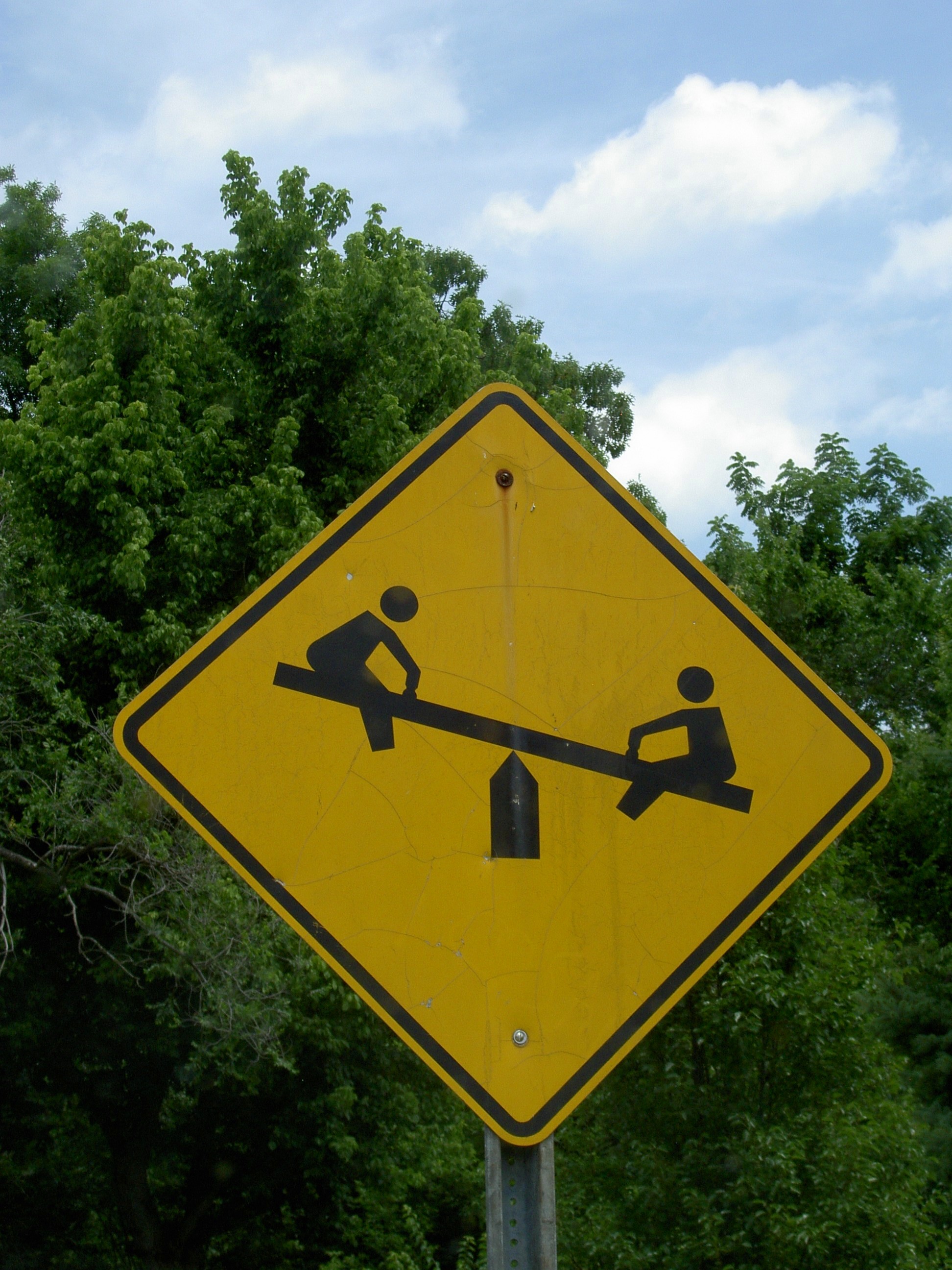
Did you ever balance on a see-saw when you were a child? There was always the challenge of working with the other person to find that perfect point where you were hovering in a horizontal line for a second or two, before one of you fell, a victim of weight and gravity.

The word seesaw may have come from the French words ci-ça, which mean this and that, or perhaps from the back and forth action of an actual saw. The imagery of the seesaw feels appropriate for a lot of the choices we face as we look for emotional balance, especially in how to respond to what life throws at us. We swing back and forth between options: On this side, we have pessimism; on that side, optimism. On this side, we have anger; on that side, equanimity. On this side, we have judgment and denial; on that side, acceptance. This, that, this, that.seesaw_balance

How do you choose the appropriate response in any given situation? Yesterday when I was talking about changing negative self-talk into positive self-talk to reduce stress, a listener challenged me on the concept of always looking for the silver lining. She was right to do so, because optimism isn’t always the correct response, especially if it keeps you from seeing a situation with clarity. There are certain instances where it’s better to be pessimistic because it keeps you cautious. For instance, you don’t want your airline pilot to be too much of an optimist!

Martin Seligman, in his book “Learned Optimism”, writes that optimism should be a flexible, situational choice. “You can choose to use optimism when you judge that less depression, more achievement, or better health is the issue. But you can also choose not to use it, when you judge that clear sight or owning up is called for.” He goes on to say that just because those of us who are not born optimists can learn how to be more optimistic, doesn’t mean that we lose our values or good judgment. It just means that we now have a tool we can choose to use when it is to our benefit.

Responses aren’t always either-or. If I choose not to respond in anger, that doesn’t mean I opt for complete passivity either. If we keep in mind the back and forth motion of a saw, we see there is a range of potential responses. We often find equilibrium in the middle, at the fulcrum point of the seesaw. The key is to give ourselves time to make the choice. It’s that pause, that “take-a-breath” moment that’s the hardest part for me. Instead of reacting with anger, can I ask a question that gives me a better understanding of the situation? If I discover something that I didn’t know, will that little bit of extra information keep me from making a snap judgment and help me respond thoughtfully instead of reacting harshly?

Learning to choose between responses takes time and practice. Herbert Benson and Eileen Stuart recommend this sequence:

  • Stop
  • Breathe: Release physical tension
  • Reflect: What are your automatic thoughts, irrational beliefs, or distorted thinking styles? Ask yourself these questions:
  • Is it really true?
  • Am I jumping to conclusions?
  • Is it to my advantage to think this way?
  • Am I catastrophizing?
  • Is there another way to look at the situation?
  • Can I handle it?

Thoughts, feelings and behaviors all influence each other, in a feedback loop. By questioning habitual thought patterns, we can subtly shift how we feel, and eventually, how we act. Think of it as the way you might shift weight on your end of the seesaw, to keep it balanced or to let it fall. It’s your choice.

Now what?

What do you with what you know, what you’ve learned, the gifts you have? Is having it all enough for you, or does meaning only accrue when you act on what you have? In “The Illuminations” by Andrew O’Hagan, one character says to another, “People who read books aren’t reading them properly if they stop with the books. You’ve got to go out eventually and test it all against reality.”

Several days ago, I went to a yoga workshop billed as “Yoga: The Advanced Practices”. Now that title might make you think that I’m someone who can do a headstand with ease, or twist my leg around neck, or any number of other challenging yoga postures, but nothing could be farther from the truth. And, in fact, the workshop’s “advanced practices” weren’t about asana (physical postures) at all. They were about the real “meat” of yoga — pranayama (breathwork) and meditation. We spent only about 40 minutes of the three hours doing asana.

Why do the other practices matter so much more? As our teacher, Greg, said, they provide the answer to the question, “Now what?” As in, “I’ve mastered a handstand. Now what?” Or, “I’ll never master a handstand. Now what?” Breath and meditation give you the space, the way, to take the yoga off the mat and into the world. As you grow in emotional awareness and focus, they help you be the person who can give back to the community, who can be the better spouse, the better friend, the better parent.

The very next day after the yoga workshop happened to be the Jewish holiday of Rosh Hashanah. As I was reading through the prayerbook, I came across this meditation: “Why be concerned with meaning? Why not be content with satisfaction of desires and needs? The vital drives of food, sex and power…are as characteristic of animals as they are of us. Being human is a characteristic of a being who faces the question: After satisfaction, what?

Now what?

The world we see reflects who we are. Sometimes we need to correct our course or re-affirm our best qualities and intentions so that they are manifested in that reflection. Any kind of meditation helps us do that, as does the meditative practice of affirmative writing, part of the “Writing to Heal” program. Affirmative writing can crystallize values and create a vision for one’s life; it helps us identify our gifts and be grateful for them; and it can be a guide to living a life where you flourish and grow.

So take paper and pen, find somewhere to sit quietly, and answer these questions in writing (resist the urge to self-edit):

  1. What are your gifts? You best qualities, what you offer to others?
  2. What gift do you feel is ready to emerge, evolve or resurface?
  3. How have you denied or hidden any gift in the past?
  4. How is your life and others impacted when you withhold your gift?
  5. How might your life and others be impacted if you offered your gift?
  6. What might living with this gift look like and feel like?
  7. What support from others do you need to develop your gift?
  8. What does your gift need from you?

Naming your gifts, and thinking about how others are impacted when you offer them, is a powerful way to answer the question, “Now what?” When I did this exercise, and I responded to question 6, how would living this gift look and feel, the words I wrote were, “spacious, exciting, vibrant.”

An authentic life is an examined life. Living with questions like these can sometimes make us uncomfortable. But eventually, if we want the answer to “now what?” we’ve got to go out and test the answers against reality.

Is resiliency the most important skill schools should teach?

Going back to school every September evoked feelings in me that were a mix of anticipation and trepidation. There was the excitement that surrounded the newness of it all – new books, new clothes, new teachers, new learning – as well as the fear associated with the certainty that it would all soon become a slog of homework, pressure to get good grades, and conflicts with friends. The college students I teach are no different. After approaching the fall semester with optimism, by spring all five sections of our stress management course are usually full.

Back to school doesn’t have to mean back to stress, though. Or at least not back to overwhelming stress. There are tools we can pass on to kids that will make a significant difference in how equipped they are to handle the challenges of their young lives – tools that will improve their resiliency in both the short and long term.

A 2014 survey by the American Psychological Association showed that teens report more stress than any other age group, stress that is primarily due to financial insecurity, as well as conflict at home and with peers. Those higher stress levels are not benign – they can result in both physical and psychological symptoms, poor performance in school and the inability to make healthy lifestyle choices. But teaching teens appropriate self-care skills can mitigate the stress.

The Benson-Henry Institute recently reported on such a curriculum that they brought to Boston-area high school students. Over a 6-8 week period, the students were taught about the science of stress and relaxation, learned how to reframe thoughts and attitudes, and practiced meditation and mindfulness skills. Those who received the curriculum reported significant drops in perceived stress and anxiety, as well as higher productivity. The results also held up over time – one year later, the students still demonstrated a greater ability to manage stress, as well as the ability to make healthy choices in their lives.

The resiliency program taught to them included the same things that are good for all of us: How to use breathing, mindfulness and imagery to work through tough challenges, how to change our negative self-talk into positive statements, and how our healthy choices bolster us during times of stress. If all goes well, when these kids get to college a stress management course will just be a refresher for them, not a starting point.

Each of the skills they learned – meditation, mindfulness, and reframing — does something different. As Jon Kabat-Zinn writes, “Meditation is neither shutting things out nor off. It is seeing things clearly, and deliberately positioning yourself differently in relationship to them.” Meditation creates a shift in perspective, allowing us to live with emotions that are both positive and negative, to really see ourselves and others with blinders off.

Mindfulness helps us foster our attentional capabilities, and to bring greater awareness to our interactions, our work and the world around us. While the Benson-Henry researchers still want to look at which skills have the most effect, and for which stressors, my guess is that the mindfulness practices are probably connected to improved relationships and better academic work.

The third skill, reframing thoughts to be more positive, helps students understand that stress comes mostly from within, and that they can take charge of their thoughts with practice. Every single negative thought that crosses our minds can be substituted with a more accurate or positive alternative. Storyteller and artist Ilan Shamir has a book, Simple Wisdom, that is subtitled “A Thousand Things Went Right Today!” What if we simply stopped a few times each day and listed just 10 of those things that went right so far? I’m certain we would all immediately experience at least a slight shift to a more positive pole.

Actor Will Smith once said that, “The things that have been most valuable to me I did not learn in school.” I don’t think he is alone in that. But maybe if teaching resiliency skills in school becomes the norm, kids will grow up believing that they learned something there that is extremely valuable and applicable to all of life’s challenges.

How to forgive, even if you can’t forget

Is it possible to forgive and forget? While a few lucky people seem able to embrace the idea as part of their “live and let live” philosophy, most of us have a tendency to hold on to hurt. For us the question becomes how to transform the experience enough to allow forgiveness.

Forgiving and forgetting have been on my mind since reading two different books dealing with love and war. In “The Buried Giant” by Kazuo Ishiguro, the Saxons and the Britons have been at peace with each other since the time of King Arthur – but the price of the peace has been a near-total erasure of their memories of the past. A spell was cast upon them, so they live almost entirely in the present, with only occasional fragments of memory appearing out of the mist. They have blessedly forgotten the massacres of their families during the war, but they have also nearly forgotten that they had children at all. To awake “the buried giant” means that memory will be restored and people will renew their quest for revenge.

The second book dealing with forgiveness and memory was “Half of a Yellow Sun” by Chimamanda Ngozi Adichie. The story involves two sisters who have had a falling-out because of an infidelity, and are barely speaking to each other. But when the Biafran war breaks out, they are driven together for support amid the chaos, uncertainty and death around them. The wronged sister says to her sibling, “There are some things that are so unforgivable that they make other things easily forgivable.” The larger wrongs have helped her put her personal pain in perspective so that she can forgive her sister.

Psychologist Charlotte VanOyen Witvliet says that the act of forgiving doesn’t mean we literally forget what happened. Instead, “Forgiveness involves remembering graciously. The forgiver remembers the true though painful parts, but without the embellishment of angry adjectives and adverbs that stir up contempt.” Remembering graciously may mean re-telling the story of the painful event. If we strip the story of the angry words, what are we left with?

The message of “The Buried Giant” was that remembering graciously is impossible, that reconciliation is not an option, whereas “Half of a Yellow Sun” held it out as a possibility. In writing about reconciliation, Thich Nhat Hanh says that you must “begin to see that your enemy is suffering,” and while we sometimes “need indignation in order to act…the world does not lack people willing to throw themselves into action. What we need are people who are capable of loving…”IMG_2325

Forgiveness holds significant benefits for the person who extends it. When we let go of the angry narrative and negative emotions, blood pressure drops, the immune system gets a boost and we have fewer circulating stress hormones. Forgiveness heals us from the emotional pain that attaches itself to the constant replaying of a painful event. If you can stop the loop and retell the story, you don’t need to have your memory wiped clean in order to come to terms with the pain of the past. But that doesn’t mean forgiveness is easy either.

WebMD has some useful strategies for cultivating forgiveness, including practicing gratitude, using meditation and breathing to quell anger, and cognitive reframing (retelling the story). But they also make it clear that the first step in forgiveness is giving up the desire for revenge, and sometimes that is as far as someone can go. If one is able to move on from there, emotional forgiveness involves replacing emotions like anger, hatred, resentment and bitterness with empathy, compassion and love. Forgiveness becomes something that we have to commit to and maintain on a daily basis, much like sobriety.

Ultimately, emotional forgiveness means that you can begin to “see” the story of the person who hurt you. To do that it’s useful to remember one of my favorite quotes from Plato: “Be kind, for everyone you meet is fighting a harder battle.”

Savoring a sunny day

What do you want your day to feel like? The question isn’t what do you have to do today, or what do you want to accomplish today — but how do you want it to feel as you are going about it? What emotion or sensation do you want as an evocation of your day?

I want my day to feel like sunshine.

How did I choose sunshine? I started my day with an on-line meditation from Amy Ippoliti. With a paper and pen nearby, the practice began with gratitude – what do you feel good about, grateful for, right now? The next few minutes were spent contemplating yesterday’s successes or positive moments. In each case, I meditated on the question, then wrote things down. And for the final step of the meditation, the question was, “What do you want your day to feel like?” Is it a feeling of joy, or fun, or ease?  Can you visualize it?

Sometimes when we’ve been going through a succession of bad days, or are under a lot of stress, it’s hard to remember that we can often choose how to feel, just as we can choose how to react. I know that’s true for me. A series of mishaps in my home, a lot of travel recently, and some new responsibilities have overwhelmed me at times. I focus on the negatives, let myself get carried away with anxiety, and forget that these are very, very small problems compared to what some people face.

So this morning I looked at my gratitude list. It included feelings about my children and the comfortable life I have. I thought about a letter I recently received from someone who referred to my son’s smile as “a little bit of sunshine.”

I considered everything that was positive about yesterday — the helpfulness of the people I dealt with, the fact that I felt in control of things instead of overwhelmed, the nice mid-day run that I had, and most of all, the beautiful, sunny, cloudless day that it was.

So when I got to the part about how do I want my day to feel today, there was no question that I wanted it to feel like sunshine. I wanted it to feel like that beautiful cloudless day, my son’s smile and being bathed in light.

The thing is, though, that not every day is sunny and cloud-free. Some days are overcast, both literally and spiritually. So how do we capture the sunshine on those days? How can we sustain the positive emotions from one day to the next, no matter what happens?

A recent study by Richard Davidson at the University of Wisconsin showed that some people are able to savor positive emotions longer, while in other people they subside quickly. The difference is related in part to the activation of the reward center in the brain. So capturing sunshine on a cloudy day depends on keeping that reward center more active.

There’s no question that doing so requires making a choice to focus on those positive emotions. It might be by meditating on lovingkindness or compassion, or by calling up memories of a time that felt especially joyful or comforting. In either case, the goal is to really drop back in to that feeling, so much so that you experience it all over again. The more you practice doing that, the easier it will be to get back to that baseline of positive emotion.

This 5-Finger Exercise* is good way to begin (spend 2 minutes on each part):

Touch your thumb to your index finger. Think about  time when your body felt healthy fatigue, such as after an exhilarating physical activity. Can you capture the feeling again now?

Touch your thumb to your middle finger. Think back to a time when you had a loving experience, perhaps a warm hug or an intimate moment with someone.

Touch your thumb to your ring finger. Now recall the nicest compliment you’ve ever received. Can you really accept it now? By accepting it, you are giving a gift to the person who said it to you.

Touch your thumb to your little finger. As you do so, go back to the most beautiful place you have ever been and dwell there for a while.


*The 5 Finger Exercise is adapted from one I was given. I’m sorry I do not know who developed it.