Teach your children well

The public conversation has been a swirl of questions since the unspeakable mass shooting in Newtown, Connecticut last week. How can we prevent these kinds of events? What does mental illness have to do with it? Can we control it by banning certain weapons? How will these child survivors handle it? How can we best protect our children?

Kids_0003We could buy our children bulletproof backpacks, as many parents are apparently doing in the aftermath. Or we can teach them lifelong skills that will not only build resilience for dealing with stressful events, but perhaps help schools and communities become environments where young people will not feel isolated, marginalized and desperate.

The American Psychological Association has tips for parents on how to help children build resilience. Their suggestions include things like “make connections”, “teach self-care”, and “nurture a positive self-view”. This is great advice, but a little vague. Even if a few parents look at the APA web site, how many have the skills to implement the ideas? Children, teachers and communities would be better-served by school-based programs:

  • Mindfulness programs in school. Congressman Tim Ryan of Ohio was so affected by a mindfulness retreat he experienced a few years ago that he wrote a book about it (A Mindful Nation) and worked to get funding for “Skills for Life”, a social and emotional learning program, in Youngstown, OH schools. Teachers receive training, which helps them with their personal stressors, and then they bring the program into the classroom. The children have responded enthusiastically, teachers have found that their classes are better-behaved, and academic performance has even improved. Goldie Hawn, through her Hawn Foundation, has supported a similar program called “MindUP” in the Miami-Dade schools. The program helps develop emotional resilience skills, as well as “helping children function in their environments in a more mindful and less stressful way”.
  • Teaching Tolerance, a program of The Southern Poverty Law Center which aims to foster “school environments that are inclusive and nurturing”. They have developed many anti-bias education resources, including teaching kits, curricula and professional development programs. While their program was initially focused on building tolerance for people of different races and ethnicities, it is applicable to fostering acceptance for children with any kind of differences. One of their initiatives is the “Mix It Up at Lunch Day” which has been held every November since 2002. On that day, kids are encouraged to sit with someone new, someone outside of their “group”, at lunch. These kind of interactions help reduce bias and misconceptions about others.Hand Reaching
  • Compassion training. Dr. James R. Doty, Director and Founder of Project Compassion and Clinical Professor of Neurosurgery at Stanford University, has written, “Why, in a country that consumes 25% of the world’s resources (the U.S.), is there an epidemic of loneliness, depression, and anxiety…Our poverty in the West is not that of the wallet but rather that of social connectedness.” Neuroscience research, at Stanford and elsewhere, has shown that people can train themselves to be more compassionate and to feel greater empathy. This is vital for all of us to cultivate, no matter how old we are. As long as people do not feel connected to each other, it is too easy to forget about the people on the margins.

Will we ever eliminate all acts of violence? Probably not. But I would argue that time and money spent on building mindfulness, peace and compassion in schools are equally as important as resources for math and reading.  Thich Nhat Hanh has written, “A fresh way of being peace, of making peace, is needed…We rely on each other. Our children are relying on us in order for them to have a future.”

Need inspiration? Go outside.

If I told you there was an app for your phone that would help you be more creative, would you buy it? What if I told you that giving up your phone for a while might enhance your creativity? Is that as appealing?

A new study published this week shows that people performed 50% better on a test of creativity after spending four days in nature with no electronic devices. The researchers aren’t sure what exactly caused the gains in creativity — being in nature or giving up the devices, but there’s support for the idea that it’s both of those things.OLYMPUS DIGITAL CAMERA

There’s something called “attentional restoration theory” that apparently relates to multi-tasking. Basically, multitasking requires a lot of executive functioning in the brain, which is kind of exhausting, and the theory is that being in a natural setting can replenish that functioning ability. Other studies have demonstrated that hiking can improve certain mental abilities.

The sad reality is that most of us don’t spend nearly as much time in nature as did previous generations. It’s true that we are not an agrarian society anymore, but it’s also a fact that recreation in nature has declined as time spent with electronics has increased. Yet there’s a lot of evidence that we crave what nature offers us.

Look at our holidays, both religious and secular. Many revolve around symbols of nature. Yes, those holidays originated during agrarian times, but the important thing is that we still celebrate them. So at Christmas, people bring trees into their homes; at the Jewish holiday of Sukkot, people build structures outside, decorated with leaves and branches, in which meals are eaten; at Thanksgiving, a cornucopia is often symbolic; and summer holidays are an occasion for picnicking.

Why are homes and apartments with views of woods and water more valuable? Why do we have houseplants? Why are landscape paintings so popular? Why do we take dozens of photos of sunsets? We are striving to bring the outside in and make that connection with nature.

At the same time, taking a break from 24/7 connection with devices is important too. I read yesterday that silent retreats have become hugely popular in recent years: places that offer solitude and a chance to look inward have waiting lists of people who crave some time in silence. The time spent alone in stillness can be an opportunity to find mental space, to discover things about themselves, to replenish the spirit.

That kind of mental space also nourishes creativity. Why is creativity important? Not only can it help you enhance your ability to reach your highest potential, it is also critically important to managing stress. People who are creative thinkers perceive potential stressors differently, and come up with more ways to cope with them. Creative people are more open to new experiences, so fear doesn’t get in the way of solving problems or achieving dreams. And people who are more creative are also more flexible, enabling them to adapt to new circumstances.

Did you ever get stuck on a problem at work or school, and decide to take a break and go for a walk? Did you find that during your walk you came up with an idea that might move you forward? Fresh air, sun light, and views of nature are food for the mind, body and spirit. As John Muir once wrote, “Keep close to Nature’s heart…and break clear away, once in a while, and climb a mountain or spend a week in the woods. Wash your spirit clean.”

Shouldn’t “holiday stress” be an oxymoron?

The emails are starting to arrive. “Holidays Stressing You Out?” says one. “Staying Healthy During the Holidays“, with managing stress as the first topic, reads another. What’s wrong with this picture? The word holiday suggests festivity, recreation, and a vacation mentality. The word stress suggests discomfort, a lack of balance, perhaps even unhappiness. These two words do not belong together.shiny tree

Someone once suggested to me that managing stress is all about managing expectations. While I don’t agree with that 100%, I do think it applies to holiday stress. Much of the stress around holidays comes from what might be considered unreasonable or unnecessary expectations:

  • The expectations we have about  spending time with family and friends.
  • The expectation that we have to give gifts to a specified list of people, and/or the expectation that  we have to spend a certain amount of money.
  • The expectation that we will eat and drink too much.
  • The expectation that we will hold on to traditions, even ones that aren’t serving us anymore.

Another way of putting this?  Too many shoulds, musts, oughts, have tos.

Tips for managing holiday stress are useful, but only as a second step. Like any kind of stress, managing stress around holidays has to start with values clarification, with doing some of the inner work.One of my yoga teachers has observed that for many of us, the default is to do as much as we possibly can, without asking ourselves if it is appropriate, or if we are suffering because of it.

What is values clarification? It could start with questions such as these:

  • What is most meaningful to me about this holiday?
  • What are the things or activities that bring me joy? Which cause me or others to suffer?
  • What do I need in order to be most fully present for the people I love?

When we do this kind of inquiry, we might be able to change our interaction with the holiday for the better. But like coping with any stress, that can’t happen unless we’re willing to make changes, and even rock the boat a little. Doing all the same things in the same old way won’t lead to any significant improvement.

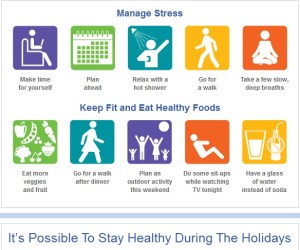
Advice from healthfinder.gov

Once you’ve clarified what’s important to you, and what is going to bring the most happiness to you and those you love, that’s the time to turn to techniques like the planning calendar, keeping up your exercise, and drinking more water. If you start with those things, without stopping to examine your values, you’ll find yourself returning to the default — just using prioritizing and planning as a way to cram more into each day. Even if one of those things you eke out time for is “relaxing”, it might not be as beneficial as it could be if you knew you were living each day in alignment with what’s truly important to you.

Can you wake up each morning during the holiday season knowing that the day will bring you something good? I know of someone who takes a moment before getting out of bed each morning to remember something positive about the day before, and something joyful to look forward to in the day ahead. Stress hormones are typically at a cyclical peak when we first wake up in the morning — so you could do yourself a lot of good by starting each day with a smile instead of a feeling of dread. That’s easier if you’re clear on what you value.

Let’s make “holiday stress” a thing of the past.

Half full or half empty

Perspective. It’s what makes the difference between coping well with misfortune, or falling apart. It determines whether we’re happy with what we have, or always wanting something more. It can turn an event into a huge stressor or a minor bump in the road.

In the aftermath of Hurricane Sandy, perspective is everything.

The hurricane barely affected me – a cancelled flight and a messy yard. But the devastation and loss elsewhere is on a scale that is almost overwhelming. Yet, even some of the hardest hit people are able to put their situations in perspective, like the man I saw quoted in the newspaper who had no power and was waiting in a gas line, but was grateful that he didn’t lose anything more; or the people who lost their homes and all their possessions, but were happy they didn’t lose their lives or their families.

It’s the meaning we give to events that makes them more or less stressful to us. Our ability to reframe a situation, to view it more positively, is affected by our personality type, by overall wellness, and often, by something called “hardiness”.

The term hardiness, and the idea of a “hardy” personality, came out of research done back in the 1980s with the breakup of the Bell Telephone companies. Dr. Salvatore Maddi did a long-term study of telephone company employees to find out how they dealt with the stress of job loss or change. What he found was that hardiness was a determinant of how resilient people were in the face of stress, whether they were able not just to survive, but to thrive.

The people he designated as “hardy” had three important beliefs that helped them during adversity: an attitude of commitment that drove them to be involved in events rather than isolated; an attitude of control, which helped them work to influence the outcome of events, instead of passively accepting them; and an attitude of challenge which motivated them to look at the unexpected changes as an opportunity to learn.

So when we see neighbors helping each other after the storm, we are witnessing a form of commitment. When we see people taking out their own chain saws and cutting up downed trees, opening up fire hydrants for water, or walking miles to work, we see them taking control of the outcome. And when we see people hoisting water up to an 8th story window by ropes, cooking dinner on their outdoor grills, or huddling around a satellite TV truck to pick up a WiFi signal, we see that they are accepting the challenge of the situation and learning new ways to get the things they need.

We can’t forget, however, that some of the hardest-hit people did not come into this situation with a great deal of resilience or wellness. They were barely surviving as it was, because of economic uncertainty, poor health, or both. For them, and for people who suffered the most devastating losses, their emotional and physical reserves will be exhausted quickly. I’m gratified by how quickly power is being restored in some areas, but there are other places, and many people, who will need our help for a very long time.

The American Psychological Association has some guidelines on their web site for dealing with traumatic stress, such as after a disaster. Many of them come from the research on hardiness and resilience. The American Red Cross, in addition to providing for physical needs, also provides emotional assistance to people affected by the disaster. Please consider making a donation to them.

Well, we all need someone we can lean on, And if you want it, well, you can lean on me.”   (Keith Richards, Let It Bleed)

Looking in the mirror

“What did I receive today? What did I give today? What troubles did I cause others today?” These are the questions that form the core of the Japanese meditation practice called Naikan. It is not about keeping score; rather, it is a way of putting life in perspective and acknowledging our interdependence.

The word “Naikan” can be translated as “inside looking”. The practice was developed by Yoshimoto Ishin in Japan as an accessible method of structured self-reflection. In the U.S., the ToDo Institute offers programs in Naikan and other methods of purposeful living. They refer to the practice of Naikan as being like a “shift from a zoom lens to a wide-angle lens”.

So what did I receive today?

  • A good cup of coffee made for me by my husband
  • An invitation from my friend for dinner
  • Pleasure from the butterflies attracted to our yard by the bush my husband planted
  • I wore a robe that was given to me by my mother
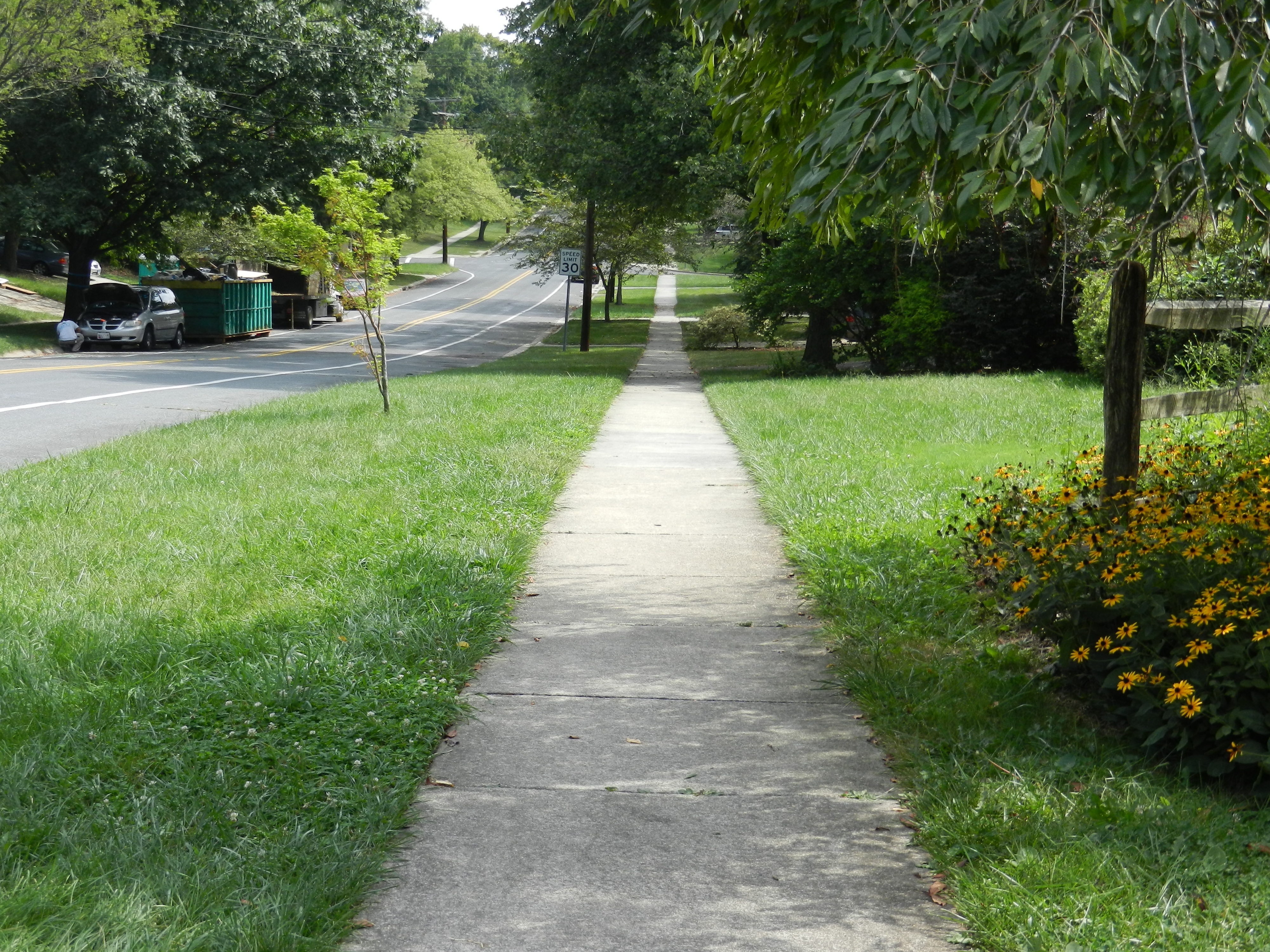
  • A walk on safe sidewalks and streets in my neighborhood built by my county government

What did I give today?

  • I bought groceries and made dinner for my family
  • I invited my neighbor to walk with me
  • I listened to the chatty person who kept me from my work
  • I collected things I no longer need so I can give them to charity

What troubles did I cause others today?

  • I kept the light on when my husband was trying to sleep
  • I hurried my son when he was talking to me so that I could read the newspaper
  • I was impatient with people in the store parking lot

Practicing Naikan reflection can help alleviate stress too. By stopping to appreciate the things other people do for us, we acknowledge that they have a choice, and we can’t just expect that they will do what we want. That helps us let go of rigid ideas of the way things are “supposed” to be. At the same time, by reflecting on the trouble we might be causing others, we become aware of the ripple effect of our actions and the possibility that they might be the source of some of the conflict in our lives.

Asking the questions can be revealing. Did my impatience impact how someone else’s day went? Am I failing to appreciate someone who is doing a lot for me? What would others say that I gave them?

Taking the time to examine my day, even down to the tiniest interactions, takes me out of the “I’m the center of the universe” mindset and reminds me that every day I depend on others to do their jobs, to make me smile and to challenge me to be my best self. President Obama’s recent comment, “You didn’t build that,” was taken out of context and criticized by many of his opponents. But what I think he meant to say was, “You didn’t build that alone.” Our success, good fortune, and wellbeing are not just a result of our own choices, actions and temperament; they are built on the cumulative choices and actions of people who came before us and who work and live alongside us.

As Albert Schweitzer once said, “Just as the wave cannot exist for itself, but is ever a part of the heaving surface of the ocean, so must I never live my life for itself, but always in the experience which is going on around me.”

Something to teach, something to learn

Today I learned that my new yoga teacher is about to be a high school senior. I knew she was young, but not that young. She had just led us through a vinyasa flow class that was challenging, yet gentle; energetic, yet calming. Everyone thought it was great.

I am amazed by the grace and composure of this 17-year-old. When I think back to myself at that age, I can’t imagine even doing what she does, let alone doing it so well.

What makes a good teacher? Passion, confidence, knowledge? Along with those attributes, I believe that a good teacher cares deeply about her students, demonstrates it, and has the wisdom to know that there is as much to learn from them as there is to teach to them.

We benefit most as students when we let go of any expectations we have about what our teacher should be. Age, sex and size don’t define a talented yoga teacher, just as degrees and credentials don’t define talent in a college professor. Losing the words “should”, “ought”, and “must” from our vocabulary opens the door to invaluable experiences, and prevents a lot of the stress that comes from the belief that situations have to evolve in a certain way. Opening that door prepares us to engage, learn and make the most of what life, and our teachers, offer.

Certainly I used to be more rigid than I am today. From my children, I learned to be patient and adaptable. From my older relatives, I learned about dignity. From my friends, I learned to be compassionate and understanding. From my neighbors, I learned about community. From difficult people, I learned to forgive and let go.

Perhaps the most self-discovery comes when the lines between teacher and student blur, and we realize that there is something to be learned from everyone we meet. Every interaction is an opportunity to uncover something we already knew, but weren’t seeing. I only hope that I am able to touch other people the way my new yoga teacher touches me.

Seize the day

Good time management can help most of us avoid a lot of stress. Setting goals, planning out the day ahead of time, and working during our most high-energy hours can lead to greater productivity, less time pressure and a calmer life. Sometimes, though, it’s best to let serendipity win out over planning.

Case in point: yesterday was a gorgeous day. It was one of those days where the sky is a completely cloudless, brilliant blue. The day was warm, but the humidity was low. It was the best day we had had, or were going to have, this entire week.

So when my friend said to me after a morning yoga class, “What are you doing today? Let’s get something to eat and then take a long walk – it’s so beautiful today!” I barely hesitated. It’s true that thoughts of my to-do list, and the vague commitments I had for the day did cross my mind. But I quickly realized that there was nothing so pressing that it couldn’t be done later in the day, or even the next day.

The word “serendipity” is a difficult one to define and translate, but it essentially means discovering something by accident while looking for something else, or finding something wonderful when we weren’t looking for it at all.  It’s possible to let serendipity play a role in daily time management, just by being aware of, and open to, the opportunities and beautiful moments that might turn up in the course of the day. Michael Olpin and Margie Hesson, in their text on stress management, suggest ‘split-page scheduling’ – dividing your planner page with a line down the middle, listing your plans, activities and appointments down the left side, and leaving the right side blank until the end of the day. Then you use the right side to record the unpredicted moments that arose during the day, such as “a new acquaintance, a fresh idea, a child’s question, an unexpected opportunity, a friend’s need, a chance meeting, a beautiful sunset.”

By opening ourselves to a certain amount of spontaneity in the day, we have the possibility of becoming more creative, experiencing life more fully, and even choosing to take new directions. We allow ourselves to enjoy the journey more, while not losing sight of the destination.

Yesterday, I spent a few lovely hours with my friend, walking and talking. We learned more about each other, enjoyed the fresh air and exercise, and came home hungry and tired. Even with my sore feet (lesson learned: don’t walk 4 miles in flip-flops), I still felt invigorated when I got home. I was able to get some of my work done, I enjoyed the process of preparing dinner more than usual, and I slept well. It felt like a day well-lived.

Look to this day!

For it is life, the very life of life.

In its brief course

Lie all the verities and realities of your existence:

The bliss of growth;

The glory of action;

The splendor of achievement;

For yesterday is but a dream,

And tomorrow is only a vision;

But today, well lived, makes every yesterday a dream of happiness,

And every tomorrow a vision of hope.

Look well, therefore, to this day!

“Kalidasa,” ancient Sanskrit poem

Living with uncertainty

“Stress levels increased since 1983,” read the headline in USA Today last week. Not surprised? What’s interesting is why stress is higher for some people than others.

Sheldon Cohen and Denise Janicki-Deverts analyzed three national surveys (1983, 2006 and 2009) that used the same measure of stress. In all three, women’s stress was consistently higher than men’s, younger people had more stress than older people, people with less education reported higher stress than those with more, and people with lower incomes showed more stress than people with higher incomes.

What was different between 2006 and 2009 was that the increase in stress after the economic downturn was almost totally driven by middle-aged, college-educated, white men who were employed full-time. Cohen and Janicki-Deverts theorize that this finding could be related to the “threat of job loss, actual job loss, or loss of retirement funds.”

But what I see is that this could also be about loss of power and control. It’s not news that people who are lower in a hierarchy have more stress than those on top. And since it’s also still true that most of the power in our society is held by white middle-aged men with college degrees and full-time jobs, in some senses those people had the most to lose when the economy turned sour.

The stress levels of women, the young and the poor didn’t increase significantly because their position in the hierarchy didn’t change much. But for white, middle-aged men, the downturn may have been the first time they felt themselves to be on shaky ground. All of a sudden, there were no guarantees.

The Company Men”, a film about the economic downturn, portrays this theme convincingly. The main characters, who thought they had it made, suddenly were experiencing the uncertainty that other groups have traditionally lived with. Depending on their access to coping strategies, they either weathered the storm or were destroyed by it.

Our new reality is that many of us will be living with uncertainty for a long time. So how do we inhabit that reality in a way that doesn’t wear us down and make us sick?

  • Recognize what you can control and what you cannot. The stock market is out of our control. So are the actions of other people. But we can control how we react to events. Focus on what’s present right now instead of worrying about what can’t be predicted or controlled.
  • Be careful of how you talk to yourself. Too often, we limit ourselves by having a negative narrative going on in our minds (I’m not good enough, I’m too old, I’ll be next to lose my job). Practice replacing those negative thoughts with positive statements.
  • Believe in yourself. Easier said than done, right? It takes practice to change how you think of yourself. But if you remind yourself of the way you’ve handled situations in the past, and all the things that you are capable of, your ability to believe and trust in yourself will increase.
  • Write about it. James Pennebaker and others have shown that people who write about their feelings every day for several days can improve their moods and feel better emotionally.
  • Have a sense of humor. It helps us change our perspective on life events and sometimes even turns a potential stressor into something less threatening. Know what kinds of jokes, movies or comics are sure to make you laugh, so that you can turn to them when necessary.
  • Consider the idea of change as opportunity. As Claude Bernard once said, “Man can learn nothing unless he proceeds from the known to the unknown.”


Transition Time

I’m getting ready to leave on a trip out of the country, and I find myself looking forward to the airplane flight. Is it perverse to look forward to 8 hours stuck on a plane, with uncomfortable seats, so-so food and potentially irritating fellow passengers? Maybe, but the reason I’m anticipating it is because of the time it will give me to shift my perspective from the hustle and bustle of home/work/pre-trip preparation to the rhythm of days spent seeing new things and mastering unfamiliar cities.

Skipping transition time can make it more difficult to change tasks. From the toddler who has a tantrum when a play date abruptly ends, to the adult who has to go from meeting to meeting all day, everyone needs space to process change. When we don’t leave enough time before and after each activity, stress is often the result, either because we can’t stick to our hectic schedules, or because we just don’t have time to think.

When we experience stress in the emotional center of the brain, other executive functions of the brain are affected almost immediately. It’s harder to focus, we have trouble making decisions, and our ability to engage in abstract thinking is compromised. Some people can recover more quickly if they are psychologically resilient, but that usually is a result of a temperament you’re born with, or practicing stress management.

That brings me back to transition time as part of a stress management plan. It provides a psychological break between one thing and another that can allow us to process what just happened and to organize our thinking for what’s about to happen. It can also nurture our creativity. The Japanese chef and restaurateur Nobu Matsuhisa travels all over the world regularly. He said in a recent interview that, “I actually prefer a longer flight to a short one. That way I have time to read a book, watch movies, and think about new dishes.” If he didn’t have that time to just relax and think, would his restaurants be as successful as they are?

In this era of 24/7 availability, it is also welcome to have time on planes to be quiet. Although the advent of WiFi on planes has made it easier (and perhaps expected) that people will work during a flight, at least there are still no ringing and buzzing cell phones. We can all have a short break from immediate access.

My time during the flight will be spent with a book, maybe a game of Sudoku, and I hope, some sleep. I will enjoy hearing the accents of the Scandinavian flight attendants, adjusting my ear to the voices I will hear when I arrive. I’ll have time to breathe, to re-set my brain, and get ready to discover what the days ahead hold for me.