Making your resolutions reality

Debbie Ford wrote that “New Year’s resolutions often fail because toxic emotions and experiences from our past can sabotage us or keep us stuck with the same old thoughts, patterns and regrets.” It can be scary to look closely at ourselves, to acknowledge some of our fears and emotions. That’s why having a plan for dealing with those negative voices boosts the staying power of your resolutions. Here’s part 2 of stress management as a foundation for resolutions:

Live purposefully — What drives you? What are you passionate about? When you combine  your values with the gifts and strengths you offer to others, that synergy helps you feel engaged, connected, and part of something larger than yourself. If, as Sean Johnson suggests, you ask yourself every day, “What is worth my time, attention, prana, love?”, and then follow that path, your actions will bring you an authentic feeling of happiness, rather than anxiety.

Move more — This advice doesn’t have anything to do with a resolution you might have about exercising more. This is movement for the joy of motion. Just move more, even when you don’t exercise. Walk somewhere that you usually drive – you’ll notice different things! Dance when you’re cleaning the house. Go ice-skating. Take the stairs instead of the elevator at least once a day. Movement is what our bodies crave when we are overloaded with the products of stress. It just feels good to move, so do it!Skaters

Practice compassion — starting with yourself! This is probably the most helpful thing you can do for yourself if you are trying to stick to resolutions. Don’t beat yourself up when things aren’t going as planned. Observe your own struggles, and those of others, with compassion. Try this meditation from Jack Kornfeld: “May I be held in compassion. May I be free from pain and sorrow. May I be at peace.” After you have directed these thoughts toward yourself for a while, turn them to others you know.

Learn something new everyday — Knowledge is power. Are you trying to have a healthier diet? Instead of following the latest fads, read some reputable nutrition literature and educate yourself in a way that will make your actions more successful. Try a different source for the news of the day to get another perspective. Read a book about something you know nothing about — it may be a great distraction from the focusing obsessively on what you are trying to change.Laughing woman

Laugh – then laugh again, and again. The other day I found a little collection of comic strips that I’ve cut out of newspapers. Even though I’ve read them many times, they still make me laugh every time I see them. We laugh for all sorts of reasons – sometimes it’s because things are genuinely funny, other times we laugh because a situation is so absurd, often we laugh just so we don’t cry. Like movement, laughter helps us rid the body of stress hormones. It also helps shift perspective, realize that we are not alone, and take the mind off of problems. Remember that your resolutions are supposed to make your life better, so don’t take them so seriously – resolve to laugh more in 2016!

How to revamp your resolutions

So we’re eleven days in to 2016, and the tension might be starting to mount. Will it be the fresh start or the old ways that win out? Just how stressed are you about your new year’s resolutions? Are you wondering why a promise to yourself might be harder to keep than one you make to someone else?

If you’re having trouble, take heart. You’re not alone and there’s still a way to salvage your resolutions for 2016. But change is hard, and stress is a given as we fight against those entrenched habits of mind and body that just want to maintain the status quo. Dealing with the stress of change has to be the underpinning of the other resolutions.

Sydney_69

To help you out, I’ve adapted my top ten stress management tips to relate them to your new year’s resolutions and goals. I’ll share the first five here, and the others next week:

Know what you value — We all have core values, which may include things like health, family, religion or money; and then satellite values that we feel less strongly about. How are those values playing out in the resolutions you’ve made? If your core value is good health, for instance, and appearance is more of a satellite value, then maybe your weight loss resolutions need to be tweaked. Rather than setting a specific weight loss goal so that you can fit into a certain size, a health goal of consuming less sugar might be more aligned with your values.

Nurture your relationships — The support of the people around us can play a major role in the success or failure of our resolutions. How strong are your relationships with the people in your social network? Are there things that need repair in some of your friendships? Have you been supportive of other people’s goals? Think about how turning your attention to someone near you might provide emotional support to you both.

Practice gratitude — When we hit a roadblock, or cheat on a diet, or fall off the wagon, it’s easy to start berating ourselves and feel like we’ve failed. Use those moments to practice gratitude instead. Be thankful that you had five good days of healthy eating before something tempted you. Express gratitude for the sunny day that will allow you to get out and exercise, even if you didn’t yesterday. Say thank you to the employer who is paying for your smoking-cessation program.

Be present — Slowing down and paying more attention in each moment can make us more aware of the choices that precede our actions. When we’re trying to make “better” choices or break “bad” habits, mindfulness makes the choices more conscious, less rote. For instance, when you’re eating, just eat — don’t work, drive or watch TV at the same time. Sit down and look at the food, smell the food, notice the colors, before the first bite goes in your mouth. When we choose food deliberately, eat slowly, and savor each bite, we can feel more satisfied with less, because we have been fully engaged in the process of eating.

Don’t forget to breathe — Breathing mindfully can focus attention in a way that may clarify your resolutions for you. Thich Nhat Hanh has a breath exercise he suggests for bringing the mind back to the body. While slowly breathing in and out, you say “Breathing in, I’m aware of my whole body. Breathing out, I’m aware of my whole body.” If you’ve been living too much in your head, and neglecting your health, this can be a way of turning your attention back where it’s needed, while letting go of any tension that might have built up.

Wayne Dyer says that our intentions create our reality. It’s my hope that these five ways of bringing more intention to your resolutions will help make them your reality.

Is resiliency the most important skill schools should teach?

Going back to school every September evoked feelings in me that were a mix of anticipation and trepidation. There was the excitement that surrounded the newness of it all – new books, new clothes, new teachers, new learning – as well as the fear associated with the certainty that it would all soon become a slog of homework, pressure to get good grades, and conflicts with friends. The college students I teach are no different. After approaching the fall semester with optimism, by spring all five sections of our stress management course are usually full.

Back to school doesn’t have to mean back to stress, though. Or at least not back to overwhelming stress. There are tools we can pass on to kids that will make a significant difference in how equipped they are to handle the challenges of their young lives – tools that will improve their resiliency in both the short and long term.

A 2014 survey by the American Psychological Association showed that teens report more stress than any other age group, stress that is primarily due to financial insecurity, as well as conflict at home and with peers. Those higher stress levels are not benign – they can result in both physical and psychological symptoms, poor performance in school and the inability to make healthy lifestyle choices. But teaching teens appropriate self-care skills can mitigate the stress.

The Benson-Henry Institute recently reported on such a curriculum that they brought to Boston-area high school students. Over a 6-8 week period, the students were taught about the science of stress and relaxation, learned how to reframe thoughts and attitudes, and practiced meditation and mindfulness skills. Those who received the curriculum reported significant drops in perceived stress and anxiety, as well as higher productivity. The results also held up over time – one year later, the students still demonstrated a greater ability to manage stress, as well as the ability to make healthy choices in their lives.

The resiliency program taught to them included the same things that are good for all of us: How to use breathing, mindfulness and imagery to work through tough challenges, how to change our negative self-talk into positive statements, and how our healthy choices bolster us during times of stress. If all goes well, when these kids get to college a stress management course will just be a refresher for them, not a starting point.

Each of the skills they learned – meditation, mindfulness, and reframing — does something different. As Jon Kabat-Zinn writes, “Meditation is neither shutting things out nor off. It is seeing things clearly, and deliberately positioning yourself differently in relationship to them.” Meditation creates a shift in perspective, allowing us to live with emotions that are both positive and negative, to really see ourselves and others with blinders off.

Mindfulness helps us foster our attentional capabilities, and to bring greater awareness to our interactions, our work and the world around us. While the Benson-Henry researchers still want to look at which skills have the most effect, and for which stressors, my guess is that the mindfulness practices are probably connected to improved relationships and better academic work.

The third skill, reframing thoughts to be more positive, helps students understand that stress comes mostly from within, and that they can take charge of their thoughts with practice. Every single negative thought that crosses our minds can be substituted with a more accurate or positive alternative. Storyteller and artist Ilan Shamir has a book, Simple Wisdom, that is subtitled “A Thousand Things Went Right Today!” What if we simply stopped a few times each day and listed just 10 of those things that went right so far? I’m certain we would all immediately experience at least a slight shift to a more positive pole.

Actor Will Smith once said that, “The things that have been most valuable to me I did not learn in school.” I don’t think he is alone in that. But maybe if teaching resiliency skills in school becomes the norm, kids will grow up believing that they learned something there that is extremely valuable and applicable to all of life’s challenges.

How to forgive, even if you can’t forget

Is it possible to forgive and forget? While a few lucky people seem able to embrace the idea as part of their “live and let live” philosophy, most of us have a tendency to hold on to hurt. For us the question becomes how to transform the experience enough to allow forgiveness.

Forgiving and forgetting have been on my mind since reading two different books dealing with love and war. In “The Buried Giant” by Kazuo Ishiguro, the Saxons and the Britons have been at peace with each other since the time of King Arthur – but the price of the peace has been a near-total erasure of their memories of the past. A spell was cast upon them, so they live almost entirely in the present, with only occasional fragments of memory appearing out of the mist. They have blessedly forgotten the massacres of their families during the war, but they have also nearly forgotten that they had children at all. To awake “the buried giant” means that memory will be restored and people will renew their quest for revenge.

The second book dealing with forgiveness and memory was “Half of a Yellow Sun” by Chimamanda Ngozi Adichie. The story involves two sisters who have had a falling-out because of an infidelity, and are barely speaking to each other. But when the Biafran war breaks out, they are driven together for support amid the chaos, uncertainty and death around them. The wronged sister says to her sibling, “There are some things that are so unforgivable that they make other things easily forgivable.” The larger wrongs have helped her put her personal pain in perspective so that she can forgive her sister.

Psychologist Charlotte VanOyen Witvliet says that the act of forgiving doesn’t mean we literally forget what happened. Instead, “Forgiveness involves remembering graciously. The forgiver remembers the true though painful parts, but without the embellishment of angry adjectives and adverbs that stir up contempt.” Remembering graciously may mean re-telling the story of the painful event. If we strip the story of the angry words, what are we left with?

The message of “The Buried Giant” was that remembering graciously is impossible, that reconciliation is not an option, whereas “Half of a Yellow Sun” held it out as a possibility. In writing about reconciliation, Thich Nhat Hanh says that you must “begin to see that your enemy is suffering,” and while we sometimes “need indignation in order to act…the world does not lack people willing to throw themselves into action. What we need are people who are capable of loving…”IMG_2325

Forgiveness holds significant benefits for the person who extends it. When we let go of the angry narrative and negative emotions, blood pressure drops, the immune system gets a boost and we have fewer circulating stress hormones. Forgiveness heals us from the emotional pain that attaches itself to the constant replaying of a painful event. If you can stop the loop and retell the story, you don’t need to have your memory wiped clean in order to come to terms with the pain of the past. But that doesn’t mean forgiveness is easy either.

WebMD has some useful strategies for cultivating forgiveness, including practicing gratitude, using meditation and breathing to quell anger, and cognitive reframing (retelling the story). But they also make it clear that the first step in forgiveness is giving up the desire for revenge, and sometimes that is as far as someone can go. If one is able to move on from there, emotional forgiveness involves replacing emotions like anger, hatred, resentment and bitterness with empathy, compassion and love. Forgiveness becomes something that we have to commit to and maintain on a daily basis, much like sobriety.

Ultimately, emotional forgiveness means that you can begin to “see” the story of the person who hurt you. To do that it’s useful to remember one of my favorite quotes from Plato: “Be kind, for everyone you meet is fighting a harder battle.”

How to use a billion breaths

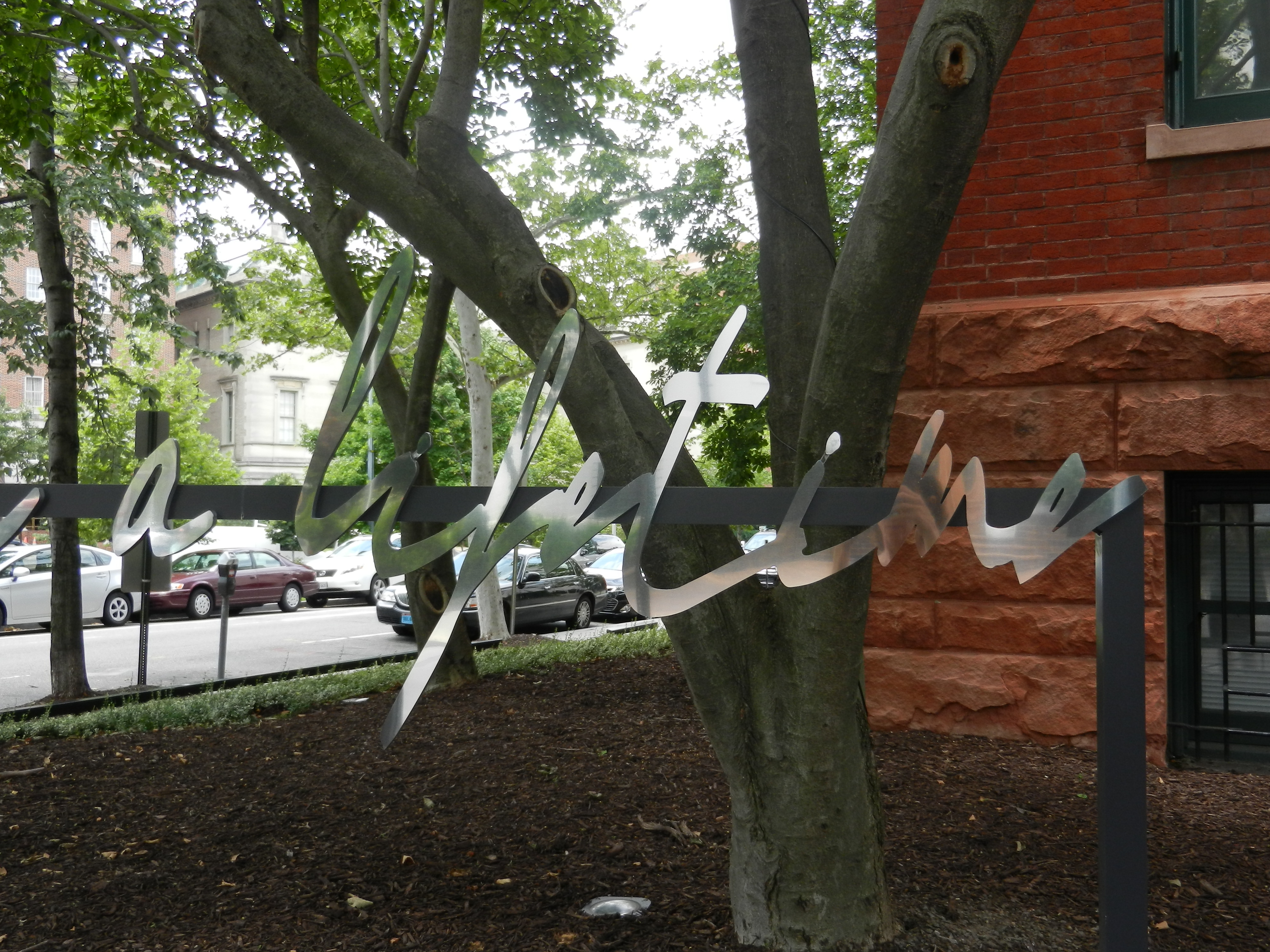
If there is an art to breathing, Jill O’Bryan has made a career of it. Since 2000, the NY artist has focused on a series of drawings based on capturing her own breaths over periods of time. Along the way, she has calculated that in a 97-year lifetime, she would breathe a billion breaths. To celebrate longevity and a life well-lived, she has created a piece that has been installed outside the Phillips Collection in Washington, D.C.DSCN3750

When you walk by “One Billion Breaths in a Lifetime,” you’re invited to complete the art by gazing at your own reflection in the polished chrome of the letters. Reflection, not just of your face, but of your life, feels called for. If we each have around a billion breaths, how will we use them?

Do you take a breath to say words of love, or to say words of hate?   Do you take a breath to whisper a secret or to shout a curse? To slow your heart or to fuel your passion?  The breath is something that we take for granted, and yet it is the first thing we wait to hear when a baby is born, and the last thing we look for when a person dies.

We can use our breaths in so many positive ways:

To sing a song

To laugh out loud

To whistle a tune

To blow bubbles with a child

To blow out candles on a cake

To blow a kiss to someone

To warm our hands

To say a prayer

To run a marathon

To release tension in the body

To ease our pain

To help us sleep

Yet much of the time modern life works against us, and we subconsciously inhibit our natural breathing rhythm. Our breaths are shallow and tense as we wait for traffic to move, or as we practice the angry words we are waiting to say to someone. Compare that tight feeling to the relaxation that occurs after you use your breath for a big, unrestrained belly laugh. When was the last time you laughed that way?

The breath is so important in the yogic tradition that we have an entire practice, pranayama, for learning how to control the breath, or life force. Focusing on the breath, especially to deepen it and slow it down, is the best way to get in touch with our autonomic nervous systems and to counter the effects of stress and anxiety. Because the breath links the body and mind, it can be useful at those times when body and mind are discordant. Thich Nhat Hanh suggests focusing on the in and out of breathing to bring them back together again: “Breathing in, I know that I am breathing in…Breathing out, I know that I am breathing out.” In, out, in, out, in, out – until the mind and body are unified and peaceful once again.

The idea of a billion also represents abundance, but we know all too well that something that is plentiful is often wasted. We even have an expression, “Don’t waste your breath,” and although it means something different, it’s good advice to follow. At 12-16 breaths per minute, even one billion breaths don’t last forever. We have no choice but to breathe — we cannot hold onto our breaths, or save them for some unknown future purpose. We can only soften our grip and choose each day how we will make the most of them.DSCN3754

It’s no magic wand, but it is a plan

Most of us can probably rattle off any number of things on a daily basis that stress us out. So when you hear that April is stress awareness month, you’re probably asking why you need a special month to let you know something so obvious. But it is one thing to see the path you’re on, and something quite different to envision where you’d like to be and figure out how to get there.

magicwandWe get so used to living with our stressors that they become like old shoes we don’t even notice are wearing out – until the sole falls off or the heel breaks. To find a new way to live calls for paying attention to that old shoe before it breaks. It requires a heightened awareness of stress, some self-exploration, and a commitment to change. I don’t have a magic wand that will whisk away stress, but I do have a 6-step plan for identifying your stressors, seeing how they affect you, and learning ways to lessen their impact:

  1. Just how stressed are you? Assessment is always a good place to begin, and the Perceived Stress Scale is one way to do that. This scale has been the foremost instrument used in self-reported stress studies for years. It’s quick and easy to score, and you can even see how you compare to averages for your age group and sex.
  2. What are your stress symptoms? Stress affects all of us differently, but there are some common physical, mental and emotional symptoms that are often related to stress. Perhaps that nagging back ache, or the irritability you feel sometimes, are related to stress. Use a symptoms checklist to see how you are faring.
  3. What are your triggers? Is your stress mostly related to the hassles of daily life, such as traffic and time pressures, or do you have bigger issues like chronic illness, relationship problems or financial worries?

Once you know a little more about yourself and your stressors, consider these steps:

  1. Eliminate, or interact differently with, your stressors. The simpler strategies here are delegating tasks and saying no to new commitments. Then consider whether the things you really value are represented in how you spend most of your time – should you make changes to live more in alignment with your values? Another way to change interaction is improving communication – thereby strengthening relationships and perhaps avoiding some conflict-related stress.
  2. Change how you think about your stressors. What’s your story? How do you perceive your situation, your misfortunes, and the hand you’ve been dealt? Practice substituting positive statements for some of the negative self-talk in your mental narration. Use humor to defuse stressful situations. Consider your blessings and express gratitude for them. Bring mindful attention to the people and tasks you deal with.
  3. Live more peacefully with the persistent stressors. Let’s face it – some stressors don’t go away and aren’t that amenable to re-thinking. That’s when social, emotional and spiritual resources come into play. Call on your friends and community for support; cry on someone’s shoulder; talk and laugh with others. Cultivate a spiritual life; feel connected to something bigger than yourself; spend time in nature. And finally, incorporate some kind of relaxation technique into your daily life: meditation, breathing, yoga, and massage are all good choices.Woman in the sun

We can discover santosha (contentment) every day if we look for it. As Walt Whitman said, “Keep your face always toward the sunshine – and the shadows will fall behind you.”

What some women can tell you about stress

We see the headlines all the time: “Stress makes you sick,” “Work makes you stressed,” “Stress makes you fat,” even “Stress Kills.” But why does all this happen? Why is stress so dangerous, and how do we know?

Luckily for us, there are a lot of outstanding neuroscientists, social scientists and others who are devoting their careers to answering these questions. Many of them are women, so in honor of Women’s History Month and International Women’s Day, I thought I would profile a few of them and the highlights from their work.

What socioemotional resources are available to us during stress and where do they originate?

Shelley E. Taylor is a Distinguished Research Professor at UCLA and winner of a Lifetime Achievement Award from the American Psychological Association. She is perhaps best known for the “Tend and Befriend” theory: the idea that our response to stressful situations is not always “fight or flight.” Sometimes primates, especially females, seek out social relationships to protect themselves and their offspring during stress. These “affiliative” behaviors may be mediated by the hormone oxytocin, or in men, vasopressin, which may act as a thermostat for social resources, triggering a hormone response when our social support goes too low.holding_hands1

How exactly does stress age us and why are we more likely to develop chronic diseases as we age?

It turns out that we have little caps on the ends of our chromosomes called “telomeres”. These are bit like the tips at the ends of our shoelaces. Just like shoelace tips, the telomeres stabilize the ends of the chromosomes and keep them from unraveling. Elizabeth H. Blackburn and Carol W. Greider (along with Jack W. Szostak) won the 2009 Nobel Prize in Medicine for their work on how telomeres protect the chromosomes and how the enzyme telomerase maintains the length of the telomeres even as the cells divide. If we don’t have enough telomerase, and cells keep dividing as they do, eventually telomeres get so short that cells die — limiting years of healthy life. And guess what has an impact on telomerase — stress!image

How does that cell aging manifest itself physically and psychologically?

Elissa Epel of UCSF studies cell aging in people with major depression and those who suffer acute and chronic psychosocial stress. She has focused on the role of telomerase and the stress pathways that lead to early aging, overeating, abdominal obesity and immune responses. She is also involved with interventions using mindfulness and social support to help lower stress reactivity and improve emotion regulation.

How does social status impact our stress levels and their health consequences?

Carol Shively, of Wake Forest University, studies monkeys and other primates to explore how social stress might lead to depression and greater susceptibility to disease. She has found that animals who are lower on the social ladder for extended periods of time have twice as much hardening of the arteries as dominant animals. Other studies have shown similar patterns in humans.

Why do we want to eat comfort food during stress, and why do we gain fat around the abdomen?

Comfort foods and abdominal fat actually reduce stress and make us feel better. Mary Dallman, also at UCSF, studies the brain-pituitary-adrenal interrelationships and how chronic stress effects changes in energy balance. She has found that every type of cell in the body has receptors for glucocorticoids [stress hormones], which means that stress can potentially cause havoc everywhere. It also leads to an increase in the synthesis of fat and glucose, while protein synthesis declines, throwing off how we process the food we eat.

In spite of all this stress, how can we be happy?

Sonja Lyubomirsky, professor of psychology at UC Riverside, and winner of the Templeton Positive Psychology Prize, studies human happiness, what makes people happy, and how people can become happier. Her work shows that while we all have temperaments that make us more or less happy to begin with, a fairly significant percentage of our potential for happiness is open to change. Her research has found that generally happy people tend to interpret events in a positive way that supports their happiness, while chronically unhappy people tend to interpret the same events in ways that bolster their unhappiness. So she also studies how the thoughts and behaviors of the naturally happy people an be encouraged or taught to those who are less positive.

The takeaways from all of this work are 1) stress is toxic; 2) it affects all of us; and 3) there are ways to reduce its impact on our health. I’m grateful to these scientists, and so many others, for the intellect and passion they have devoted to this work. It has informed my teaching, inspired my writing and improved my personal wellness.


Wisdom by way of Picasso and Elizabeth Bennet

Our greatest thinkers, artists, innovators and scholars have in common a curiosity that persists throughout life. They are open to new ideas and never stop learning. As Pablo Picasso said, “I am always doing that which I cannot do, in order that I may learn how to do it.”

All dimensions of wellness “act and interact” in ways that impact quality of life. Growth in the intellectual dimension helps us pro-actively solve problems, widens our understanding of the world and its people, and gives us a sense of control over events. Intellectual well-being is a key factor in maintaining resilience in the face of stress because it enables us to think critically, to see opposing points of view and to trust ourselves to make good decisions.IMG_0416

Recent findings from the Benefits of Lifelong Learning project show that non-job related adult education increases self-confidence and well-being, leads to greater tolerance of and trust in other people, and broadens social networks. Adult learners become more health-conscious, start doing more volunteer work in their communities, and show increased motivation to further their studies. Learning begets learning, or as daVinci noted, “Learning never exhausts the mind.”

Earlier this week, I attended a funeral where a young man eulogized his grandfather by sharing with us some of his wisdom. The older man was intensely proud of his grandson, yet he often said to him (with a smile), “Remember – you’re always a freshman.” Not only was he saying, “Don’t get cocky,” he also meant that we’ve always got something to learn, we’ll always be new to something. Or as John Wooden put it, “It’s what you learn after you know it all that counts.”

There’s often a sigh of relief at graduations – whether high school, college or grad school – that formal education is finished, at least for a while. But after some time passes, many of us miss those days in school, and not just because of the lifestyle. We miss being challenged, stimulated, exposed to new ideas, that buzz we get when we feel ourselves growing. Unfortunately modern life often distracts us from further intellectual pursuits – we get caught up in earning a living, raising a family, keeping up with the latest technology, and think that we don’t have the time or money or energy to take a class, learn a language or practice a musical instrument.

Fear sometimes holds people back too. Deciding to learn something new first requires us to admit that there’s something we don’t know. That’s more difficult for some of us than we’d like to admit. We don’t really want to be “a freshman” again. What if we fail? What if we’re not good at something? Can our fragile egos take the risk?

Fortunately, there are ways to dip a toe in the water of intellectual growth if signing up for that degree program or those cello lessons is too big a step right now:

  • Read a book for fun. Yes, fun. It might be non-fiction on a topic that interests you; or try fiction in a genre different than your usual taste.
  • Attend a seminar or lecture. Local newspapers are usually full of listings for free events, at least in big metropolitan areas.
  • Write. A private journal or a blog such as this one will stimulate critical thinking and send you out looking for information and ideas.
  • Play old-fashioned board games or card games. Many of these challenge you to think strategically.
  • Watch a TED talk. They have thousands of short lectures that offer “ideas worth spreading.”
  • Stay up to date with events in the world, but don’t just accept what you see and read. Question it, look for the opposite view.

There’s a scene in “Pride and Prejudice” where Mr. Darcy tells Elizabeth Bennet that he doesn’t have the talent for easily conversing that some people do. Elizabeth counters by saying that she doesn’t play piano as well as some women, but she always took that to be her own fault for not practicing enough. Ultimately we are each responsible for our own growth and development, aren’t we?

How to find home in the clutter

It’s time to shake things up a bit. Get the dust out of the corners, check for cracks in the foundation and clear the clutter. Fall – the time of new clothes, new schools, new jobs – is the perfect time for spring cleaning – not just in your home, but maybe in your life.

imageTransitions into summer and winter feel almost seamless to me, but moving into spring or fall is always more significant. Wardrobes change, colors change, and the association with the start of the school year never fades, no matter how long I’ve been out of school. That trepidation I felt as a child is reflected in the feelings that start after Labor Day – time to get serious about work, start new projects, and stop spending dreamy afternoons in the sun. Start asking, “What serves me well, what doesn’t?”

The idea of spring cleaning (or fall, in this case) has roots in various religious and cultural traditions, often connected to the start of the New Year. The Iranian word for the practice translates as “shaking the house”, and what better image is there for the clearing of clutter, both literal and figurative?

Two weeks ago, I happened to be in California when an earthquake actually did “shake the house”. But we don’t need something quite that dramatic to spur us to take a look at what needs a revamp. Unfortunately, we often view the clutter in our lives with a lot of negative self-judgment, which sometimes just causes us to procrastinate more. By encouraging yourself, rather than focusing on shame, you leave the personalizing behind, accept where you are now, and begin to think creatively about it.

Carolyn Koehnline, a therapist who helps people with clutter, recommends “clearing clutter with compassion.” A lot of times, the physical things we need to lose, as well as the relationships we need to change, are so loaded with emotion that we just get stuck. Koehnline recommends some writing prompts that help get you past the stuck point:

Finish the sentences:

If I keep it…..”

“If I let it go….”

Or make lists:

It is time to let go of….”

“It is time to keep….”

“It is time to make space for….”

Not only do these writing exercises help us visualize possible scenarios, they also solidify our intentions, making action more likely. Notice that the list-making is constructed in the present tense – instead of wishfully saying I will do this in the future, I create a world where I am doing this right now.

In a Slate magazine piece, J. Bryan Lowder also recommends reassessing all of the “passive systems” in your environment that enable clutter. Is there something about the way things are designed or placed in your home or office that encourages accumulation and confusion? What habits do you have that support disorder? Can you change your relationship with your space and your stuff?

Sarah Susanka, architect and author of the best-selling book, The Not So Big House, followed that up a few years ago with a book called The Not So Big Life: Making Room for What Really Matters. It is a workbook for examining our relationship to time, space, work, and possessions. She says that often our desire for more stuff is really a way of covering up what our hearts are actually longing for – a life that is a true reflection of who we are.

When I moved a few months ago, I had to face my clutter head-on and make tough decisions about what it was time to let go of. In many ways, I am still in that process of creating a life that reflects who I am. But I remind myself that home isn’t the building we live in, the furniture we sit on or the things we own. As Sarah Susanka says, “Home is a way of being in one’s life.”

Creating an oasis

“We become habituated to the familiar, but the familiar isn’t always healthy,” says yoga teacher Felicia Tomasko. Her words might apply to our relationships, our diets, our jobs, or our surroundings. Sometimes we get so used to living in situations that don’t benefit us that we forget there is an alternative. But look around – is your environment helping or hurting you?

Our minds and bodies are one big source of input, and the saying, “Garbage in, garbage out” seems appropriate. If our senses are bombarded by too much noise, tension, unpleasant colors, harsh light and bad air – if we don’t have someplace to serve as an oasis from all that – if we don’t feel safe and comfortable —  the environment will increase stress and contribute to poor health and lower productivity.

The renowned architect and designer Michael Graves says, “I believe well-designed places and objects can actually improve healing, while poor design can inhibit it.” He doesn’t say that lightly. A recent profile in the Washington Post described how Graves was left paralyzed after an illness, and how his experiences turned his work in a new direction. He has first-hand awareness of how the color of a room can lift or sink one’s spirits, or how a lack of accessibility to perform everyday tasks can lead to feelings of helplessness and hopelessness. He is now taking on projects that rethink hospitals, senior living centers and housing for wounded military.

We can think of the environment on both the macro and micro levels. The term, “built environment” isn’t a household phrase yet, but it is widely used in the public health community. According to the Prevention Institute, the built environment consists of the “physical structures and infrastructure of communities”; it can encompass how land is zoned, how a community is designed, what kind of housing is available, transportation options and access to green space. The Prevention Institute has highlighted some recent projects that have contributed to healthier communities:

  • Building a jogging path through a cemetery in Los Angeles so that people without a park in their neighborhood would have a place to exercise and enjoy green space
  • Organizing a community to obtain a full-service grocery store in their area
  • Starting a project in Boston for lead-safe backyards for children to play in
  • Turning vacant lots into community gardens
  • Redesigning an unsafe intersection to make it more pedestrian and community-friendly
  • Engaging a community to create murals that improved the aesthetics of their Philadelphia neighborhoodNew York (2)

By changing the macro environment in even small ways, people may feel safer, may be able to eat more healthy foods, may enjoy more social support from the community and may have more opportunity to exercise. When a community buys in to projects like these, and uses the assets it has to bring them to fruition, the first project can often serve as a catalyst for on-going improvements to the environment.

Our micro environments, on the other hand, are sometimes easier, or at least quicker, to alter. With fewer people to please, it becomes simpler to take pro-active steps to create a healthier space. Think about how you feel in certain rooms. Are there particular places that you associate with stress? Are there others where you feel more calm or creative? What is it about the space that provokes those feelings? Is it the activities that take place there? Is it the design or usefulness of the area? Does it feel light or dark, cluttered or spacious? What can you change to make your space more conducive to health and well-being? Some things to consider are:

  • Having sources of natural light and good ventilation
  • Bringing nature indoors – with flowers, a plant, or even a picture of nature
  • Rearranging furniture, or even room uses, to better suit how you live and work
  • Painting your rooms in colors that please you, or calming colors like blues and greens
  • Creating sound that is pleasing – music, water, wind chimes
  • Setting aside a place in the home, even a small one, that is free of work, tension and dissension

Philip Johnson has said that “all great architecture is the design of space that contains, cuddles, exalts, or stimulates the persons in that space.” Even without a great architect, can we create those places of contentment for ourselves?