How not to drown in rage

“The Torqued Man” by Peter Mann is a Nazi-era novel about spies and double agents, truth and lies, and contorting oneself to survive. At one point a character reflects on the changes that have been inflicted on society:

When each day brings unprecedented assaults on civility, each one enough to make you gasp with rage and disbelief, you gradually grow accustomed to this new form of breathing, until you hardly notice you are hyperventilating.

Living in an environment of nonstop rage and disbelief will soon exhaust even the most resilient person’s energy. That’s why it’s so important that we take moments of care for ourselves, in order to rest, replenish, and restore.

Anxiety makes us feel worried and fearful, and it can also lead to rapid, shallow breathing – even hyperventilating. At such times it’s helpful to have an array of breathing practices to counteract the escalating fear and slow the breathing down. A previous post of mine outlines some of those practices, like alternate nostril breathing and 4-7-8 breathing. When you do 4-7-8 breathing, the exhale is twice as long as the inhale (8-count vs 4-count) which works well to dial down the stress response and trigger the parasympathetic nervous system.

Ujjayi breathing, which is used in yoga practice, is also beneficial for anxiety. To do ujjayi breathing, you keep your lips closed and constrict the back of your throat as you breathe so that you make a kind of rushing sound. Some people describe it as sounding like snoring, and others say it sounds like the ocean, which I prefer. The breathing itself calms you like the other practices and the sound adds a resonance that becomes another focal point.

Sometimes repeating the lyrics to a song, a poem, or a favorite prayer can also help ground us when we’re anxious. This week the New York Times has a special feature about the benefits of memorizing a poem, as many of us had to do in school. Using the poem “Recuerdo”, by Edna St. Vincent Millay, they are guiding readers each day through the process of using rhythm and alliteration to memorize it, stanza by stanza, so that by the end of the week, it can be committed to memory. This poem happens to incorporate all five senses, which makes it almost like a guided imagery practice. Try it!

By taking the time to restore ourselves in these kinds of ways, we can develop more long-term resilience for the challenges we face. As James Baldwin said, “There is never time in the future in which we will work out our salvation. The challenge is in the moment; the time is always now.” So let’s be ready to meet our moment by first treating ourselves with compassion and care.


Daydream believing

My daydreams aren’t what they used to be. I’m pretty sure that’s a good thing, though. It all depends on what we mean by daydream.

Type “daydream” into Google, and this pops up: “Pleasant thoughts that distract one’s attention from the present.” That’s the way I mostly daydreamed for many years. I would use my daydreams as a tool for imagining some future event – usually something that was definitely going to happen, like a vacation. Fantasizing about the future event got me out of the mundane day-to-day life and into something happy and pleasant. After all, who doesn’t like to think about vacation?

But I realized recently that I don’t daydream like that much anymore. I think it’s because I discovered that life is better when I find something satisfying to experience each day that I awake, rather than off in the future. As Daniel Gilbert has written, “When we imagine the future, we often do so in the blind spot of our mind’s eye.” We don’t really know how the future will turn out, and over-fantasizing about it can make it disappointing when it finally arrives.

The dictionary.com definition of daydream is “a reverie indulged in while awake,” a reverie being a “state of dreamy meditation.” This seems like a better way to describe the kind of daydreaming that leads to creativity, problem-solving and fulfilling goals. There’s a saying that ‘where your thoughts go, your energy flows’. In that sense, daydreaming can be uniquely valuable as a way to come up with new ideas, figure out what to do with your life, create a piece of art or music, or imagine a different world.

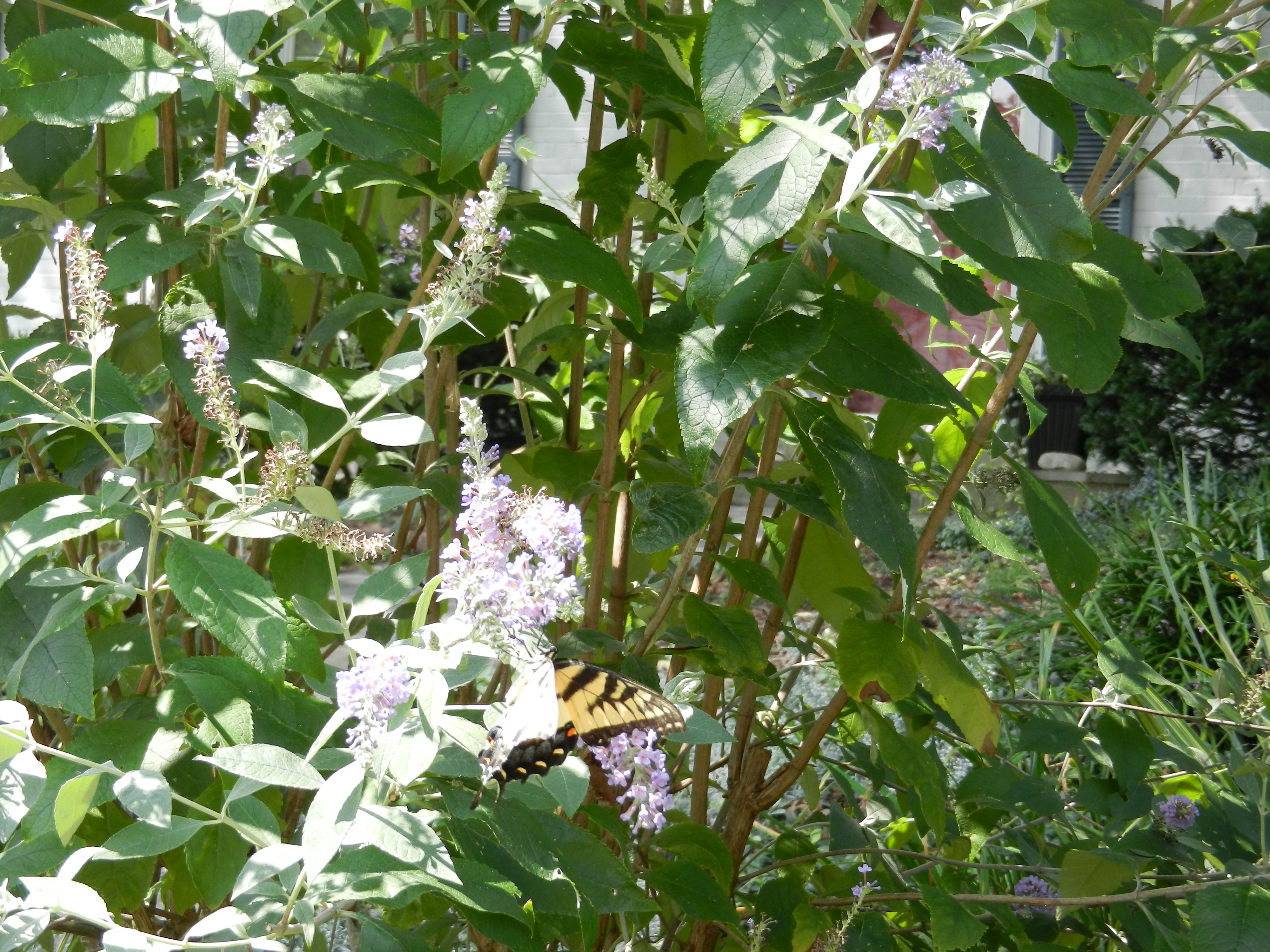
Sitting in my backyard listening to the birds chirping, watching the butterflies flit around the flowers and losing myself in watching clouds, is the kind of daydreaming that occupies me more now. That “dreamy meditation” invites ideas and images into the conscious mind. It’s the daydreaming that leads to new blog posts, and poems, and learning about nature. It’s the daydreaming that allows me to act on what I imagine.Butterflies_03

On the Psychology Today website, there’s an article by Amy Fries called “The Power of Daydreaming.” It’s an extensive overview of all the ways in which daydreaming is good for us, as well as the ways that daydreaming can be negative, such as if it is too “worry-based”. While it’s helpful to use daydreaming as a way to role-play a situation ahead of time, or assess its risk, it becomes maladaptive if it causes anxiety or obsessive negative thinking.

Daydreaming is essentially what we are engaging in when we use positive visualization or guided imagery to relax. We take ourselves away from the present moment (which might be stressful) and into another place that is beautiful and calm, a place that has meaning for us. Daydreaming becomes a short-term tool for getting through a difficult moment.

Does it seem like there’s a disconnect between present moment awareness and daydreaming, which takes us out of the present moment? Fries doesn’t believe the two have to be in conflict, but thinks that we can find the balance that gives us the right amount of each. She says that we need to be able to imagine art, philosophy, spirituality and progress in order to bring them into existence for ourselves.

So I welcome my daydreams as a respite, and try to be present to the serendipitous ideas that come up in them. Who’s to say what the difference is between daydreaming and just thinking? Albert Einstein once said that, “The secret to creativity is knowing how to hide your sources.” Could he have been talking about daydreams?