My simple season

When my kids were small, they had a Little Golden Book called My Book of the Seasons. This book had an appealing way of using alliteration and repetition to bring to life the change of seasons. For each season, the book described traditional, iconic imagery, such as pumpkins and snowflakes, and then asked, “Can you see it, can you hear it, can you smell it?” It was wonderful to read out loud.

I think of the book fairly frequently, especially now when I am enjoying the  transition from late spring to early summer. At the beach for Memorial Day weekend, I have had my first local peaches and strawberries of the year. I’ve been basking in the warm sun on the sand. I’ve been taking in the aromas of the plants, as well as the smells of backyard barbeques. I’ve been listening to the birds calling to each other and the children splashing in the waves. Yes, I can feel it, I can smell it and I can taste it. Summer is here!

There’s something incredibly elemental about using the senses to experience the change of seasons. And while a lot of change can be unsettling to people, there is something comforting in the cycle of the seasons, and in knowing that these simple pleasures of summer (or any other season) will be available year after year.

This is also the easiest time of year to simplify and improve how we eat. John Schlimm, the author of a couple of vegan cookbooks, described his style of cooking recently on a radio program. One of his criteria is that all the ingredients he uses have to be available in any neighborhood supermarket, even in the smallest towns. The point is, we don’t need exotic ingredients to make a wonderful-tasting, healthy meal. And with summer here, the farmers’ markets are open, the fruits are ripening, the tomatoes are full of flavor, and there is an abundance of choices. Mmmm…I can see it, I can smell it, I can taste it….

Summer offers itself to us as a lesson in simplicity. It’s not just that the food is fresher and more basic. Our pace slows as we take school breaks and work vacations.  We don’t need to wear heavy clothes so our bodies feel lighter and easier. We can be more in touch with nature because it’s so easy to step outside. All that is required of us is to pay attention and make the choice to enjoy the simple pleasures without asking for more.

Jon Kabat-Zinn talks about voluntary simplicity as “seeing less  so I can see more, doing less so I can do more, acquiring less so that I can have more”. I see the truth of his words today when I feel so incredibly rich because of the simplest things I have – good, fresh food, beautiful surroundings, warm air, blue skies, and loving people.  

People often talk about simplifying their lives. But what they don’t realize is that there’s no “doing” involved in it. It’s all right in front of us already. Like Dorothy in “The Wizard of Oz”, who realized that she could go home any time she wanted, all we have to do is say, “I can see it, I can hear it, I can feel it…”

In the zone

Comfort zone, time zone, twilight zone, euro zone, green zone, in the zone? As we traverse in and out of various kinds of zones, how can we keep as balanced and true to ourselves as possible?

I just came back from a trip to three different countries in 11 days. While this trip sets no kind of record for whirlwind travel, it still demanded an expenditure of energy in both mind and body to find some kind of equilibrium each day. Stepping into another country takes me to the borders of my comfort zone, at least at first. Then I add crossing time zones, and life definitely takes on a twilight zone feel!

While the body can be helped by following good travel advice like refraining from caffeine and alcohol, drinking plenty of water, and exposing oneself to sunlight every day, how do we handle the mental stress?

I love having new experiences, seeing unfamiliar places, learning new things – but such growth doesn’t happen in my comfort zone. So I had to think about how best to navigate the challenges of meeting a lot of new people, learning my way around strange cities and communicating in places where I don’t speak the language.

On my trip, I happened to be reading Search Inside Yourself, a new book by Chade-Meng Tan about the mindfulness-based emotional intelligence curriculum he started at Google. In the book, Meng describes the emotional competencies that (according to Daniel Goleman) make up self-awareness: emotional awareness, accurate self-assessment and self-confidence.

Meng, who describes himself as a shy person, discussed how he prepared for a speech to a large audience by using these competencies of self-awareness. He made his ego “small enough that my ‘self’ did not matter,” and big enough that he “felt perfectly comfortable speaking alongside” the luminaries at the event. He also kept in mind his strengths and limitations so that he could focus “on adding value where [he] could contribute most.”

I realized that by bringing mindfulness and self-awareness to my experiences on my trip, I was better able to deal with the challenges and turn them into positive events. I’m not the bravest or most out-going person in the world, but by staying present and paying attention to people and situations, I was able to increase my self-confidence and to use my strengths to my advantage. For instance, as a spouse at a dinner with people in an industry in which I do not work, sometimes I might feel inadequate or not “high-powered” enough. But by focusing on my strengths in my own field of stress management, and being mindfully engaged with each person I met, I found that I had plenty to contribute to conversations.

In a similar way, as I navigated streets and neighborhoods, I relied on my strong sense of direction, my curiosity and my desire to see everything to give me the confidence to explore on my own. But I tried to stay emotionally aware so that I would know when I needed a break in the “comfort” zone of my hotel room.

The British writer Lawrence Durrell once said, “Travel can be one of the most rewarding forms of introspection.” In that spirit, I’m still tapping into Search Inside Yourself at home now. I plan to use some of the book’s tools, such as journaling and body scanning, to build even greater self-awareness. After all, we never know when the next trip outside our comfort zone will happen.

Transition Time

I’m getting ready to leave on a trip out of the country, and I find myself looking forward to the airplane flight. Is it perverse to look forward to 8 hours stuck on a plane, with uncomfortable seats, so-so food and potentially irritating fellow passengers? Maybe, but the reason I’m anticipating it is because of the time it will give me to shift my perspective from the hustle and bustle of home/work/pre-trip preparation to the rhythm of days spent seeing new things and mastering unfamiliar cities.

Skipping transition time can make it more difficult to change tasks. From the toddler who has a tantrum when a play date abruptly ends, to the adult who has to go from meeting to meeting all day, everyone needs space to process change. When we don’t leave enough time before and after each activity, stress is often the result, either because we can’t stick to our hectic schedules, or because we just don’t have time to think.

When we experience stress in the emotional center of the brain, other executive functions of the brain are affected almost immediately. It’s harder to focus, we have trouble making decisions, and our ability to engage in abstract thinking is compromised. Some people can recover more quickly if they are psychologically resilient, but that usually is a result of a temperament you’re born with, or practicing stress management.

That brings me back to transition time as part of a stress management plan. It provides a psychological break between one thing and another that can allow us to process what just happened and to organize our thinking for what’s about to happen. It can also nurture our creativity. The Japanese chef and restaurateur Nobu Matsuhisa travels all over the world regularly. He said in a recent interview that, “I actually prefer a longer flight to a short one. That way I have time to read a book, watch movies, and think about new dishes.” If he didn’t have that time to just relax and think, would his restaurants be as successful as they are?

In this era of 24/7 availability, it is also welcome to have time on planes to be quiet. Although the advent of WiFi on planes has made it easier (and perhaps expected) that people will work during a flight, at least there are still no ringing and buzzing cell phones. We can all have a short break from immediate access.

My time during the flight will be spent with a book, maybe a game of Sudoku, and I hope, some sleep. I will enjoy hearing the accents of the Scandinavian flight attendants, adjusting my ear to the voices I will hear when I arrive. I’ll have time to breathe, to re-set my brain, and get ready to discover what the days ahead hold for me.

Running with friends

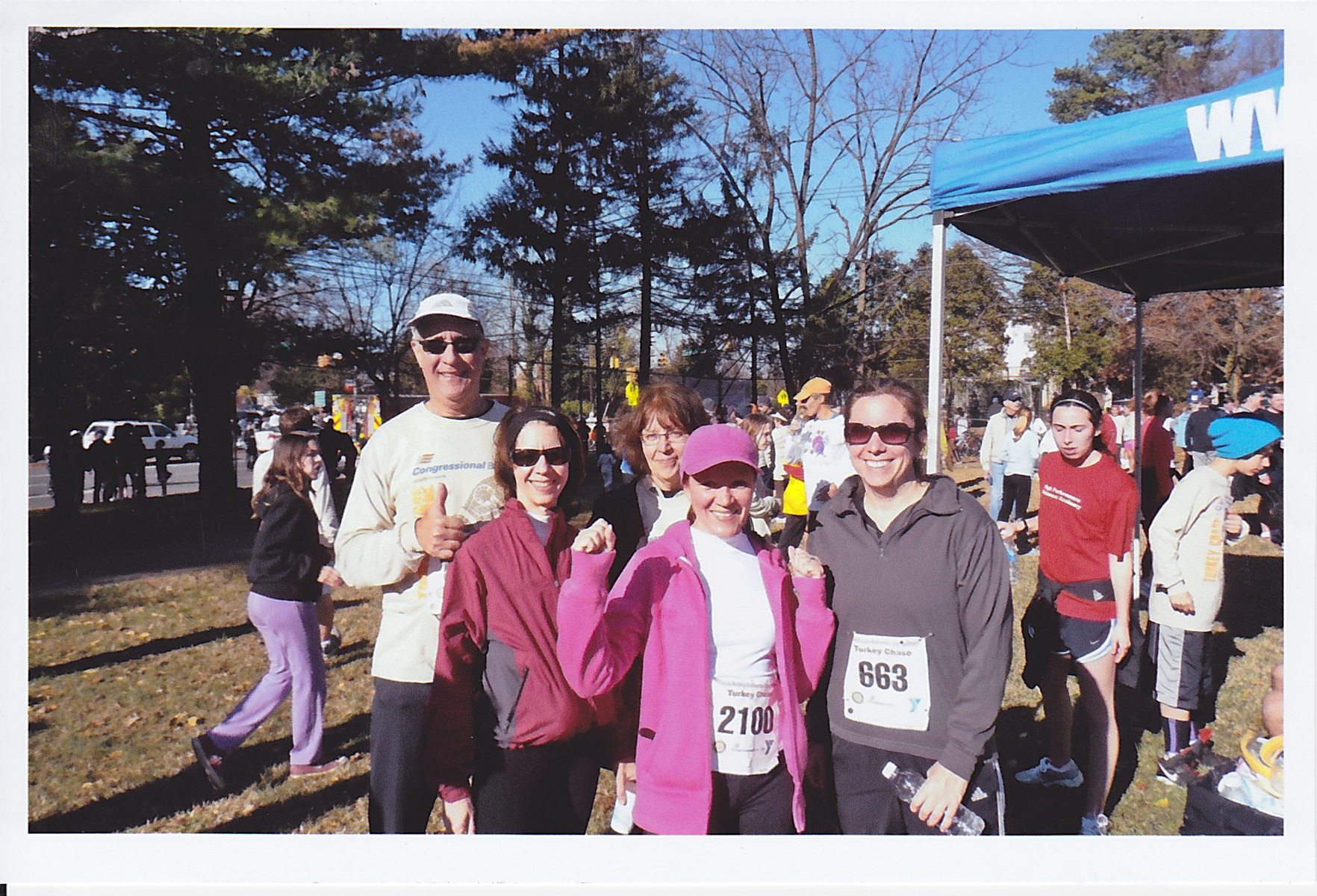
Yesterday I ran a 10k race, the longest I’ve run since my last 10k in November. I would not have done it without my running partner, Naomi.  I would say we keep each other motivated, but it’s more like we keep each other from being slackers. Neither of us loves running enough to do it consistently on our own. But knowing that we’re each depending on the other keeps us going.

Years of studies consistently show that social support is a significant factor in keeping people exercising, especially women. One recent study indicates that it is the esteem social support that is most significant – the positive feedback, encouragement and compliments we receive from others. On the other hand, companionship social support – having another person exercise with you – can actually keep people from exercising more strenuously.

I guess in some ways, that’s what’s happening with my friend and me. We keep each other running, but we don’t often push each other to work harder. We talk a lot while we run; a favorite question when the running gets difficult for one of us is, “Do you have a good story?” We don’t work together or live near each other, so hearing about each other’s lives is a great diversion. This doesn’t lend itself to doing speed work, but it has made us better friends over the years.

I could, and sometimes do, run with my husband. He’s good about keeping us on pace and running longer distances. But he sets a high standard for himself and that can sometimes carry over to me. Running with my friend, by comparison, is pretty much judgment-free. If one of us wants to walk, we walk. If one of us wants to run 3 miles instead of 4, that’s what we do. And if one of us suggests a 10k, the other one usually agrees.

The question, I guess, is what’s enough? While I know that challenging myself physically can prepare me for other challenges in life, I’m not the kind of person who needs to run a marathon to accomplish that. I have plenty of other opportunities in my life to prove myself, and to get that runner’s “high” feeling. Running is just one of the ways that I stay healthy. So even though it was a bit disheartening to see the fastest runners returning toward us when we were still two miles from the finish, I don’t feel too bad about our 10-1/2 minute miles yesterday. We ran 6.2 miles for the first time this year, and we felt pretty good at the end of it.

Olympian Wilma Rudolph, once the fastest woman in the world, said that she “… loved the feeling of freedom in running, the fresh air, the feeling that the only person I’m competing with is me.” My wish for every run is to find that kind of freedom and to feel the lightness that can come from running unencumbered in the fresh air. I may not be setting records, but I’m still running, and I’m glad I’m not alone.

Earth Day 2012…

…and it’s raining a steady, drenching rain. It is cold and miserable, yet nourishing to our plants and soil, which were snow-deprived all winter. It’s a good day to sit inside and think about what the day means and how I can do my part to make my piece of the Earth a healthier place.

When Earth Day started 40 years ago, it was in response to an an oil spill, and it ignited a new focus on environmental activism and political action. Much of the Earth Day messaging has been about energy use, clean air and water, and more recently, climate change. The theme for Earth Day last year was “A Billion Acts of Green”, and currently the counter on the EDN web site shows over 999 million acts of green submitted by visitors to the site.

The theme for the Earth Day Network this year is “Mobilize the Earth”, calling on people worldwide to unite their words and actions to create a sustainable future. “A Billion Acts of Green” and “Mobilize the Earth” speak to the idea that small actions can add up to a large impact, and that it will take all of us together to make the world a better place to live and grow.

So I’ve been thinking about what acts of green I can add to my life. I already recycle as much of my trash as I can, freecycle some unwanted items and donate others, try to use gadgets as long as possible before buying new ones, responsibly recycle my electronics, use an electric lawn mower, combine errands in the car when possible, and respond to appeals from Clean Water Action and other environmental groups. What’s left?

  • Being more mindful of water use. My local water company says that 70 gallons is the typical daily per person water usage in our area. My household is a little lower than that, but it’s still vastly greater than people use in other countries. Millions of people in the world don’t have access to a reliable source of clean water at all.
  • Riding my bike instead of driving. Last summer I bought a pannier for my bicycle, determined that I was going to start riding to the grocery store. I did it exactly once before the weather got cold. (I’m a bit of a wimp when it comes to riding in cold weather). I am going to set a goal of substituting the bike for the car once a week this spring and summer. This has the added benefit of being exercise too!
  • Making “meatless Mondays” a habit. We’ve been gradually incorporating this idea in our house and 2012 could be the year to solidify it. The meatless Monday trend has the benefit of being good for the environment (lots of CO2 comes from cattle), saving water (it takes a lot more water to raise animals for meat than it does to grow plants) and making us healthier too. The Meatless Mondays web site has lots of great recipe ideas and other tips on how to incorporate this idea into your life.
  • Volunteering. Yes, I belong to environmental organizations, write letters occasionally, and send them money sometimes. But I used to do more, such as cleaning up my local stream and volunteering for environmental organizations. I can do that again.

I read back over the steps I’m proposing to take, and I see how intertwined my well-being is with that of the Earth. Eating less meat, exercising more and being connected to my community will all benefit me while I am getting “greener”. My individual future is inextricably linked to the future of my world. As Aldo Leopold once said, “We abuse land because we regard it as a commodity belonging to us. When we see land as a community to which we belong, we may begin to use it with love and respect.”

Juggling Act

“Balance doesn’t mean things stop moving,” Kathryn Budig says in her “Aim True” yoga practice video. She goes on to say that what balance really means is that you are able to handle the wobbling and the moving better. How does this relate to time and energy management?

The concept of life “balance” is complicated; we think of it in terms of choices, in having to give up some of one thing to have more of another. It’s certainly true that we have to make trade-offs in life, and that we sometimes have to consciously choose to devote time to something. Otherwise, it would be just too easy to say, “I don’t have time.” But no matter how good we are at setting priorities and saying no to things that aren’t important, we often end up with a lot on our plates. In those times, how do we handle all the moving pieces with grace and balance?

Having to do my taxes this week is a good example. Yes, I started working on them last month, but I stopped when things got busy, and now only a few days remain before the deadline. Sometimes I think I might be what’s called an “arousal procrastinator”, someone who gets a thrill from doing things at the last minute. Yesterday, when I sat down to work on the taxes for a couple of hours, I felt a little undercurrent of excitement; I was energized to get it done.

Was I truly getting a burst of energy from the sense of “crisis” (essentially a stress response), or was I simply aware that I was moving the pieces of my life productively? Is there a difference, and would I be able to tell?

I like to think that I am not as much of a crisis-maker as I used to be, that I’ve learned to live my life with more equanimity and calm. I plan better now; I don’t do crazy things like decide on Monday to make a dress for a party on Friday; I let other people help me even if I know I can do the job better; I just let more things go.

Gil Fronsdal, a teacher of Buddhist meditation, describes equanimity as a translation of the Pali word, upekkha, which means “to see without being caught up by what we see”, or to see with a somewhat detached understanding and patience. Another Pali word that translates to equanimity is one that means being able to remain centered even while in the midst of everything that is happening around us.

Would I like to stay centered while doing my taxes? Yes! For one thing, I think it will lead to fewer mistakes. When we’re overly stressed, the quality of our work usually goes down. So what I’m trying to do is take plenty of short breaks from the work – getting up to stretch, walk around and look out the window – while not stopping for so long that I lose the flow.

I’m also trying to stay present with what I’m doing. In other words, while I work on the taxes, it’s just the taxes. When I’m finished with that for the day, I’ll turn my attention and focus to the next thing that needs to be done today, instead of worrying about it while I’m working on the tax return. That’s not easy for me – sometimes I feel like my mind is all over the place – but I’m getting better at it. As Fronsdal says, “As mindfulness becomes stronger, so does our equanimity.”

Keeping balanced doesn’t necessarily mean we have less to do. It’s more about finding that sweet spot where all our best qualities – attention, joy, wisdom, humor – come together to help us appreciate the wobbly ride of life.

Words: Handle with care

Wandering around the Library of Congress last week, my eyes gravitated to a quote high on the wall. It said, “Words are also actions, and actions are a kind of words.”   At the time, I didn’t know who had said it (Ralph Waldo Emerson), but it stuck in my head for days.

As I was growing up, I often heard adults say, “Actions speak louder than words.” Emerson seems to be saying that words and actions are equal, that while our actions speak for us, our words have the capacity to sting or caress as surely as if we were using our hands.

This couldn’t be truer than it is today. In this age of digital communication, people tend to throw words around carelessly. With email and texting, we don’t have to worry about wasting paper or ink; we don’t have to take the time to put a letter in an envelope, stamp it and mail it in order to send someone a message. So we don’t think as carefully about the things we say. Words have become a cheap commodity, often chosen without a lot of thought as to their meaning or effect.

If we stop and think about how much of our stress is coming from interactions with other people, we can see that a lot of it is a result of the blunt force of these mindless communications. Emails and texts deprive us of tone of voice, facial expression and body language, so their messages are often misinterpreted. Sometimes offense is taken when none was intended. Speaking face to face is not always better; often people speak at each other rather than to each other. We wait for our turn to speak, rather than listening so that we can respond with understanding.

Headlines are made when celebrities are forced to close their Twitter accounts or politicians are driven from office due to ill-advised words. For the rest of us, the results of miscommunication can be just as painful and devastating: someone doesn’t speak to you anymore, relationships are strained, or business is lost.

How can we practice communicating more clearly, more carefully and more compassionately?

  • Do take the time to be sure that saying something serves a useful purpose. Soren Gordhamer makes the point that sometimes our comments (on-line or in person) are just a form of one-upmanship: “When we are caught in what we may call the judging mind, we continually look for people and actions to criticize. Instead of a critique that seeks to help, we do so to build up our own sense of superiority.”
  • Do pay attention to what others are saying non-verbally, with eye contact, body language and even silences.
  • Do listen reflectively to other people. Repeat or rephrase what they have said to you to be sure you understand it.
  • Don’t communicate difficult messages (like breaking up with someone) via email or text. Give the other person the respect of a face-to-face meeting.
  • Don’t hit the “send” button so quickly, especially if your message is complicated or unwelcome. Wait 10 minutes and read it again to be sure it conveys what you really want the other person to hear.

How would it feel to be on the receiving end of your words? Should that be our standard for better communication? As the Buddha said, “Better than a thousand hollow words, is one word that brings peace.”


Listening in

We are not just our bodies, but it is important to be aware of what they’re telling us. The more we pay attention to how we feel – in mind, body and spirit – the easier it will be to sense when something is not right. Then we can take steps to bring ourselves back into wellness.

Sometimes conflict arises, though, when we turn to medical professionals who have a one-size-fits-all approach to healing. Too often, that approach involves a prescription for medication as a first step rather than a second or third. Even though we might have doubts about the medication, sometimes we don’t speak up about them.

Dr. Herbert Benson, an authority on mind-body approaches, writes in his book, Timeless Healing, that “…when it comes to the medical profession, we are often intimidated or scared by the subject matter and we disregard our true feelings and reactions, even though brain research tells us that emotions are critically important decision-makers in our minds/bodies.”

Benson believes that physicians underestimate people’s desire and ability to make lifestyle changes, or to try other approaches that don’t involve drugs. He says, “Trust your instincts, and trust the doctor who values your impressions and assessments.” In other words, find the doctor who starts from the premise that you know your body best.

Of course, to know your body best means that you have to pay attention to it. Some of us are very in tune with the nuances of our bodies; others tend to be dissociated. But there are a number of mindfulness practices that help us become more aware.

  • Body scan – this practice involves bringing your attention to each body part, one at a time, starting say, at your left toe, and working your way up. The attention is passive observation only, without judgment.
  • Progressive muscle relaxation – this practice has you tense and tighten parts of your body one at a time, then relax them. It helps bring awareness to the difference in sensation between tension and relaxation.
  • Present moment awareness – by sitting quietly and focusing on the breath, we can often become aware of what kind of body sensations are connected to certain thoughts. If you find your mind drifting to something troubling, you may realize the place in your body that reacts with tension to that thought.

It is estimated that 70%-80% of all healthcare visits are stress-related or stress-induced. It makes sense to use lifestyle change rather than medication to treat many of them. We can start by becoming more alert to the interaction of mind and body, and by treating ourselves with compassion. I sometimes practice a compassion meditation from Frank Jude Boccio (found in Yoga Journal magazine) that includes the line, “May I hold myself with softness and care.” There is something about that statement that always reminds me of my innate value, and the need to treat myself well.

Hippocrates said, “The natural healing force within each one of us is the greatest force in getting well.”  Learning to tune into our bodies and trust in that force would make us all better healthcare consumers and custodians of the awesome gift we have been given.

My Perfect Day

The warm weather this week has everyone excited. Everywhere I go, people have something to say about it (80 degrees in March!) and a smile on their faces when they talk about it. When I wake up in the morning now, I hear the birds chirping through my open window, indicating another glorious day. I get out of bed with a lightness that is missing in the cold, dark days of winter.

All of that leads me to think about my perfect day. This is a tool that I use with students as a starting point to figuring out their values. If you can make a list of things that constitute a good day for you, it gives you an idea of what is most important to you. What I’ve seen this week is that warm, sunny weather is very valuable to me!

Here are some other things that would make up a perfect (or very good) day:

  • Time spent with friends or family. Whether I reach out to someone, or they make contact with me, it feels good to talk (in person or on the phone) with someone I’ve known a long time. It is a reminder that I have a support system out there.
  • A really yummy meal that isn’t too unhealthy. I love to cook and I love to eat, so this is a significant part of the day. Having healthy food is a bonus because I can feel both satisfied and virtuous about the meal.
  • Some work to do, but not too much. I like the challenge of work and feeling like I make a contribution to something bigger than myself. On the other hand, I like to have choices about how I spend my time.
  • Some physical activity that I enjoy. There’s that good feeling of exhaustion that comes with working my body hard, but not too hard. I don’t need to run a marathon, but I like to get out and move. Running, hiking or yoga all fit the bill.
  • A good book to read. I’ve written before about the important role books have played in my life, along with curiosity and learning. Whether I’m reading novels or non-fiction, I always take something from the books I read.
  • Words of love or encouragement. This could be my kids saying, “I love you, Mom”; a student saying he was helped by my class; a co-worker praising my work; or even a stranger complimenting me on what I’m wearing. Affirmation always brightens my day.
  • Physical contact with someone I love. The skin is the body’s largest organ, and the sense of touch an important way to communicate. Hugs and kisses are a necessity on a perfect day!

When I look at my list of “perfect day” requirements, I see that they correspond very closely to the six dimensions of wellnessPhysical (the exercise and eating); Social (time spent with friends); Emotional (physical contact and words of love); Intellectual (reading); Occupational (working a little bit); and Spiritual (appreciating that warm, sunny day with the birds chirping). Without consciously thinking about it, my desires are reflecting my core values.

Do we know the perfect day when we are living it, or does it exist only in retrospect? Can we wake up every morning with the desire to live it well?

The Indian poet Rabindranath Tagore wrote, Do not say, ‘It is morning,’ and dismiss it with a name of yesterday. See it for the first time as a newborn child that has no name.”

Finding my balance

After two long weekends in a row away from home, I am still struggling with a feeling of disequilibrium. Don’t get me wrong – both weekends were a lot of fun, and I don’t regret going away. It’s just that I feel off-balance from having so little time at home in between.

In the language of stress, this is what is called “eustress”. It’s the good kind of stress, the kind that comes with a happy event or something else that is desirable. But it still throws us off balance in a way that is similar to negative events. It knocks us out of our usual routines, and makes demands on our bodies and minds.

For some people, travel might be routine, but for me, not so much. The first thing that goes off-kilter when I travel is exercise. My careful routine of running, yoga, and weight-training two times a week is out the window. If I’m lucky, I get in one run and maybe some quick yoga.

Eating also changes. Sometimes the food choices aren’t so healthy, or the mealtimes are erratic, or there’s too much or too little of something. Fruit is something I don’t eat nearly enough of when I am away from home.

Sleep habits might also suffer. Strange or uncomfortable beds, noisy rooms, and time changes can all cause problems.

Mentally, the demands can be more subtle. If we’re traveling for pleasure, we try to shift to vacation mode, but work might still be on our minds, especially if we think about all the things that aren’t getting done while we’re away. If the trip is business-related, we might feel like we are missing out on family time. So we are not fully present in the place we’re supposed to be.

Then, just when we’re getting used to the place we’re in, it’s time to go home!

Now we’re faced with the work that is undone, the people who need our presence and the myriad details of our lives that need to be dealt with. Sometimes it can take days to catch up. Essentially, we are trying to regain “homeostasis”, our steady state.

David Agus, who has a new book out called The End of Illness, argues that to be healthiest, people need to keep to a regular daily schedule of eating, exercise, sleep and relaxation. Most people might find it difficult to eat meals or exercise at the same time every day as he suggests, but I can see how it might be very helpful during times of stress, whether that stress is eustress (good) or distress (bad).

When I get back from a trip, my sense of focus is poor. I don’t know which task to tackle first. The temptation is to skip exercise or sleep, and to use the time to catch up on all I’ve missed. That’s probably the worst thing that I could do. Getting back to my regular schedule will ultimately make me more productive.

Here’s what I’ve observed during my first days back:

  • Right before I left for my first trip, I started doing a 21-day meditation challenge on the Chopra Center web site. Although I missed a couple of days while I was away, I have been pretty diligent about doing the meditations once or twice a day since then. That has helped to keep me grounded and calm.
  • I’ve gone back to reasonably healthy eating, although I find that I am unusually hungry at odd times of the day. That’s probably the result of not eating on a regular schedule while I was away. But I’m expecting that in a couple more days, I’ll be back on track.
  • The exercise habit is kicking back in. It helps that the weather is warmer this week and I’ll be able to run outside over the weekend. That will also help with sleep and appetite.
  • By tomorrow, I’ll probably be caught up on my work, and I’ll feel good about that.

Am I looking forward to my next trip? Yes, but I’m glad it won’t be for at least a month. While I relish the challenge and stimulation of travel and new experiences, I’m happy now for the comfort and well-being of home and habit.