“Change is gonna do me good,” goes the lyric of Elton John’s song “Honky Cat”. I’m one of those people who has to say things like that to myself, to force myself to stretch a little. No matter how much there is to gain outside what’s familiar and comfortable, most of us have to be convinced and cajoled, or forced by circumstance, out of our comfort zones.
My summer reading club
The local library was one of my favorite places during childhood. Even today, when I enter a library and get a whiff of that familiar smell of books, glue, and something undefined, I feel at home. It was, and is, a place of quiet discovery.
During every summer growing up, I was an avid member of the library’s summer reading program. The end of the school year didn’t signify a break from books to me – instead, it meant that I could dive into even more. I loved going into the cool, silent library (so different from the heat and noise outside!) and coming out filled with anticipation of what awaited me between the covers I held in my arms. Whatever the program entailed – number of books, stamps or stickers, charts or check-offs, I didn’t hesitate to sign up. Not only did I love the reading, my competitive nature kicked in as my book count got higher each week.
Those lazy days of reading for hours on end are mostly gone from my summers now, except for a few days at the beach each year. My reading takes place at odd moments here and there – subway rides, waiting rooms, or the time it takes me to fall asleep at night. Nobody but me is tracking the number of books I read – I’m in a book club of one. I’ll receive no stickers or prizes. My name won’t go on any list. Nevertheless, I feel richly rewarded.
The characters I’ve met this summer have invited me into their lives and made me care about what happens to them. Their stories are sometimes funny, but often sad; some of them are clever, others bizarre; most of them end with hopefulness, others with just a bleak sense of resignation. But all of them teach me something about life.
The importance of breath came into play in two novels I read. In The Garden of Evening Mists, a damaged young woman is learning archery, while in The Sojourn, a teenager becomes a sharpshooter during World War I. Both learn to “Feel your body expanding as you breathe: that is where we live, in the moments between inhalation and exhalation.” I loved the images of connecting breath and movement, just like yoga. No matter what we are aiming for, the breath is what takes us there, and the space between breaths is like a doorway.
My passion for books was affirmed by reading Will Schwalbe’s The End of Your Life Book Club. Schwalbe and his mother, both keen readers all their lives, formed an informal book “club” while she was undergoing treatment for cancer. They would read and discuss books as they sat in waiting or treatment rooms. Schwalbe’s loving memoir chronicles the time by connecting it to the books. He remembers his mother’s friendships with people she had met around the world, and her insistence “that books are the most powerful tool in the human arsenal.” She was passionate about getting a library built in Afghanistan before she died. About one novel, she said, “That’s one of the amazing things great books like this do – they don’t just get you to see the world differently, they get you to look at people, the people all around you, differently.”
I may never visit Malaysia or Sri Lanka, settings for three of this summer’s books, and I can’t relive the World Wars which featured in others, but reading about them has given me an expanded view of what those places and times are all about. I’m so grateful that reading has given me eyes to see the world, increasing my compassion for and connection with people everywhere. That’s the power of summer reading!
Letting go of fear
Does Cory Booker practice yoga? I wonder because the Newark, NJ mayor was speaking the language of yoga in an interview with the Washington Post’s E.J. Dionne a few days ago. Discussing violence and crime prevention, he said, “Fear is a toxic state of being. You’ve got to lead with love.”
At its essence, the word yoga means to yoke, join or unite. It strikes me that Booker is speaking that language when he says that love can unite people when it replaces the fear that’s at the heart of so much of our distrust of each other. Yoga teacher Kathryn Budig says that in order to meet challenges, we need to “let go of fear and move back into a place of love.” I think they are saying the same thing.
Stress often comes from being unfamiliar with a person, place or experience. That fear of the unknown often manifests itself by us labeling someone or something as “other”, as different from ourselves. By focusing on differences we harden ourselves to feeling any compassion for the other, and we rationalize conflict and dislike. We use otherness as an excuse for our feelings about people of different nationalities, religions, races, political parties, social groups, or abilities. It makes it easier to ignore the paths that might lead to understanding.
Cory Booker’s interview covered a lot of topics, but he was talking in the aftermath of the George Zimmerman acquittal in the death of Trayvon Martin. While there’s a lot we’ll never know about that tragic evening, we can be pretty sure that it started when one person saw another and labeled him as “other”. It started with fear and distrust.
I’ve written here before about the “Just Like Me” meditation developed by Chade-Meng Tan. Combined with a loving kindness meditation, it becomes a powerful process for tearing down those feelings of otherness. The heart of it is acknowledging that the other person has the same needs and desires for health, happiness and love that you have.
As Meng says, “There are three premises behind this practice. The first is that when we perceive somebody as being similar to ourselves (“just like me”), we become much more likely to feel and act positively towards that person. The second is that kind and loving thoughts towards another can be generated volitionally. The third premise is that mental habits can be formed with practice, so if we spend time and effort creating thoughts of similarity-to-others and loving kindness, over time, these thoughts get generated habitually and effortlessly…”
It takes practice to get to the point where we react with love and kindness first. But isn’t it worth the effort? The “Just Like Me” meditation is a tool for finding our common ground, our humanity. President Obama said last week that, “we should ask ourselves if we’re doing all we can to widen the circle of compassion and understanding in our own communities.” That circle starts with compassion for self, then widens out to families, friends, to neighbors, communities, and eventually encompasses the stranger, the “other”, even perhaps an enemy, by admitting the truth that they are “just like me.”
Keep hope alive
“Tell me and I forget. Teach me and I remember. Involve me and I learn.” So said Benjamin Franklin over 200 years ago, and yet it has taken a very long time for schools to consider student engagement in a serious way.
The school system in my community has just announced that they will partner with the Gallup polling organization to measure hope, engagement and well-being in its students. They are the biggest of many school systems that are measuring well-being and putting social/emotional learning into practice. Taking a more holistic approach to student achievement isn’t just some feel good strategy. Social and emotional wellness has been found to be directly linked to student achievement and long-term success in life. The ability of a student to set goals and work toward them requires that he or she have a sense of hope – the belief that the work will lead to something good – and a feeling of being engaged in the process.
While there seems to be some hesitation on the part of some local politicians to fully embrace the idea – they don’t want to seem “silly” – the science backs it up. A 2011 study showed that students demonstrate academic gains when social emotional learning (SEL) is emphasized in school; and Daniel Goleman cites neuroscience research on how the emotional center of the brain is linked to the areas of the brain involved in cognition and learning.
How do schools nurture hope and increase engagement and well-being? Developing self-awareness, self-management and interpersonal skills usually figure prominently in SEL goals. Achieving them entails nothing less than changing the climate of the school. SEL activities might include role-playing stressful situations such as bullying, working on anger management and teaching children the language of expressing emotions.
The president of Emotionally Intelligent Schools, Marc Bracket, uses an acronym to describe social/emotional learning: RULER. It stands for “recognizing, understanding, labeling, expressing and regulating” emotion. Having the words to describe feelings, and being encouraged to express them, is a necessary step to being able to manage emotions better, and the teacher’s role is key in that process. As Daniel Goleman has said, “Teachers need to be comfortable talking about feelings.”
One of the measures on the Gallup survey being used in my district is “There is an adult in my life who cares about my future.” Whether that adult is a parent, a teacher or another mentor, the presence of someone who exhibits concern and empathy for a child is an important backstop for them, and makes it more likely that they will ask for help when they need it. When I think back on my school years, I remember the teachers who truly cared for me as bright spots in a not-always-happy environment. Those were the teachers I really wanted to please, and I like to believe that I learned more from them than from the teachers who did not inspire me to commit to myself.
Holding a positive view of oneself, having a hopeful outlook and being goal-directed are all qualities that relate to resilience – the ability to adapt and bounce back from stress and adversity. Resilience doesn’t mean that you don’t have problems, but it makes you more able to see beyond them – to be happy in spite of them and to take steps to improve your situation
The American Psychological Association says that it’s not success that makes people happy; rather, it is happy people who “work toward goals, find resources they need and attract others with their energy and optimism” who become successful.
Take it outside
There is joy in motion. It’s that simple. That feeling hit me today when I saw a photo in the paper of people doing Zumba outdoors. Their expressions are exuberant, their energy is contagious.
Outdoor exercise has a more free feeling than working out in a gym. Without the confines of walls and machines, something loosens inside. We take more chances, express ourselves more openly, lose some of our inhibitions. There’s also more of a sense of community, because we are physically in the community. And in some cases, the workouts are literally free – free yoga at the farmers’ market, free Zumba on the plaza and free Pilates in the parks.
Besides the individual benefits of outdoor, community exercise, public group workouts can demystify the practices for people who are unfamiliar with them. “Zumba”, “yoga”, “Pilates” – what do those words mean to someone who has never set foot in a gym or yoga studio? They sound like mysterious, esoteric practices that might be difficult and extreme. But when you see other people who look like you doing the moves, you begin to believe that you can do them too.
Americans are full of contradictions. We’re living longer than we did 20 years ago, but with more chronic conditions. Some of us are exercising more, but it’s not enough to keep the rates of obesity from rising. We’re not dying in accidents as much, but many more of us have diabetes. Complicated problems that require complex solutions, right? But while scientists are busy looking for treatments and technologies, we have the power to change our own trajectory. Rediscovering the joy in motion and the freedom of the outdoors can be part of that change.
My mother used to lock us out of the house sometimes when I was a kid. That wasn’t as bad as it sounds. In good weather, we were expected to play outside with other kids in the neighborhood; and if one of us came back in with dirty hands and feet, she wanted to know about it. Playing outside got me out of my head and out of my books for a while. It was during those summertime lockouts that I learned to take risks, like riding downhill on my bike without hands, and to play sports with the boys, and to see just how high we could get the playground swings to go.
What childhood activity brought you that freewheeling joy? Summer might be an ideal time to find the feeling again, either as a way to get a fitness routine going, or to get out of a fitness rut. Look around you – those people dancing in the streets and posing like warriors in the farmers’ market are smiling for a reason.
Vacation days


Daydream believing
My daydreams aren’t what they used to be. I’m pretty sure that’s a good thing, though. It all depends on what we mean by daydream.
Type “daydream” into Google, and this pops up: “Pleasant thoughts that distract one’s attention from the present.” That’s the way I mostly daydreamed for many years. I would use my daydreams as a tool for imagining some future event – usually something that was definitely going to happen, like a vacation. Fantasizing about the future event got me out of the mundane day-to-day life and into something happy and pleasant. After all, who doesn’t like to think about vacation?
But I realized recently that I don’t daydream like that much anymore. I think it’s because I discovered that life is better when I find something satisfying to experience each day that I awake, rather than off in the future. As Daniel Gilbert has written, “When we imagine the future, we often do so in the blind spot of our mind’s eye.” We don’t really know how the future will turn out, and over-fantasizing about it can make it disappointing when it finally arrives.
The dictionary.com definition of daydream is “a reverie indulged in while awake,” a reverie being a “state of dreamy meditation.” This seems like a better way to describe the kind of daydreaming that leads to creativity, problem-solving and fulfilling goals. There’s a saying that ‘where your thoughts go, your energy flows’. In that sense, daydreaming can be uniquely valuable as a way to come up with new ideas, figure out what to do with your life, create a piece of art or music, or imagine a different world.
Sitting in my backyard listening to the birds chirping, watching the butterflies flit around the flowers and losing myself in watching clouds, is the kind of daydreaming that occupies me more now. That “dreamy meditation” invites ideas and images into the conscious mind. It’s the daydreaming that leads to new blog posts, and poems, and learning about nature. It’s the daydreaming that allows me to act on what I imagine.
On the Psychology Today website, there’s an article by Amy Fries called “The Power of Daydreaming.” It’s an extensive overview of all the ways in which daydreaming is good for us, as well as the ways that daydreaming can be negative, such as if it is too “worry-based”. While it’s helpful to use daydreaming as a way to role-play a situation ahead of time, or assess its risk, it becomes maladaptive if it causes anxiety or obsessive negative thinking.
Daydreaming is essentially what we are engaging in when we use positive visualization or guided imagery to relax. We take ourselves away from the present moment (which might be stressful) and into another place that is beautiful and calm, a place that has meaning for us. Daydreaming becomes a short-term tool for getting through a difficult moment.
Does it seem like there’s a disconnect between present moment awareness and daydreaming, which takes us out of the present moment? Fries doesn’t believe the two have to be in conflict, but thinks that we can find the balance that gives us the right amount of each. She says that we need to be able to imagine art, philosophy, spirituality and progress in order to bring them into existence for ourselves.
So I welcome my daydreams as a respite, and try to be present to the serendipitous ideas that come up in them. Who’s to say what the difference is between daydreaming and just thinking? Albert Einstein once said that, “The secret to creativity is knowing how to hide your sources.” Could he have been talking about daydreams?
Three “meals” a day for the soul
It makes sense that a healthy diet and plenty of exercise can help us sleep better at night and be more resilient in the face of stress. But consider the flip side: managing stress and sleeping well can support efforts to eat better and move more.
I recently spent a day counseling people on healthy eating, but I found myself more often than not talking with them about how much sleep they got, and what their stress levels were like. They invariably said that their jobs were stressful and the hours were long. They got home later than they would like, and found it challenging to think about preparing a healthy meal. The stressful day made them feel like they “deserved” the calorie-laden dinner. And by the time they ate, and spent a couple of hours winding down, they got to bed too late to get enough sleep. They often felt fatigued and low in energy.
Most of the people I talked to were relatively young and pretty healthy. But they were struggling with maintaining healthy behaviors in the face of increasingly demanding jobs and hectic lifestyles. Suggesting complicated or time-consuming changes won’t work for them. But what about something that takes only 5 minutes?
Spending 5 minutes once, twice or three times a day doing something that brings you back to the present moment, refreshes your mind, or relaxes your body, can be incredibly restorative. Most of all, in those few minutes, you’re engaged in caring for yourself. While the idea that you deserve care seems like it should be a no-brainer, many people have a hard time embracing it. But a practice that affirms your love and care for self can be the foundation for other health behaviors.
These 5-minute fortifiers come from many sources, including my own practice. Some are adapted from a little book called Five Good Minutes by Jeffrey Brantley and Wendy Millstine. I have divided them into morning, day and evening practices:
Morning
- Resist the urge to jump right out of bed. Stay still for a moment. Listen to the sounds outside and in your home. Smile. Set an intention for the day, such as being kinder to the people who challenge you.
- Sing in the shower. As Brantley & Millstine say, “Music and song can make you feel giddy, bubbly, euphoric, and joyful.”
- Slow down. Ever notice how when you rush, you are more likely to drop things, spill things, and make mistakes; and less likely to find things you need? Taking the extra two minutes to get ready with care will not make you later.
Daytime
- Breathe at the traffic lights. Too often when we’re rushing to get somewhere, especially in traffic, we chafe at the time spent waiting. Turn it into an opportunity to notice your breath. Inhale deeply and exhale slowly. You will feel calmer when the cars start to move again.
- Take a break to look at nature. Whether it’s the view out your office window, or a picture on the wall, this practice will rest your eyes and your brain, and shift your perspective.

- Eat lunch mindfully. Stop working for the time it takes to eat. Chew slowly, really taste the food and think of how it nourishes you.
- Spend 5 minutes talking with a friend or family member outside of your work. Hearing the voice of someone who loves and cares for you helps ease the stress of the day.
Evening
Relaxing rituals in the evening help separate day from night and work from rest:
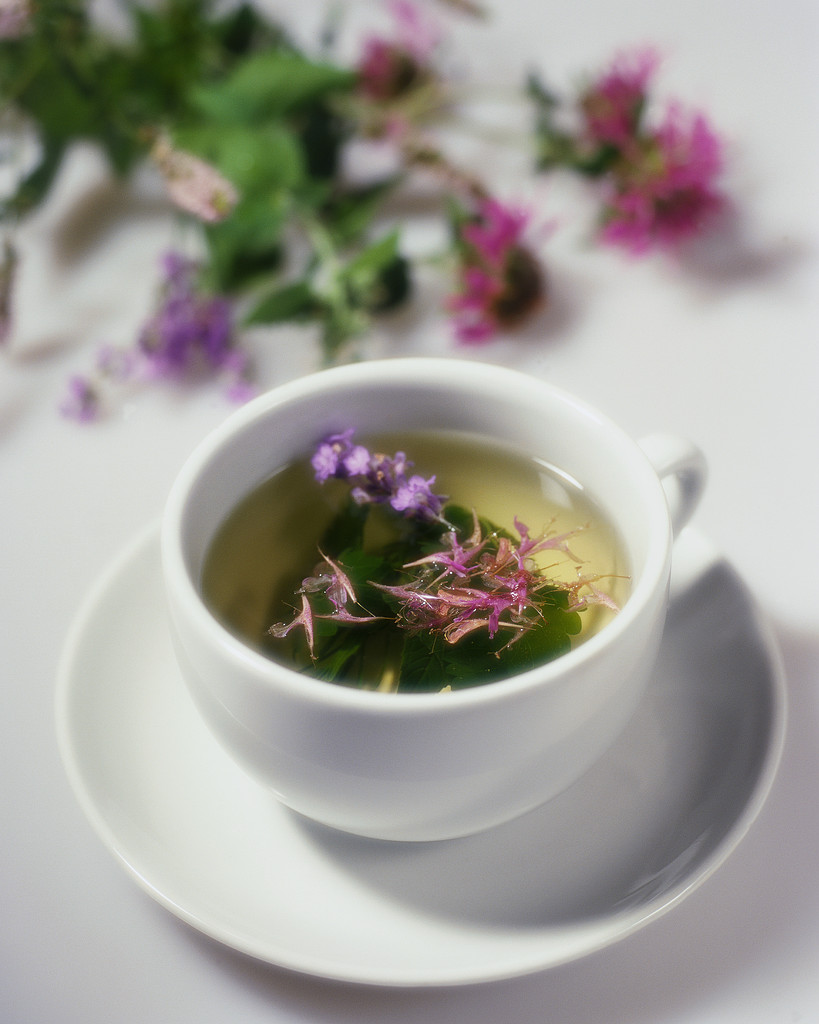
- Make yourself a cup of herbal tea to warm and soothe you before bed.
- Listen to some mellow music.
- Give yourself a foot massage.
- Read a favorite poem.
- If you find yourself anxious with thoughts about work, imagine writing them down on pieces of paper. Then picture yourself walking to a nearby river and dropping each thought into the water, letting it drift away.

By tackling stress and sleep first, we put ourselves in a better place to make choices about eating and exercise. We change our habitual ways of thinking about ourselves, make caring for ourselves a routine, and have the energy to stick to a plan.
As Soren Kirkegaard said, “Don’t forget to love yourself.”
“There is nothing either good or bad, but thinking makes it so.”
In this line from “Hamlet”, Shakespeare goes straight to the concept that happiness or unhappiness is all about perspective. Our beliefs color our view of the world. Look at something from a different angle – more importantly, think about it from a new perspective – and it might not bother you at all.
It’s really pretty apropos that a playwright gave us such a useful way to characterize our perception of stress. So much of stress, after all, comes from the stories we tell ourselves about events and the roles in which we cast ourselves. Are you playing the victim, or the victimizer? The hero or the villain? The innocent or the guilty? Sometimes it takes only a slight shift to see ourselves in a different role.
But the ironic thing about this quote is that the characters were talking about prisons, and thinking of the place they were in (Denmark) as a prison. Nothing imprisons us so much as being unable to see another side of a situation. We get stuck telling the story the same way over and over again, convincing ourselves that it is the “truth”, and not recognizing that someone else’s “truth” might be very different. This way of thinking often traps us when we feel we have been wronged by someone.
Imprisoning ourselves in the story doesn’t make the hurt go away, though. Even though it seems counterintuitive, getting free of the old story and considering a new one can be a lot more healing. Look at what the writer Gregory Maguire did with The Wizard of Oz story. He took a tale that we thought we knew, and knew well, and turned it on its head. The good witch isn’t all good – in fact, she’s downright mean at times. The wicked witch isn’t wicked at all – just misunderstood and discriminated against. Couldn’t the same be possible with the stories we tell ourselves about our own lives?
That was one of the exercises I did in a workshop on writing for health last week. Our first assignment was to write about a traumatic experience in our lives, and our feelings about it, from our own point of view. But the next day we were asked to write about the event from a different perspective. The writing was completely different the second time when I considered the other people who were involved in the event. I was able to feel more empathy and compassion for the people I might have “blamed” for the hurt.
I saw something in Yoga Journal a while back about changing your negative “what-ifs” to positive “what-ifs”. So here goes: What if you looked for the silver lining? What if you “walked a mile in another person’s shoes”? What if you forgave someone for hurting you? What if you told the story another way? What if you decided to play the villain or the fool instead of your chosen role? How would that look and feel to you?
Thich Nhat Hanh has written about roses and garbage that we cannot have one without the other. They are equal, and equally precious. “…we must be careful not to imprison ourselves in concepts. The truth is that everything contains everything else.”
The complete story of any life or any event contains an infinite number of points of view. Each side of the story might hold a valuable truth that could set you free of blaming and on to a path of discovery. The first step is changing the story.
You gotta have heart
For how many moments of your life is your heart present? Do you do things in a “half-hearted” way? Do you agree to do something, knowing that your “heart isn’t in it”? We use expressions like this to describe lack of enthusiasm, but they are really just another way of describing an absence of mindfulness.
Jon Kabat-Zinn, the founder of the Mindfulness Based Stress Reduction program, described in an interview the Chinese ideogram for the word mindfulness. He said it is made up of the character for presence, combined with the character for heart. In essence , mindfulness means presence of heart. By cultivating a quality of presence, he says, we inhabit our true selves and are more able to uncover our sense of compassion.
I’ve spent the past few days reading a book called The Orchardist, by Amanda Coplin. It is a novel about separation and grief, loneliness and misunderstanding, freedom and imprisonment. It contains a beautiful passage that, to me, perfectly describes mindfulness:
“When she was alone, when she was working, it was as if she forgot about herself. It seemed strange to state it this way, but it was as if she had no outline, no body, even though the work was physical. Where did her mind go? Her mind was steeped in the task at hand. At such times she felt a depth of kinship with the earth, and also felt very grown up, rife with compassion.”
Is mindfulness necessary for compassion to exist? Are we able to feel deep sympathy for someone else, and to care about ending their suffering, if we don’t have the ability to pay attention and be present to what they are feeling? The character in the book realizes in moments of mindfulness at work that she has attained a greater capacity to feel, that there is a spaciousness in her heart that wasn’t there before.
I’m also reminded of Like Water for Chocolate, in which all of the emotions of the character Tita become contained in the food she prepares, so that when people eat the food, they immediately feel what she feels — sadness, joy, pain. It doesn’t matter if you believe in the magic; there is something to learn from the idea that our work can contain some essential part of ourselves and that others can use their senses (taste, in this instance) to feel the emotion and presence that we put into it.
If we tune in to what our senses are telling us, really tune in, what can we learn? Whether it’s the expression on someone’s face, the sound of birds chirping, the smell of someone’s perfume, the taste of just-baked cookies, or the touch of a dog’s nose on my arm — engaging with my whole heart in that moment can help me understand what someone else feels, what is happening in my world, or just how much love can be contained in a batch of cookies. And that sense of understanding can open doors in the mind.
Our brains are plastic; we can change them if we desire. The work of Richard Davidson and other neuroscientists has shown that if we train ourselves in mindfulness, we can hone skills that help us experience more happiness and compassion. But this isn’t something minor that just makes me or you happy on an individual level. The more we “widen our circle of compassion” as Einstein said, the more chance there is for harmony and peace in the world.
Our brains are plastic, but in order for them to expand, our hearts need to be present. So think about it — can you bring your whole heart to more of what you do every day?