Urban decay?

The headline in the paper read, “Maybe it’s just crazy to live in a city”. Needless to say, it grabbed my attention.

While it was already known that mental health problems such as anxiety, depression and schizophrenia are more common among people who live in urban areas, new research (published in the journal Nature) looked at the brain to see how and why that happens.

Using fMRI scanners, researchers found heightened activity in the part of the brain called the amygdala when they assigned urban-dwelling participants to complete stressful tasks. One job of the amygdala is to assess social threats. People who lived in rural areas or small towns had lower levels of activity in the amygdala during the stressful tasks; in fact, the reaction increased as the size of the participant’s city increased. Researchers believe that city living may increase risk for mental illness by increasing sensitivity to social stress.

What is social stress? Basically it is any stress that occurs as a result of interaction with other people. For some it might amount to stress from events such as job interviews, public speaking, mingling at a cocktail party, or going on a date. For others, it might be triggered even in everyday interactions with people. Besides the greater risk for mental health issues, it is also linked to physical health conditions.

What is it about city life that makes it more stressful? The immediate things that come to mind are noise, pollution, and pace of life. But if the focus in this research was on social stress, how is that different in an urban environment? Certainly, crowding is one factor. Other possibilities are more diverse populations, more activities to choose from, and perhaps more roles to play. Each of these has the potential to increase the number and complexity of interactions with other people on a daily basis.

In rural areas or small towns, people may tend to see the same faces every day, have fewer choices to make about interactions, and have more personal space around them. Their potential for negative social stress is less.

Know yourself

The important thing to remember is that we all have different requirements from our environments. Some of us would be utterly bored with living in the country; others cringe at the thought of living in a city. Figuring out what suits you best sometimes takes trial and error. When I was younger, I lived in New York City for 6 months and developed the worse case of insomnia I’ve ever had. I came to the conclusion that the unremitting noise and stimulation hour after hour, day after day, was too much for me. Yet, if I spend too much time at a quiet beach retreat, I’m ready to go back to “real life” after a week or so.

This relates to something called the Yerkes-Dodson principle which shows the relationship between arousal and performance. It’s what is also called finding your “optimal level of stimulation”:
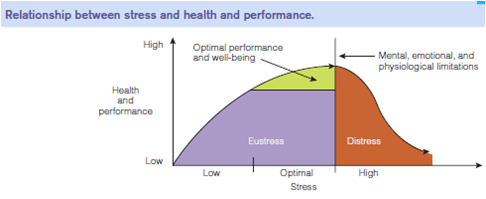
The line where stress increases to the point where performance (or quality of life) declines may be farther to the right or left, depending on each person’s capacity for stimulation.

Make space for yourself

Even if you thrive on the stimulation of city life, it’s important to protect yourself from the cumulative effects of urban stressors. For some, this might mean taking regular breaks from the city by getting away to a more rural, peaceful environment. If that’s not possible, then creating an oasis at home can help. Maybe that’s a certain space in your home that is calm and soothing. Maybe it is a space in your mind that’s created by a daily practice of meditation. It could also be achieved by finding or creating a smaller community for yourself within the larger community, people with whom you feel protected, safe, and comfortable. Whatever form it takes, the goal is to have a “place” where the stimulation is dialed down for a while.

What is your oasis? Leave me a comment to tell me how you create that space.

The power of friendship

The support of friends is always welcome, but never more so than when people are suffering. I saw that firsthand during the past week when, tragically, my sister lost the person who was her partner, best friend and father of her children. It was a shock to everyone in their community to lose someone so young and vital. But people swung into action immediately, to surround my sister with love and support.

Her friends brought food and drink to her home, cleaned her house, mowed her lawn, and even took her dog to one of their homes so she wouldn’t have to think about him. They cried with her, comforted her, listened to her, hugged her and her children, and at moments, laughed with her. It was awesome to see.

Sadly, this support is limited in its ability to ease the pain in the days and weeks ahead, but my sister still counts herself lucky to have it. She knows that she is cared for and loved, and belongs to a network of people she can call upon for help. If what research tells us is true, the negative effects of this huge stressor will be buffered by the social support, thereby helping her stay strong and healthy for her kids.

That kind of support system didn’t happen overnight. It was built by forming connections with people over many years, connections that became increasingly more stable and complex. It was based on shared interests and activities, work and school communities, and sometimes, shared difficulties. It meant giving time, attention and commitment to building relationships.

As I mentioned in an earlier post, our brains are hardwired for connection, to make and sustain strong attachments to other people, and to feel empathy and compassion. I was impressed and moved these last few days by how these attachments can be such powerful sources of strength in times of need.

Training for Life

Several years ago, when I was part of a boot camp fitness program, I was running one morning with my group. A woman passing by asked us “What are you training for?” Without missing a beat, our instructor answered, “For life.”

Today I’ve been thinking about this idea that we have to be ready for whatever life throws at us, the curve balls like divorce, job loss, deaths or serious illnesses. Sadly, too many people I know are dealing with some of those big life stressors right now. While we expect in an abstract way that our lives are going to have low points, it still can feel like a ton of bricks when we are hit with it. And when we have to deal day after day with the repercussions of divorce, or caring for a sick family member, it will tax even those of us with deep reserves of strength and good health.

Coming into a stressful situation with high levels of wellness in all dimensions can help people be more resilient and better able to meet the challenges. Physical wellness is very important, but it’s not the whole story. The 6 Dimensions of Wellness model emphasizes the whole person:

  • Physical – Do you have healthy eating habits and engage in regular exercise? Are you getting regular medical exams and engaging in self-care?
  • Occupational — Are you getting satisfaction from your work? Do you feel like you make a contribution to something? Does your choice of work align with your values?
  • Social – How are your relationships with family and friends? Do you feel that you have a support network you can call upon when needed? Do you feel connected to others in a community?
  • Emotional – How able are you to accept and express your feelings? Is your outlook on life more optimistic or pessimistic?
  • Spiritual – Do you feel a connection to something larger than yourself? Do you feel your life has meaning? Are your actions in harmony with your values and beliefs?
  • Intellectual – Are you a life-long learner? Do you take opportunities to be creative, to challenge yourself, and to share knowledge with others?

All of these dimensions make up your wellness path, and contribute to your ability to handle stress. Visualize your path right now, and think about an area you would like to improve.  Focus on enhancing your wellness in just that one dimension for now. Here are some ideas to get you thinking:

  • Physical – If your nutrition needs a boost, set a goal of eating 5 servings of fruits and vegetables each day.
  • Occupational – Evaluate your current job. Can you develop a new skill for use there or in your next job?
  • Social — Reach out to someone you’ve been missing. Make a date to go out with friends. Plan a neighborhood get-together.
  • Emotional – Start writing down your feelings in a journal. Watch a funny movie to lighten your mood with humor.
  • Spiritual – Take a walk in nature. Get involved in helping others. If you have been religious in the past, think about reconnecting with your faith.
  • Intellectual – Set a goal to read a newspaper every day, or a book each month. Perhaps sign up for a class on a subject you’ve always wanted to learn.

Wherever your path takes you, and no matter how many bumps in the road, I wish you ease and well-being in body, mind and spirit. Train for life!

Natural Wonders

Sitting at my desk this week, all I hear is the sound of birds chirping, singing and calling to each other. The distant sounds of the highway fade away to the background. Even the neighborhood dogs can’t compete with the birds in springtime.

I was so taken with the bird sounds a few days ago that I found a web site where you can click on the name of the bird and hear a recording of its song. Check it out at http://www.enature.com/birding/audio.asp

Relaxing sounds can soothe people, lower our heart rates and stimulate production of endorphins. Of course “relaxing” is in the ear of the beholder; but for me, the sounds of the birds are in that category. There is a reason why so many recordings of guided meditations tend to focus on images of nature, such as waterfalls, mountains, beaches and forests. The natural world has the capacity to nurture us, make us feel calm and supported, even improve our sleep. But thinking about connecting with nature leads to the unfortunate fact that many of us just don’t spend enough time outdoors.

Most alarming is the fact that children don’t spend nearly as much time outdoors as they used to, in fact only half as much time as they did twenty years ago. Very few play outside on their own, yet research shows that unstructured free play in the outdoors has many benefits to them – ranging from doing better in school, to being more cooperative, to just being healthier overall.

Something as simple as a view of nature helps to reduce stress in children who are highly stressed, and daily proximity to nature can help children focus, even reducing symptoms of attention deficit disorder. Playing in nature also serves the important purpose of giving children the opportunity to take appropriate risks, solve problems and develop creativity, which can lead to enhanced self-esteem.

So many benefits! Yet finding the time, a safe space, adults who are comfortable enough in nature to guide children – all are barriers. Luckily, a few organizations are working to make sure that the next generation has a taste for nature:

  • The Children & Nature Network, whose mission aims to “give every child in every community a wide range of opportunities to experience nature directly”, has tips on their web site for starting your own family nature club, along with other ideas.
  •  The No Child Left Inside Coalition is an advocacy group with almost 2,000 member organizations from across the country that seeks to raise awareness in Congress and among the public of the need for more environmental education in schools. The coalition was formed after many programs were cut in the wake of the No Child Left Behind Act.

As Thoreau once wrote, “We need the tonic of wildness … We can never have enough of nature.”

A great time to try yoga

D.C. Yoga Week starts this Sunday, May 15. The week of events, including free and reduced classes at local yoga studios, kicks off Sunday with yoga on the National Mall from 1:30 to 4:30 p.m. There will be kids’ activities, yoga practice, music and an appearance by Shiva Rea, a nationally-known yoga teacher.

D.C. Yoga Week is a great time to give yoga a try if you have never experienced it before, or if it has been a long time since you tried it. Ten local yoga studios will be offering specials during the week (see the D.C. Yoga week web site for a listing). The purpose of D.C. Yoga Week is to raise awareness of yoga’s benefits for both physical and mental health, and to give people an opportunity to try it at a reduced cost.

What are some of those benefits? Practicing yoga postures increases blood flow to specific areas of the body, supplying them with oxygen, which helps them function better. Yoga also increases flexibility in the spine & elsewhere, helping people  carry out daily activities without injury. Yoga has been shown to alleviate symptoms of many diseases and conditions, such as anxiety and stress, arthritis, headaches, high blood pressure, addiction and insomnia.

Concentration on the physical postures of yoga trains the mind to focus away from thoughts. Regular yoga practice leads to greater stress tolerance because the autonomic nervous system has a higher threshold for arousal. The parasympathetic nervous system (which correlates with relaxation) is activated when practicing yoga, and becomes more dominant. Yoga teachers will often tell you that breathing through challenges on your mat makes you better able to deal with the challenges off the mat, in your daily life.

When you try yoga for the first time, don’t give up if you’re not sure you like it. Try several different types of classes, and several different teachers, before you decide. There are so many kinds of yoga, and styles of teaching, that sometimes it takes a while to find a practice that suits you. In the meantime, Yoga on the Mall (Sunday May 15) would be a low-key, fun way to try it!