Books + beach + baby turtles = respite

Sometimes we need a respite more than we need a vacation, or even before we can be fully present for a vacation. What’s the difference between a respite and a vacation? The dictionary tells us that a respite is a short period of rest or relief from something difficult or unpleasant, while a vacation is an extended period of recreation. When I left my home in Washington 10 days ago and headed for the beach,  I was fleeing from a stressful and frustrating situation. What I didn’t foresee was how many days it would take before I really felt like I was on vacation.

I knew I had to lower my stress level, and so I set some intentions from the start, the most important being to limit my email. I turned the mail function off on my devices and decided to only turn it on twice a day to check for things that were important. The rest of the time, I vowed not to check it at all.

Here are my other intentions:IMG_2188
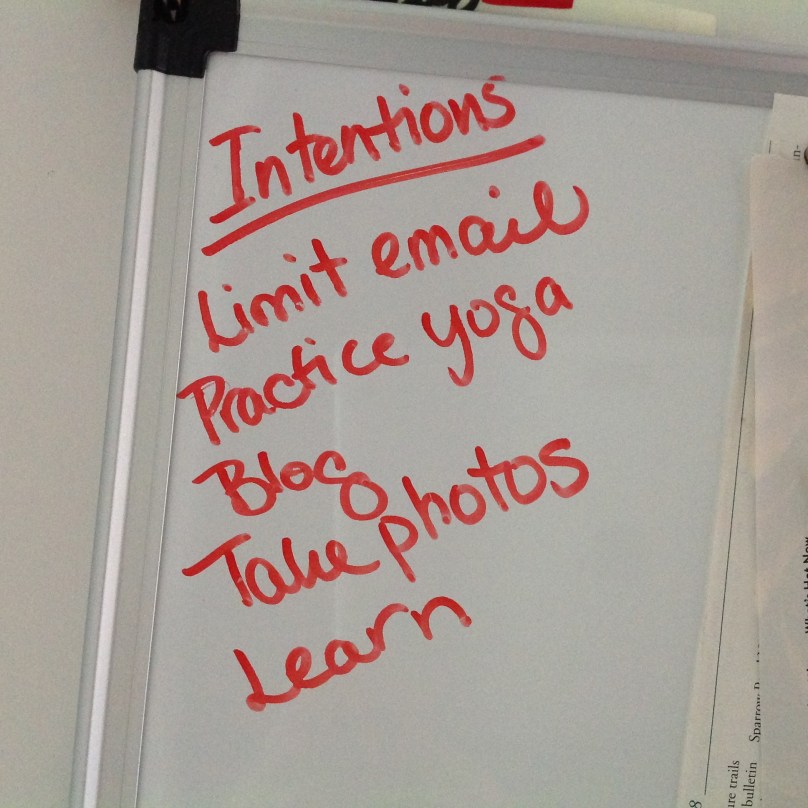
I had been neglecting my yoga practice at home. In addition, I needed to spend some time learning how to use my new camera and updating my continuing education credits, as well as this blog. But it turned out to be many days before I could focus on the more mentally-tasking intentions.

On my first morning, I went to a yoga class and felt some of the stress begin to lift. On my second morning, I began a week of going out with other volunteers to monitor sea turtle nests on the beach. Each day at sunrise when we would begin our walk down the beach, a feeling of complete well-being would come over me and I would utterly relax. When we released some straggler baby turtles near the ocean one day, and people gathered to cheer them on as they made their way, I was filled with gratitude to be part of something so simple yet so much bigger than myself.

OLYMPUS DIGITAL CAMERA

The remainder of my first four or five days was spent reading books. I couldn’t seem to bring myself to do much more than that. Overcast weather justified my couch potato tendencies a bit, but if I’m honest I admit that I just didn’t have the energy or interest to do more than that. I finished three books in rapid succession, and would have read more if they had been available. Other people’s stories have always felt like a refuge for me when I needed one.

IMG_2189

By the fifth day, the sun came out, and with it my readiness to be “on vacation.” I finally felt like I could enjoy the recreation part of my stay — the swimming, boating, biking and other fun. I took my camera out and experimented with its different settings. I spent the hot part of one afternoon doing an online class to fulfill my CE requirement. I went kayaking with my husband, and enjoyed that wonderful feeling of physical tiredness that comes from exertion. It was such a welcome change from the mental and emotional exhaustion I was feeling a few days earlier.

Thich Nhat Hanh says that,

The purpose of a vacation is to have the time to rest. But many of us, even when we go on vacation, don’t know how to rest. We may even come back more tired than before we left.

I feel lucky that I had enough time to give myself both that respite and a vacation. But what I learned is that I need to build in more respites for myself at home, and probably more boundaries to keep myself from getting to the point of so much stress. Time to set more intentions!
 

How colored chalk changed my brain

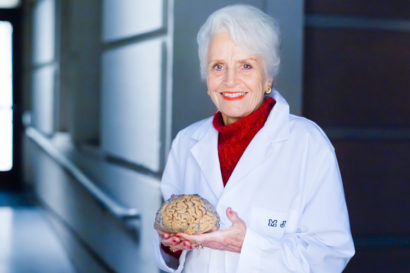
Marian Diamond is best known for studying Einstein’s brain, as well as her penchant for carrying around a hatbox with a human brain inside. But my memories of her revolve around the color-coded lectures she used to give in her anatomy class at U-C Berkeley. Before we had PowerPoint, we had Marian Diamond and her colored chalk.

We would arrive in the lecture hall and find the chalkboard covered with an outline of the day’s class, complete with drawings of anatomical structures. Several different colors of chalk were used to separate parts of the lecture or demonstrate various pathways. I never knew exactly what I would see when I walked in, only that I would be mesmerized for the entire class period by the clarity of her presentation and her dynamic teaching style. Of all the professors I had in college, she is one of only two or three whose classes I vividly remember.Diamond-Zhukova750-410x273

So when I heard that Dr. Diamond died last week, at the age of 90, I was sad for only a moment, and then I smiled, thinking back to that Berkeley lecture hall. Marian Diamond was an expert in brain development, and I realize now that she wasn’t just teaching us about the anatomy of the brain, but actually changing our brains too. She was one of the first scientists to demonstrate neuroplasticity and to test theories of how the right stimulation can promote brain development at any age.

In the introduction to her book, “Magic Trees of the Mind,” Diamond wrote that “The brain, with its complex architecture and limitless potential, is a highly plastic, constantly changing entity that is powerfully shaped by our experiences in childhood and throughout life.” She believed, and showed, that nurture is every bit as important as nature in determining how our lives turn out.

Back when I was in Marian Diamond’s class, I was contemplating a career in nursing, but unprepared for the competitiveness of Cal pre-med students. My laid-back studying habits weren’t a good match for the tough courses I was taking, and I ultimately switched majors. Little did I know that many years later I would go into the field of health education. Now I rely on Diamond’s work all the time in the courses I teach on stress management.

The critical factors in nurturing healthy brain development, according to Marian Diamond, are a healthy diet, physical exercise, being challenged, having new experiences, and being loved – especially love in the form of touch. In studies of rats, she showed that those living in an enriched environment had thicker cerebral cortices, the biggest part of the brain and the one most important for attention, memory and learning. She also learned that rats who were held and petted every day lived longer than others. While much of her work focused on children’s brain development, especially the negative effects of growing up in impoverished environments, she also realized that we retain the capacity for growth throughout life. As she wrote,

“Perhaps the single most valuable piece of information learned from all our studies is that structural differences can be detected in the cerebral cortices of animals exposed at any age to different levels of stimulation in the environment.”

People know this already, even if they don’t know anything about science. A Gallup survey several years ago showed that “learning something new” was one of the biggest predictors for whether someone thinks they had a good day. We’re bored if we’re not challenged, and we languish if we’re not loved. We know we feel better if we eat healthy food, and think better when exercise gets blood flowing to the brain.

Daniel Defoe wrote that, “The soul is placed in the body like a rough diamond, and must be polished, or the luster of it will never appear.” What we learned from the diamond that was Marian is that the brain needs its own share of polishing and nourishment for us to lead a rich, fulfilling life.


Why you need to declare independence

We observed Independence Day all over America yesterday, celebrating our freedom as a country. Yet, as individuals, we still put ourselves in chains a lot of the time. We imprison ourselves with judgment, and with the dreaded “should, ought and must.”

As often happens, I started thinking about this in a yoga class. One day last week, a teacher said, “Allow your eyes to close,” which is typical language in yoga class. But the use of the word “allow” got me thinking. Then I heard a teacher say, “Give yourself permission to….” Hmm – I was starting to see a pattern. It didn’t seem like the words were meant just to let us know that we had a choice; it seemed more like the words were an acknowledgment that we don’t often let ourselves relax, or choose to do less than we are capable of.Woman Closing Eye

At another point, the teacher asked us to do tree pose, which involves resting one foot against the opposite leg while balancing on the other foot. Usually people will use a hand to assist them in getting the foot high up on the inner thigh of the other leg; but this time the teacher asked us not to use our hands, even if that meant that we wouldn’t be able to get the foot as high. It was interesting to me to watch as some in the class couldn’t seem to bring themselves to “settle” for the foot just resting against the ankle or calf — they had to use their hands to bring the foot as high as possible. They just couldn’t allow themselves to do less than their max.

Thich Nhat Hanh writes that the two parts of Buddhist meditation are stopping, and looking deeply. It’s the stopping that’s the hurdle, because once we can do that, the looking deeply will naturally follow. But as he says, “If you’re like most of us, since you’ve been born, you’ve been running. Now it’s a strong habit that many generations of your ancestors also had before you and transmitted to you — the habit of running, being tense, and being carried away by many things, so that your mind is not totally, deeply, peacefully in the present moment.”

The constant running can lead to “wrong perceptions,” including the self-judgment that results in constant striving.  For some of us, the constant striving comes from the mistaken belief that we have to be the best at everything we do — the best in our professional lives, the best parent, the best athlete, the best host, and yes, the best in yoga class. But why? If there is one, or maybe two or three, area of life where we really give 110% to be our best, why can’t we just let ourselves be…okay at some of the other things?

In their book, “Five Good Minutes,” Jeff Brantley and Wendy Millstine have a practice called, “Retire the judges in your mind.” It’s all about letting go of the self-judgment and self-criticism. They suggest that while you are sitting quietly, and with that intention, that you notice the judgmental thoughts and say, “Thank you, you may or  may not be true, but thank you anyway.”Brisbane_85

If you stop striving for a moment, and let that foot rest a little lower on the leg in tree pose, maybe you’ll notice something about tree that you couldn’t see when you were using so much effort. Maybe stopping and looking deeply for a moment allows you to grow your tree differently the next time you do it. Thich Nhat Hanh compares the release of tension that comes from letting go with soaking mung beans: “You don’t need to force the water to enter the mung bean. You let the mung bean be in the water, and slowly, slowly it goes in….The same is true for you.”

Here’s a radical thought — sometimes maybe we should do less in order to do more. So declare your independence from the tyranny of “I must,” “I should” and “I have to.” Allow your eyes to close, give yourself permission to stop, take whatever it is you need.


5 Ways to take a Vacation Day right now

In Washington, some of the bars opened early yesterday so that people could come and drink while watching James Comey’s testimony before the Senate Intelligence Committee. All around the country people took the day off from work so that they could stay riveted to the TV. It’s a crazy world when this is how we’re spending our days off!

Instead of sitting on a barstool, however, I turned to my “52 Lists Project” journal for inspiration and distraction (although I confess to a few sneak peeks at the testimony). List #22 asks us to think of favorite places we have been and what made them so appealing. But that’s not the end — the next step is to think of places in our communities that could “transport” us the same way. In other words, can we bring the vacation experience to our everyday lives? Can we transport ourselves for a little while away from all the chaos of recent times?

When I list my favorite vacations, in places like Croatia, Hawaii, Seattle, Yosemite or Australia, here are some of the characteristics that pop out:

  • Simplicity
  • Scenic drives
  • Grandeur
  • Friendly people
  • Fresh food
  • Connections to the past
  • Bringing the outdoors in

How do I replicate that at home?

1. Simplicity & fresh food:

IMG_0172

When I visited Croatia, I was impressed by the beautiful national parks, the simplicity of people’s lifestyles, the ability to eat a meal where every bite of food came from the farm we were on. Here at home the next best thing is to make a meal based on what comes from the farmer’s market or my yard:

IMG_2332

2. Bringing the outdoors in:

Poipu Beach Park

In Hawaii, the thing I liked best was the way the boundary between indoors and outdoors was so blurred. Nearly everyplace I went was open to the outside; there wasn’t a big reliance on artificial air conditioning.  This is hard to achieve during summer in DC, but I could spend more time on the roof of my building, eat at more outdoor restaurants, and open my windows when the temperature allows:

2017-06-09 11.46.10

3. Grandeur. I haven’t been to Yosemite in years, but the grandeur of the park is something one can never forget. Its sheer rock faces, memorialized by Ansel Adams and countless photographers since him, are familiar even to people who haven’t been there. It’s a place that is just jaw-dropping in all seasons. What my area offers:

Great Falls_3Great Falls Park – the rocky passage of the Potomac down the Mather Gorge, accessible by way of the Olmsted Island bridges, provides a pretty awe-inspiring outing that I never tire of.

IMG_2318The monuments, while man-made, have a whole lot of grandeur about them.

4. Connections to the past:Rome - Colosseum, Forum, Palatine (12)In America, we can’t compete with the Greeks or Romans on the ancient past, but we do have the advantage of recent history here in Washington:
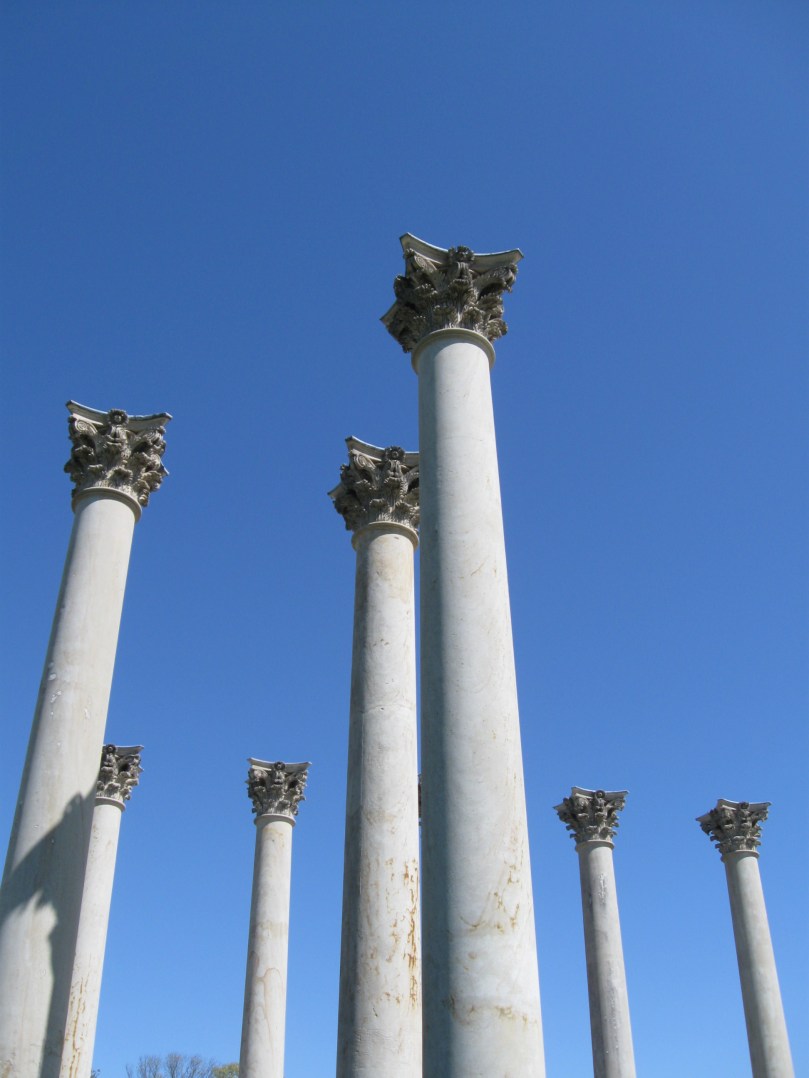
Arboretum_20120407_13The original columns from the U.S. Capitol can be seen at the National Arboretum.  The way they rise up out of nothing, in the middle of a huge expanse of green, is spectacular.

5. Scenic drives:

Great Ocean Road_226In both Ireland and Australia, I took breathtaking drives along coastal roads. That’s tougher to replicate here where we’re inland, but how about the cherry blossoms in spring:


Cherry Blossoms (2)

In some ways, this prompt is very much like a values exercise we do in stress management. It asks you to imagine your perfect day and what it would include, then compare it to your typical day. How alike are they? Is there a way to make more days perfect, by incorporating more of what you value?

The columnist Earl Wilson once said that, “A vacation is what you take when you can no longer take what you’ve been taking.” As much as we might value watching important Senate testimony, a steady diet of it isn’t good for anyone. If you can’t take it anymore, perhaps it’s time to take a real vacation day.


Listen well to those still, small voices

Sometimes in yoga class I hear voices in my head. No, I’m not losing my mind – rather, I keep being reminded of lessons I’ve absorbed from my teachers over the years, both the ones I loved and the ones I didn’t. Their “voices” trigger muscle memory, but also something more – a deeply ingrained wisdom.

We’re nearing the end of the traditional school year; my semester of teaching is already over. I often whether my  students have taken anything away with them from our short time together. Sometimes I tell them straight out what I hope they will remember: pay attention, don’t lose sight of your strengths, remember to breathe. But once they’re gone from my sphere, what do they recall? Have I given them anything that serves them in their future?

Current pedagogy tells us that teachers talk too much, that if students are really going to learn and internalize concepts, they need to be the ones generating the ideas and doing more of the talking. But it takes a special kind of teacher to pose the right questions, the challenging statements, or even the metaphors that prompt students to think critically and come up with valuable ideas.

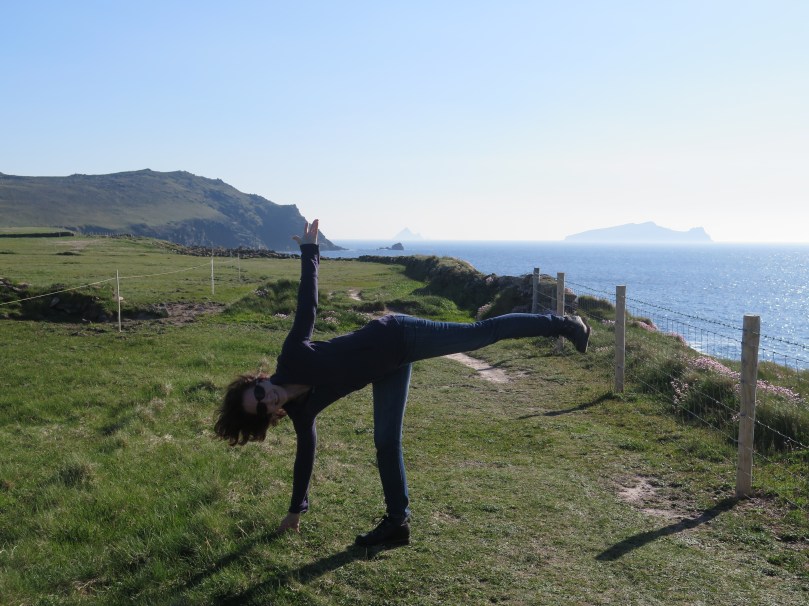
When we take the responsibility for our own learning, it doesn’t necessarily matter if  what we hear from one teacher contradicts what we were told by another. This happens sometimes in yoga class. One teacher will instruct that the position of the feet be just so for a certain posture; another will say something different. Or one will say the hand should rest just here, another will say no, it shouldn’t. That used to annoy me, now it just makes me smile, because I know I can count on the wisdom of my body to position feet, hands or whatever just where I need them to be. At the same time, I’m still hearing the voices of teachers saying things like “Don’t collapse into the posture,” or “Imagine that your shoulder blades are the temple doors,” and their whispers tell me what adjustments I need to make in that moment.3-Co. Kerry-Slea Head loop (35)

Most of us talk too much, and listen not nearly enough. What if we were to see ourselves as being both teachers and students, simultaneously? Instead of passively taking in information, students also need to be able share and teach it, but they need tools and the right environment for that shift to happen. Otherwise the wisdom – whether it’s the teacher’s voice or our own — doesn’t stick. My younger sister, who just received her doctorate in education, has mastered the creation of that kind of environment. It doesn’t matter whether she is sitting with a class of sixth graders or with a group of adult learners — she raises everyone up by the respect she shows them and the joy she brings to the process. She perfectly embodies the concept of taking your work very seriously, but not taking yourself too seriously. She is humble enough to know that she has as much to learn from the sixth graders as from her professors.

Last week, my sister shared a reflective practice on her professional blog that came out of a course for educators. The first two questions of it could (and perhaps should) be used by anyone who aspires to be a lifelong learner:

What have you learned this week?

How have you learned this week?

Her point is that to incorporate learning into practice, we need reflection. We have to be able to articulate not only what we learned, but how we learned it. Whether that’s kinetically, through practicing postures in yoga, or through the use of a metaphor, like the temple doors, reflection on the process reinforces learning and stores those voices in memory.

A couple of years ago, I heard from a former student unexpectedly. He wasn’t a particularly stellar student, nor had I been that close to him. It had been at least a year, maybe more, since he was in my class. But he emailed me to say that he was using the breathing techniques that he learned in my class and they were really helping him. I guess he was hearing voices too.


Dreaming & scheming together

I was nearing my seventeenth birthday before I slept in a room without one of my sisters. I’ve always thought those years of close contact had something to do with my need for a lot of “alone” time now. As Joseph Campbell said, we all need “a sacred space,” even just a corner of a room, where “you can experience and bring forth what you are and what you might be.” And yet, my memories of the rooms I shared resonate so much more vividly than those I had to myself.

The Patient Voice Project at the University of Iowa (an expressive writing project for people who are ill) often assigns participants to write about their childhood bedrooms. After all, it’s a topic that virtually everyone can write about, and it offers a “way in” to the practice of expressive writing. Telling stories through expressive writing often changes the experience and shows us the way forward.

We lived first in a small duplex house built in 1924. The presence of my older sister, born only 16 months before, hovered over me. We napped together, played together, and shared everything. Shortly after our third sister was born (just  shy of two years after me) we moved to a “bigger” house, about 1000 square feet, but with three bedrooms. Most of my memories begin  there.

The musician Robert Smith says that he still goes back to his parents’ house so that he can just sit in his childhood bedroom and “feel small.” When I think about the shared rooms of my childhood, small is the operative word. We felt small and so we played small games and dreamed small dreams in those rooms.

Little golden bookMy older sister and I like to tell people how we constructed paths around our room with our collection of Little Golden Books. I have no idea how many books we actually had, but at the time, it seemed liked hundreds. Since they were all the same size, we could line them up and turn them into roads. While we were supposed to be napping, somehow we were developing a sense that we needed to have a path to somewhere else.


Role-playing the life of the adults we knew was another pastime in our room. Our mother went every week to have her hair done, so we decided to do it too. My sister (being the bossy one) decided to take the part of hairdresser, so it fell to me to have my hair “done.” She cut my hair with preschool scissors, we stuffed the shorn locks into a shoe box and thought no one would notice. I don’t recall feeling any remorse or regret, even after we were found out.

2017-04-19 15.55.37
After the haircut

For many years, the three of us shared a room with Sleeping Beauty cut-outs on the wall where we created our own fantasy lives. We had to go to bed when it was still light outside and other kids were playing in the streets, so we played “house” in our beds. By carefully turning down the covers (bedspread, blanket, sheet) to different intervals, we could delineate three different rooms atop the bed. There, we would each play-out grown-up life in our own “home.” Invariably, we ended up making too much noise and bringing down the wrath of our very real parents.

By high school, of course, our world had expanded, and the bedroom was no longer our playground. My older sister and I got a “new”, wood-paneled bedroom when my dad finished the basement of the house, but we fought like cats and dogs over the space. My sharpest memory of that time is when I divided our room by building a wall between our beds out of my shoe boxes. (Even then, I loved shoes!) We had gone from building roads to building walls, and I couldn’t wait for her to go off to college and leave me with a room of my own.

The funny thing is that I don’t remember much from the time when I had the room to myself. Sarah Susanka has written that, “We are all searching for home, but we are trying to find it by building more rooms and more space,” instead of thinking about the essence of what makes the spaces feel like home. Without someone to share it and fight over it, the room lost some its luster. There’s a line in the Beach Boys’ song, “In My Room,” that goes, “Do my dreaming and my scheming lie awake and pray…” I think I must have sensed that so much of the dreaming, scheming and praying had been a shared experience, that it was the people, not the place, that were important to me.

.

Do you believe in miracles?

“We need to recognize that there is no age at which we lose our ability to be miracle workers,” writes  Darren Main in “Spiritual Journeys Along the Yellow Brick Road.”  Leave your comfort zone, he says, take risks and rediscover a sense of creativity and exploration – because in doing so, you can accomplish great things.

IMG_0086Are you feeling like it might take a miracle to get through the next four years? Do you doubt how much control you have over what happens to you? If so, it might be a good time to take stock of your physical, emotional and psychological “bank account”. What resources do you have and how can you best put them to use?
It is widely recognized that resilient people are more able to recover quickly from stressful events, and to utilize a variety of coping skills and strengths in doing so. Resilient people have generally built up these resources ahead of time (i.e. the bank account) by engaging in practices that enhance their physical and psychological well-being.  So when tough times hit, they have a more positive view of themselves, can make plans, and are clear-eyed about what’s needed. Most importantly, resilient people tend to have what’s called an internal locus of control.

Locus of control is a term that refers to the degree to which individuals believe that they can control the events that affect them. Are outcomes based on your ability and effort, or are they the result of outside forces and luck? If you believe that you can control yourself and influence the world around you, you are said to have an internal locus of control. If, on the other hand, you think that everything is decided outside of your control, and many events are just fated to happen, you probably have an external locus of control. While most people don’t fall at one extreme or another, we do have tendencies in one direction.

People who have a high internal locus of control tend to be happier, less depressed, and to suffer less stress. People who have a higher external locus of control often don’t seek solutions for problems because they don’t believe they can effect any change. It is possible to develop a more internal locus of control, however, by monitoring your self-talk. Check to see if you are speaking in absolutes (never, always, must, have to), and try substituting other words. Instead of saying, “I can’t”, say “I won’t” or “I choose not to”. The important thing is to remind yourself that you do have choices.

The more you can leave your comfort zone and have some success making small changes, the more you will believe in your capabilities, and the greater sense of agency you will have. Or, as Jon Kabat-Zinn puts it, “Your confidence in your ability to grow influences your ability to grow.”

This is more important than ever for people who are unhappy about the direction of the new U.S. administration. During a recent talk at American University, DeRay Mckesson of the Black Lives Matter movement said that progressive activists need to do more than just oppose everything for the next four years. They need to be creative, ambitious, and to “fight for real things, too, in this moment.  I worry sometimes because I’ve seen people get so defeated that they forget to dream about what the world can be.”

Miracle workers are the resilient, dedicated people who leave their comfort zones every day to dream and enact what the world can be. They are the teachers who show their students how to be critical thinkers. They are the people I volunteer with, who provide food, clothing and opportunity (with dignity) to those who need a helping hand. They are the lawyers who went to airports to represent immigrants. They are the women who are deciding to run for office in their local communities.

Amelia Earhart once said that, “The most difficult thing is the decision to act, the rest is merely tenacity.” We can all be miracle workers if we set aside fear, make the decision to act, and fight for real, positive change.

083


How do we define our values after an election that tested them?

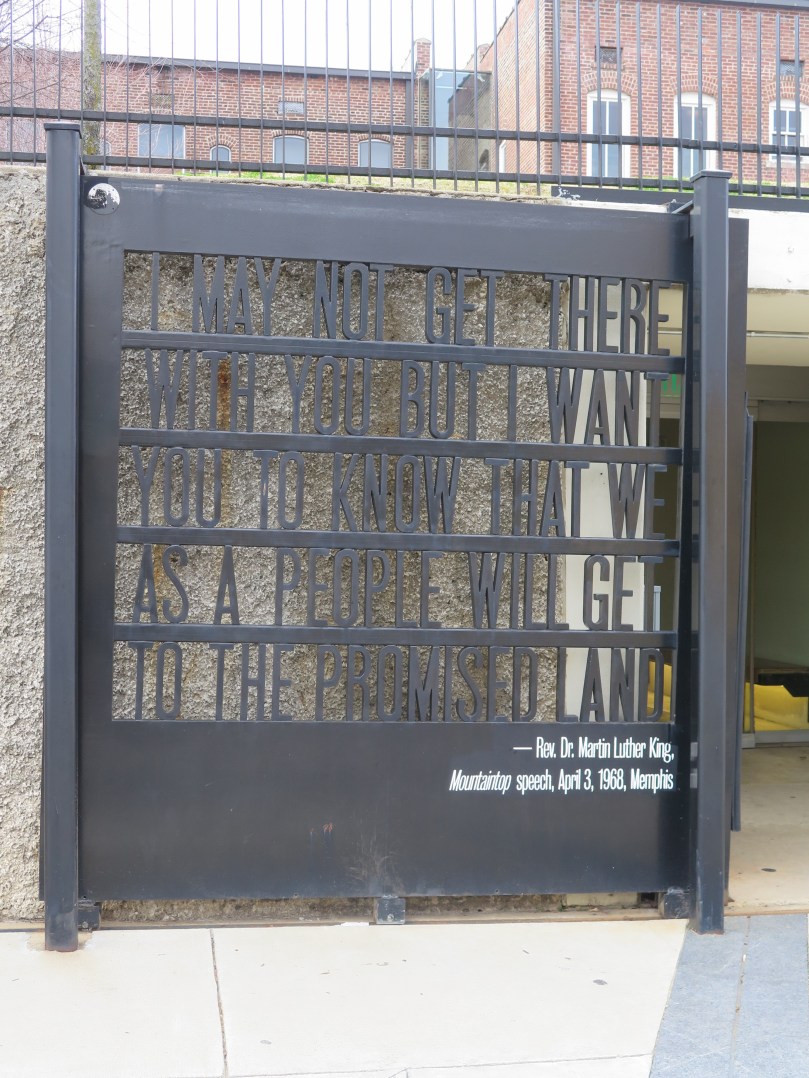
It’s been hard not to think a lot about values during these days following the election. Martin Luther King Jr. wrote that “If we are to go forward, we must go back and rediscover those precious values…all reality hinges on moral foundations…” With those moral foundations so profoundly shaken, can Americans still believe in shared values?

Difficult times test people’s values, and the election proved to be one of those times. Many of us trusted that shared values of love, respect, kindness and honesty would guide people’s decisions. But as I wrote several weeks ago, people often vote with their toddler brains, not their adult brains. Competing values, or alternative interpretations of values, prevailed.

Values can be organized a couple of different ways. We can talk about core vs. satellite values, with core values being the ones you are most strongly attached to, the ones you would fight or die for; and satellite values being ones that are more loosely held and amenable to change. We can also define values as being either instrumental or terminal. Instrumental values are those personal characteristics and traits that guide us, such as honesty and courage, while terminal values are those related to goals or outcomes like having a job that will allow you to support your family.picture1

People’s core values usually don’t change much over time; they are central to who you are. But what if you have to choose between upholding one or another of your core values? Then what? That collection of core principles must be subject to some sort of hierarchy of importance. Is having enough money more important than religion? Some people make that choice when deciding whether to work on the sabbath. Is spending time with your family more highly valued than your career? Many of us have to make that choice.

In much the same way, if we look at values using the instrumental/terminal construct, there might come a time when you perceive that a choice is necessary between upholding an instrumental value, such as respect for others or yourself, and a terminal value, such as getting the job you want.

What do we do when we are tested like that? I could say that I would never sacrifice my core values of respect for others, belief in religious freedom, and teaching our children  loving kindness — no matter which other core value was at risk. But perhaps not everyone feels they have that luxury. Or maybe they just see it through a different lens.

When they cast their votes, did people think that they could temporarily set aside the values of respect, knowledge, inclusiveness and truth, and get them back later? Did they realize that they were making that trade-off for only a promise of something better, not a guarantee? What happens when we are tested again?

This might be a good time for all of us to consider the constitution. Not the U.S. Constitution, but our personal constitutions. A personal constitution is a written clarification of values, a way of identifying and prioritizing core and satellite values.  Your constitution can be just a paragraph that describes in your own words what you believe in and what it means to live by your values. That statement, says Stephen Covey, “becomes the criterion by which you measure everything else in your life.” It’s your guidebook for challenging times and moral tests.

If we are to go forward, we must go back and rediscover those precious values. Start with the constitution, your constitution. Let it be your foundation for the next four years and beyond.


Wouldn’t it be more pleasant to ask for nothing?

Sometimes I lose sight of the fact that the “Santosha” of my blog name means contentment. I write about the struggle to find contentment more than what it means to have it. The Roman Stoic philosopher Seneca said that “We never reflect how pleasant it is to ask for nothing.” Now I see that I’ve been asking for contentment more than discovering it right here.

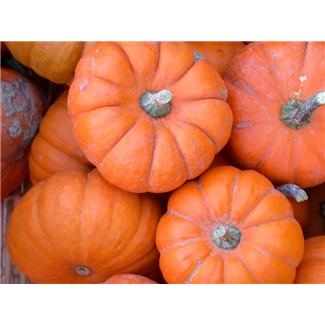
One of my favorite yoga teachers, Jo Tastula, says that we tend to focus a lot on what we want to receive, rather than what we want to let go of. She relates this to the season of Fall, and recommends that we consider the image of the tree dropping its leaves. What does that perspective look like? From up in the branches, perhaps it is a relief, or a comfort, to let go of what’s been weighing us down; to be bare and pared down to essentials. The fullness of Fall (imagine a nice round pumpkin or apple) gives way to completion (harvest, year-end). It’s a time to rest, to renew, and to strive less and prepare more.pumpkinsWhile Seneca has a somewhat mixed historical reputation, he is still considered to be one of the first great Western thinkers, and much of what he had to say about emotions is relevant to us today. When he said that “Contentment is achieved through a simple, unperturbed life,” he was talking not only about emotional regulation, but also gratitude, because contentment is impossible without feeling grateful for what we have already. Contentment requires us to stop asking for things, so that we can reflect on what is present. Thanksgiving_23

A recent episode of the comedy TV show “Blackish” demonstrated this idea in a gently humorous way. The main character, Andre, is upset to learn that his daughter is questioning her belief in God. But his own belief often consists of prayers that are requests  — asking God for some action or some thing that he thinks will make him happy. Later in the episode, after a moment of crisis for the family, he realizes the value of what he has and what he almost lost. Then his prayers change, and are about gratitude and thanks. In that moment, he stops striving, knowing that he has what is essential to him.

What would happen if you stopped striving for a while, maybe even shed some dead leaves? Perhaps you’d have time to nourish the truly important parts of your core. Or maybe just have time to breathe, and in that moment, discover santosha.

It seems to me that contentment is about satisfaction, and happiness is about satisfaction-plus. The plus is extra joy, extra pleasure. It’s like dessert at the end of the meal – it’s nice, but you don’t need to have it every day. I’m reminded of two books that I used to read to my kids when they were little. One was called “More, More, More, said the Baby”, and the other was titled “Just Enough is Plenty.” It’s nice to have more, but on many days, simply to be satisfied is enough, in fact it’s plenty.


Give up or let go? What’s the difference?

Why do we give up? Why do we surrender, admit defeat, part ways with somebody or something, or stop hoping for a positive outcome? Maybe it’s because sticking with it is too hard, or it takes too long, or because we’re tired of failing. Sometimes we decide that we’re just not strong enough to see something through, or we just don’t care enough.

That’s very different from letting go, at least in the Buddhist sense of letting go. Letting go means easing up on the tightness with which we hold onto people, things or ideas. It means relinquishing our hold on how we want things to be, and instead knowing that we have given our best effort and now we accept what happens. Thich Nhat Hanh has written:

…for many of us, even when we are most joyful, there is fear behind our joy…We are afraid of things outside of ourselves that we cannot control…We try to hold tight to the things we care about — our positions, our property, our loved ones. But holding tightly doesn’t ease our fear. Eventually, one day, we will have to let go of all of them.

Letting go can be a lot scarier than giving up. When you give up, you can stop thinking about the person, thing or  idea, and just eliminate it from your life. Letting go, on the other hand, means realizing that you don’t have control over everything, and you might have to live with and accept an outcome that is different than what you hoped for. You don’t stop caring when you let go of the outcome.

How can the feelings of caring very deeply about something, while at the same time having no control over it, co-exist? To Jon Kabat-Zinn, letting go is “allowing things to be as they are.” That means being a witness to one’s fears and insecurities, being fully aware of those feelings, and being able to live peacefully with them. How hard is that?!

Without a doubt, a really strong mindfulness practice is a good place to start the process of letting go: The practice of looking deeply inside and not being afraid of what arises, but rather noting it and letting it go by. But that’s not enough. We also have to be able, in that stillness, to move from worry and unease to comfort and joy. Not an easy task!

Thich Nhat Hanh suggests that instead of running from the present moment because of the difficulties we face there, we instead try to remember all the positive things in life, which usually are greater. Maybe it’s the smiling face of a loved one, a particular place that brings you peace, or some accomplishment of which you are proud. There is an exercise in a stress workbook that I have, which can help identify both the things in life that drain your energy (the difficulties and worries) as well as the things that fill you with energy and revitalize you. These are the things you want to bring attention to:

Drainers and Fillers

Once you go through this process of identifying what aspects of your life are either filling you with joy and energy, or sapping your strength, you can make decisions. There might actually be things on the left side (drainers) it would make sense to give up on. There will be others on which you’ll want to loosen your grip and try to live with more peacefully. The fillers will help you do that — you’ll remember who is there to support you, what brings you joy, and where you find meaning in your life. The fillers will provide the images you turn your thoughts to during meditation. They will help you remember the wide open space in front of you, and all of the possibility that exists beyond your fears.