The sun rises every day — you can too

When my kids were younger, if they had a bad day, I would often remind them, “Every day is a new day.” It sounds like a platitude, but I was trying to get across to them that we don’t have to be defined by our mistakes. We have the opportunity with each new morning to start fresh, set a new intention, smile and act differently than we did the day before.

That might seem daunting, but the capacity for reinvention is in all of us. This idea was brought into focus for me while reading Laura Bates’ book, “Shakespeare Saved My Life”. She has taught Shakespeare in prisons for many years, even to people in maximum security who have no chance of parole. Her star student, Larry Newton, was convicted as a teenager, and sentenced to life without parole or even the right to appeal. He had never attended school regularly past 5th grade, and had been in isolation for years because of behavioral incidents in prison. If all of that isn’t a reason for despair, I don’t know what is. Yet, after he was accepted into Bates’ program, he blossomed. He started examining his life and his choices, he read and studied voraciously, and he became a teacher of other inmates. Here is what he said after realizing that he had been faking it, not making his own choices, but just trying to impress others in his earlier life:

And as bad as that sounds, it was the most liberating thing I’d ever experienced because that meant that I had control of my life. I could be anybody I wanted to be. I didn’t have to be some fake guy that my buddies wanted me to be. When I started reading Shakespeare, I was still in segregation; that circumstance didn’t change. But I wasn’t miserable anymore. Why? The only thing that was different was the way that I saw myself. So the way that I felt about myself had to be the source of all my misery; we perpetuate our own misery. And that realization is empowering! So Shakespeare saved my life, both literally and figuratively. He freed me, genuinely freed me.

When the prisoner-students read and discuss Shakespeare, they frequently talk about prison as a metaphor, even though for them prison is real. But they can see that all of us put ourselves in prisons on a regular basis, when we trap ourselves in negative patterns of thought or irrational beliefs about ourselves. If a maximum security prisoner who will never get out can start looking at himself differently and more positively, shouldn’t we all be able to?sunrise2

Too many times, we become passive bystanders in our own lives, just letting circumstances drive us and other people define us. Yoga teacher Jo Tastula says that we need to be more aware that we are the creators of our own lives, and that our thoughts, our words, and our behavior set us on the path to what we make of it. When we are under stress, or experiencing a lot of negative emotions, it’s easy to veer off the path we want to be on. Somehow we can sense that things aren’t lining up right anymore, but we trap ourselves on that wrong path because we think there’s no way back.

That’s why paying attention to the cycles of nature can inspire us. Every day, the sun rises again. Every month, there’s a new moon. Every spring, the trees and flowers come back to life. These are reminders that change can happen over and over again; and they are opportunities to renew and reinvent ourselves. So tomorrow when the sun comes up, ask yourself: If a convicted murderer and prisoner for life can become a scholar-writer-teacher-mentor, what can you become today?

Splish, Splash

When are chores not really chores? When a spoonful of mindfulness is added, of course! While it’s not exactly front page news, a recent study out of Florida State University found that students who washed dishes mindfully — by focusing on sensations — experienced a reduction in nervousness and an increase in “mental inspiration”.

The researchers may themselves have been inspired  by Jon Kabat-Zinn, whose best selling “Wherever You Go, There You Are” included an essay on “Cleaning the Stove While Listening to Bobby McFerrin”. Kabat-Zinn wrote, “I can lose myself and find myself simultaneously while cleaning the kitchen stove…I get into the round and round or the back and forth, feeling the motion in my whole body.”Handwashing with salt 3

In fact, it is attending to the sensory experience that uplifts both washing dishes and cleaning the stove. We start to notice the smell of the soap, the soothing warmth of the water, the hard or soft surfaces being cleaned, and the sounds of scrubbing, scraping, and water running. If a jumble of sensations has been metaphorically going in one ear and out the other, mindfully cleaning offers the opportunity to stop and focus on each one separately.

Educator Maria Montessori once said that, “We cannot create observers by saying ‘observe’, but by giving them the power and the means for this observation and these means are procured through education of the senses.”

Just as the Montessori method of learning emphasizes exploring and manipulating things in the environment, our practice of mindfulness can also be enhanced by educating our senses, and manipulating them to discern the separate inputs. Our everyday lives provide many moments when we can practice this, but we can also benefit from designated exercises from time to time. Here is one from the book, “Sense Relaxation Below Your Mind””:

Hand Washing with Salt:

Close your eyes and wash your hands.

Take some ordinary table salt and rub it gently over the back and front of the hands. Do each of the fingers. Rinse, and feel the skin. After drying your hands, rub in some oil or cream.

Experience how your hands feel.

Handwashing with salt 4

For those of us who sometimes think that our sense of touch has been reduced to tap, swipe and pinch; our sense of hearing to beeps and buzzes; and our sense of sight to the glow of a retina display, practicing sensory awareness can restore and renew us. Become the observer, rather than the thinker, for a while. The means to do it are there if you choose to use them. So if a few weekend chores are hanging over your head today, consider them an opportunity to lose yourself  — and then find yourself anew.


Now what?

What do you with what you know, what you’ve learned, the gifts you have? Is having it all enough for you, or does meaning only accrue when you act on what you have? In “The Illuminations” by Andrew O’Hagan, one character says to another, “People who read books aren’t reading them properly if they stop with the books. You’ve got to go out eventually and test it all against reality.”

Several days ago, I went to a yoga workshop billed as “Yoga: The Advanced Practices”. Now that title might make you think that I’m someone who can do a headstand with ease, or twist my leg around neck, or any number of other challenging yoga postures, but nothing could be farther from the truth. And, in fact, the workshop’s “advanced practices” weren’t about asana (physical postures) at all. They were about the real “meat” of yoga — pranayama (breathwork) and meditation. We spent only about 40 minutes of the three hours doing asana.

Why do the other practices matter so much more? As our teacher, Greg, said, they provide the answer to the question, “Now what?” As in, “I’ve mastered a handstand. Now what?” Or, “I’ll never master a handstand. Now what?” Breath and meditation give you the space, the way, to take the yoga off the mat and into the world. As you grow in emotional awareness and focus, they help you be the person who can give back to the community, who can be the better spouse, the better friend, the better parent.

The very next day after the yoga workshop happened to be the Jewish holiday of Rosh Hashanah. As I was reading through the prayerbook, I came across this meditation: “Why be concerned with meaning? Why not be content with satisfaction of desires and needs? The vital drives of food, sex and power…are as characteristic of animals as they are of us. Being human is a characteristic of a being who faces the question: After satisfaction, what?

Now what?

The world we see reflects who we are. Sometimes we need to correct our course or re-affirm our best qualities and intentions so that they are manifested in that reflection. Any kind of meditation helps us do that, as does the meditative practice of affirmative writing, part of the “Writing to Heal” program. Affirmative writing can crystallize values and create a vision for one’s life; it helps us identify our gifts and be grateful for them; and it can be a guide to living a life where you flourish and grow.

So take paper and pen, find somewhere to sit quietly, and answer these questions in writing (resist the urge to self-edit):

  1. What are your gifts? You best qualities, what you offer to others?
  2. What gift do you feel is ready to emerge, evolve or resurface?
  3. How have you denied or hidden any gift in the past?
  4. How is your life and others impacted when you withhold your gift?
  5. How might your life and others be impacted if you offered your gift?
  6. What might living with this gift look like and feel like?
  7. What support from others do you need to develop your gift?
  8. What does your gift need from you?

Naming your gifts, and thinking about how others are impacted when you offer them, is a powerful way to answer the question, “Now what?” When I did this exercise, and I responded to question 6, how would living this gift look and feel, the words I wrote were, “spacious, exciting, vibrant.”

An authentic life is an examined life. Living with questions like these can sometimes make us uncomfortable. But eventually, if we want the answer to “now what?” we’ve got to go out and test the answers against reality.

Is resiliency the most important skill schools should teach?

Going back to school every September evoked feelings in me that were a mix of anticipation and trepidation. There was the excitement that surrounded the newness of it all – new books, new clothes, new teachers, new learning – as well as the fear associated with the certainty that it would all soon become a slog of homework, pressure to get good grades, and conflicts with friends. The college students I teach are no different. After approaching the fall semester with optimism, by spring all five sections of our stress management course are usually full.

Back to school doesn’t have to mean back to stress, though. Or at least not back to overwhelming stress. There are tools we can pass on to kids that will make a significant difference in how equipped they are to handle the challenges of their young lives – tools that will improve their resiliency in both the short and long term.

A 2014 survey by the American Psychological Association showed that teens report more stress than any other age group, stress that is primarily due to financial insecurity, as well as conflict at home and with peers. Those higher stress levels are not benign – they can result in both physical and psychological symptoms, poor performance in school and the inability to make healthy lifestyle choices. But teaching teens appropriate self-care skills can mitigate the stress.

The Benson-Henry Institute recently reported on such a curriculum that they brought to Boston-area high school students. Over a 6-8 week period, the students were taught about the science of stress and relaxation, learned how to reframe thoughts and attitudes, and practiced meditation and mindfulness skills. Those who received the curriculum reported significant drops in perceived stress and anxiety, as well as higher productivity. The results also held up over time – one year later, the students still demonstrated a greater ability to manage stress, as well as the ability to make healthy choices in their lives.

The resiliency program taught to them included the same things that are good for all of us: How to use breathing, mindfulness and imagery to work through tough challenges, how to change our negative self-talk into positive statements, and how our healthy choices bolster us during times of stress. If all goes well, when these kids get to college a stress management course will just be a refresher for them, not a starting point.

Each of the skills they learned – meditation, mindfulness, and reframing — does something different. As Jon Kabat-Zinn writes, “Meditation is neither shutting things out nor off. It is seeing things clearly, and deliberately positioning yourself differently in relationship to them.” Meditation creates a shift in perspective, allowing us to live with emotions that are both positive and negative, to really see ourselves and others with blinders off.

Mindfulness helps us foster our attentional capabilities, and to bring greater awareness to our interactions, our work and the world around us. While the Benson-Henry researchers still want to look at which skills have the most effect, and for which stressors, my guess is that the mindfulness practices are probably connected to improved relationships and better academic work.

The third skill, reframing thoughts to be more positive, helps students understand that stress comes mostly from within, and that they can take charge of their thoughts with practice. Every single negative thought that crosses our minds can be substituted with a more accurate or positive alternative. Storyteller and artist Ilan Shamir has a book, Simple Wisdom, that is subtitled “A Thousand Things Went Right Today!” What if we simply stopped a few times each day and listed just 10 of those things that went right so far? I’m certain we would all immediately experience at least a slight shift to a more positive pole.

Actor Will Smith once said that, “The things that have been most valuable to me I did not learn in school.” I don’t think he is alone in that. But maybe if teaching resiliency skills in school becomes the norm, kids will grow up believing that they learned something there that is extremely valuable and applicable to all of life’s challenges.

How to forgive, even if you can’t forget

Is it possible to forgive and forget? While a few lucky people seem able to embrace the idea as part of their “live and let live” philosophy, most of us have a tendency to hold on to hurt. For us the question becomes how to transform the experience enough to allow forgiveness.

Forgiving and forgetting have been on my mind since reading two different books dealing with love and war. In “The Buried Giant” by Kazuo Ishiguro, the Saxons and the Britons have been at peace with each other since the time of King Arthur – but the price of the peace has been a near-total erasure of their memories of the past. A spell was cast upon them, so they live almost entirely in the present, with only occasional fragments of memory appearing out of the mist. They have blessedly forgotten the massacres of their families during the war, but they have also nearly forgotten that they had children at all. To awake “the buried giant” means that memory will be restored and people will renew their quest for revenge.

The second book dealing with forgiveness and memory was “Half of a Yellow Sun” by Chimamanda Ngozi Adichie. The story involves two sisters who have had a falling-out because of an infidelity, and are barely speaking to each other. But when the Biafran war breaks out, they are driven together for support amid the chaos, uncertainty and death around them. The wronged sister says to her sibling, “There are some things that are so unforgivable that they make other things easily forgivable.” The larger wrongs have helped her put her personal pain in perspective so that she can forgive her sister.

Psychologist Charlotte VanOyen Witvliet says that the act of forgiving doesn’t mean we literally forget what happened. Instead, “Forgiveness involves remembering graciously. The forgiver remembers the true though painful parts, but without the embellishment of angry adjectives and adverbs that stir up contempt.” Remembering graciously may mean re-telling the story of the painful event. If we strip the story of the angry words, what are we left with?

The message of “The Buried Giant” was that remembering graciously is impossible, that reconciliation is not an option, whereas “Half of a Yellow Sun” held it out as a possibility. In writing about reconciliation, Thich Nhat Hanh says that you must “begin to see that your enemy is suffering,” and while we sometimes “need indignation in order to act…the world does not lack people willing to throw themselves into action. What we need are people who are capable of loving…”IMG_2325

Forgiveness holds significant benefits for the person who extends it. When we let go of the angry narrative and negative emotions, blood pressure drops, the immune system gets a boost and we have fewer circulating stress hormones. Forgiveness heals us from the emotional pain that attaches itself to the constant replaying of a painful event. If you can stop the loop and retell the story, you don’t need to have your memory wiped clean in order to come to terms with the pain of the past. But that doesn’t mean forgiveness is easy either.

WebMD has some useful strategies for cultivating forgiveness, including practicing gratitude, using meditation and breathing to quell anger, and cognitive reframing (retelling the story). But they also make it clear that the first step in forgiveness is giving up the desire for revenge, and sometimes that is as far as someone can go. If one is able to move on from there, emotional forgiveness involves replacing emotions like anger, hatred, resentment and bitterness with empathy, compassion and love. Forgiveness becomes something that we have to commit to and maintain on a daily basis, much like sobriety.

Ultimately, emotional forgiveness means that you can begin to “see” the story of the person who hurt you. To do that it’s useful to remember one of my favorite quotes from Plato: “Be kind, for everyone you meet is fighting a harder battle.”

Savoring a sunny day

What do you want your day to feel like? The question isn’t what do you have to do today, or what do you want to accomplish today — but how do you want it to feel as you are going about it? What emotion or sensation do you want as an evocation of your day?

I want my day to feel like sunshine.

How did I choose sunshine? I started my day with an on-line meditation from Amy Ippoliti. With a paper and pen nearby, the practice began with gratitude – what do you feel good about, grateful for, right now? The next few minutes were spent contemplating yesterday’s successes or positive moments. In each case, I meditated on the question, then wrote things down. And for the final step of the meditation, the question was, “What do you want your day to feel like?” Is it a feeling of joy, or fun, or ease?  Can you visualize it?

Sometimes when we’ve been going through a succession of bad days, or are under a lot of stress, it’s hard to remember that we can often choose how to feel, just as we can choose how to react. I know that’s true for me. A series of mishaps in my home, a lot of travel recently, and some new responsibilities have overwhelmed me at times. I focus on the negatives, let myself get carried away with anxiety, and forget that these are very, very small problems compared to what some people face.

So this morning I looked at my gratitude list. It included feelings about my children and the comfortable life I have. I thought about a letter I recently received from someone who referred to my son’s smile as “a little bit of sunshine.”

I considered everything that was positive about yesterday — the helpfulness of the people I dealt with, the fact that I felt in control of things instead of overwhelmed, the nice mid-day run that I had, and most of all, the beautiful, sunny, cloudless day that it was.

So when I got to the part about how do I want my day to feel today, there was no question that I wanted it to feel like sunshine. I wanted it to feel like that beautiful cloudless day, my son’s smile and being bathed in light.

The thing is, though, that not every day is sunny and cloud-free. Some days are overcast, both literally and spiritually. So how do we capture the sunshine on those days? How can we sustain the positive emotions from one day to the next, no matter what happens?

A recent study by Richard Davidson at the University of Wisconsin showed that some people are able to savor positive emotions longer, while in other people they subside quickly. The difference is related in part to the activation of the reward center in the brain. So capturing sunshine on a cloudy day depends on keeping that reward center more active.

There’s no question that doing so requires making a choice to focus on those positive emotions. It might be by meditating on lovingkindness or compassion, or by calling up memories of a time that felt especially joyful or comforting. In either case, the goal is to really drop back in to that feeling, so much so that you experience it all over again. The more you practice doing that, the easier it will be to get back to that baseline of positive emotion.

This 5-Finger Exercise* is good way to begin (spend 2 minutes on each part):

Touch your thumb to your index finger. Think about  time when your body felt healthy fatigue, such as after an exhilarating physical activity. Can you capture the feeling again now?

Touch your thumb to your middle finger. Think back to a time when you had a loving experience, perhaps a warm hug or an intimate moment with someone.

Touch your thumb to your ring finger. Now recall the nicest compliment you’ve ever received. Can you really accept it now? By accepting it, you are giving a gift to the person who said it to you.

Touch your thumb to your little finger. As you do so, go back to the most beautiful place you have ever been and dwell there for a while.


*The 5 Finger Exercise is adapted from one I was given. I’m sorry I do not know who developed it.


How to use a billion breaths

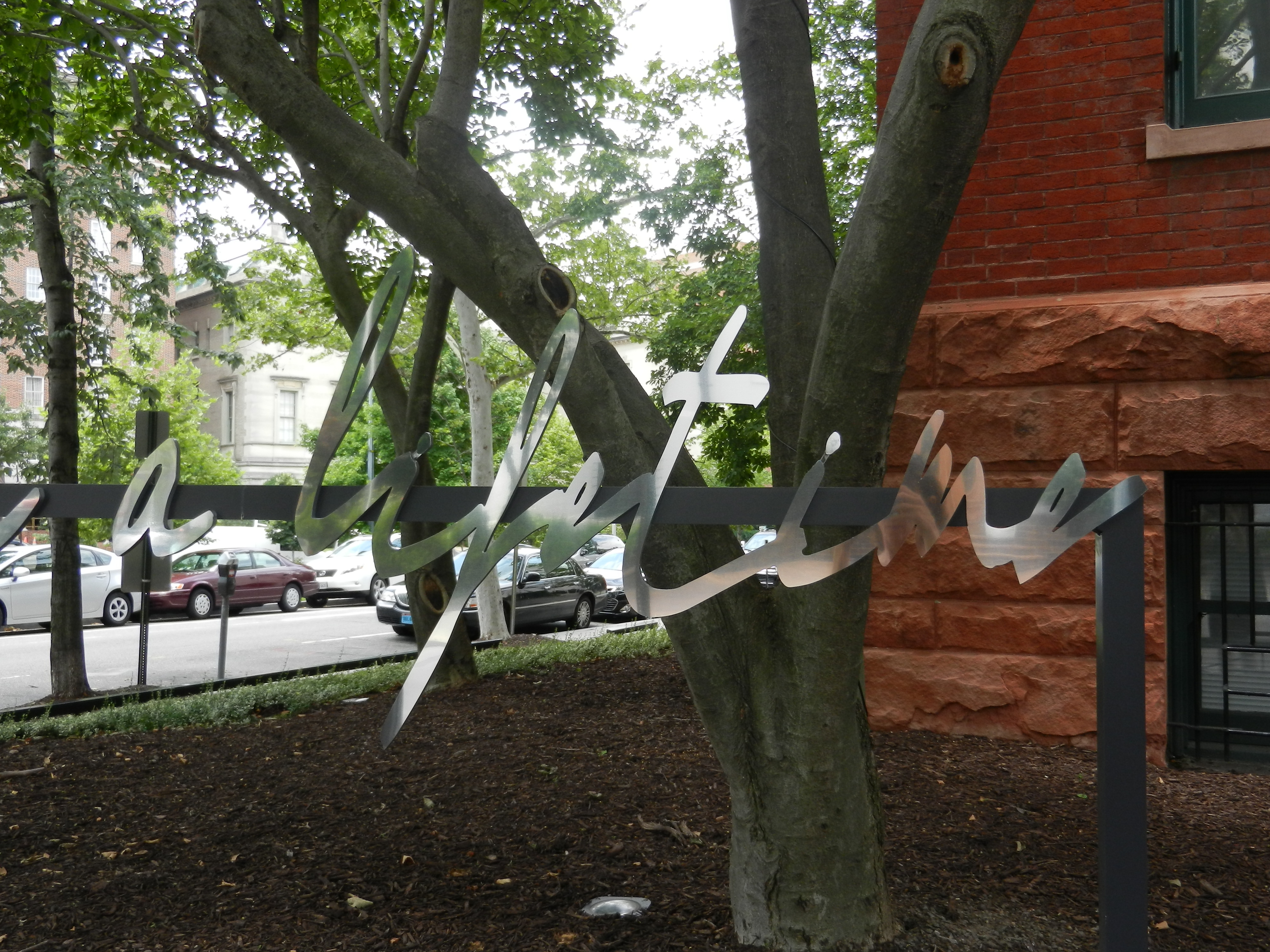
If there is an art to breathing, Jill O’Bryan has made a career of it. Since 2000, the NY artist has focused on a series of drawings based on capturing her own breaths over periods of time. Along the way, she has calculated that in a 97-year lifetime, she would breathe a billion breaths. To celebrate longevity and a life well-lived, she has created a piece that has been installed outside the Phillips Collection in Washington, D.C.DSCN3750

When you walk by “One Billion Breaths in a Lifetime,” you’re invited to complete the art by gazing at your own reflection in the polished chrome of the letters. Reflection, not just of your face, but of your life, feels called for. If we each have around a billion breaths, how will we use them?

Do you take a breath to say words of love, or to say words of hate?   Do you take a breath to whisper a secret or to shout a curse? To slow your heart or to fuel your passion?  The breath is something that we take for granted, and yet it is the first thing we wait to hear when a baby is born, and the last thing we look for when a person dies.

We can use our breaths in so many positive ways:

To sing a song

To laugh out loud

To whistle a tune

To blow bubbles with a child

To blow out candles on a cake

To blow a kiss to someone

To warm our hands

To say a prayer

To run a marathon

To release tension in the body

To ease our pain

To help us sleep

Yet much of the time modern life works against us, and we subconsciously inhibit our natural breathing rhythm. Our breaths are shallow and tense as we wait for traffic to move, or as we practice the angry words we are waiting to say to someone. Compare that tight feeling to the relaxation that occurs after you use your breath for a big, unrestrained belly laugh. When was the last time you laughed that way?

The breath is so important in the yogic tradition that we have an entire practice, pranayama, for learning how to control the breath, or life force. Focusing on the breath, especially to deepen it and slow it down, is the best way to get in touch with our autonomic nervous systems and to counter the effects of stress and anxiety. Because the breath links the body and mind, it can be useful at those times when body and mind are discordant. Thich Nhat Hanh suggests focusing on the in and out of breathing to bring them back together again: “Breathing in, I know that I am breathing in…Breathing out, I know that I am breathing out.” In, out, in, out, in, out – until the mind and body are unified and peaceful once again.

The idea of a billion also represents abundance, but we know all too well that something that is plentiful is often wasted. We even have an expression, “Don’t waste your breath,” and although it means something different, it’s good advice to follow. At 12-16 breaths per minute, even one billion breaths don’t last forever. We have no choice but to breathe — we cannot hold onto our breaths, or save them for some unknown future purpose. We can only soften our grip and choose each day how we will make the most of them.DSCN3754

Bending the arc of history

“Love wins, love wins,” went the chant in front of the U.S. Supreme Court this morning after the historic decision in support of gay marriage. I felt tremendously lucky to be there at that moment, with my sister, friends, and hundreds of other people whose lives and loves depended on the outcome. Even now, several hours later, I find it difficult not to tear up when I think about that emotional moment when the decision was announced.Supreme Court_28

Honore de Balzac wrote that, “The more one judges, the less one loves,” but today we took a huge stride toward acceptance of all people, toward judging a little less, and loving a lot more. This is truly a decision that will create acceptance and support for so many people in our communities, and will hurt no one. We all benefit by the extension of marriage to everyone.

Gratitude goes to the plaintiffs in the case whose personal stories spoke for so many others. They exemplified Maya Angelou’s words:

In the flush of love’s light, we dare to be brave. And suddenly we see that love costs all we are, and will ever be. Yet it is only love which sets us free.

Who would I be without my sisters?

At the end of each semester, I receive a packet of narrative comments that my students have submitted as part of the course evaluation. Leery as I sometimes am about reading them, they provide an opportunity to reflect on what works and what doesn’t, and how I can improve the course. One of the things that my students most appreciate is the opportunity to heal through writing, and easily the most valuable assignment to them is the letter of gratitude that I ask them to write. The gratitude letter doesn’t just say “thank you,” it is a full acknowledgement of what someone has done for you and an appreciation of what that gift means.

But while assigning the gratitude letter to my students year after year, I have only rarely written one myself. Reading their comments recently made me realize that I have a group of people to whom I owe tremendous gratitude:

To my sisters:

Thank you for being my first friends, for teaching me about loyalty, the importance of relationships, and how to care for others. With you, I never felt alone – someone was always a step ahead and a step behind, protecting me. Being with you was like being in a private club with its own secrets and rituals. I think that’s why I hated camp, dropped out of Girl Scouts and never wanted to live in a dorm. My sisters were, for the longest time, the only group I needed to be part of. Remember how, no matter how old we were, Dad always referred to us collectively as “you girls”?

Thank you for teaching me how to share, no matter how reluctantly. Thank you for giving me the freedom to be myself. I know I can still be my most authentic when I am with you. Yes, we judge, doubt and second-guess each other sometimes, but we also accept each other, no matter how many flaws. We have learned through each other’s mistakes, and we have made mistakes together.

OLYMPUS DIGITAL CAMERABrenda Shaughnessy has a poem called “Why I Wish I Had More Sisters”, where she writes, “I wish I had more sisters, enough to fight with and still have plenty more to confess to.” Over the years, we have fought and we have confessed; in fact we have experienced a full range of human emotion. When I was cruel to one of you, I learned shame. When one of you was cruel to me, I learned forgiveness. We have carried anger, jealousy and resentment with us at times, but also love, kindness and compassion.

I am never at a loss for conversation when I am with you. We can laugh and cry, celebrate and grieve, in equal measure. Shaughnessy writes, “None of us would be forced to be stronger than we could be.” We have proven this to be true over and over again, as we have gone through difficult times together. When one of is hurting, there is someone to hold her up. We don’t always understand each other, but we never give up on each other.

Finally, thank you for making my husband part of the family, for loving him and our children almost as much as your own. We are stronger as a family because of the support and safe space you have provided. There is a synergy to love that is shared.

You continue to inspire me, to be my collective North Star. You are smart, dedicated, curious, funny and accomplished women. You keep me honest, you force me to grow, and I love you for it. I don’t wish I had more sisters – I realize I have just enough.


Secrets to tightrope walking without a net

Why can one person walk with ease across a rope strung between two tall buildings, while another wobbles on a beam five times as wide? Why can one person meet life’s challenges with calmness and purpose, while the next person seems buffeted by the slightest turbulence? The difference may well be the quality of equanimity, “mental calmness, composure and evenness of temper, especially in a difficult situation.”

My own recent failures to maintain composure led me to reflect on my capacity for equanimity. I realize that when I am over-tired or surprised, or when dealing with phone or cable companies, I can sometimes completely lose any equanimity I possess. But at least I am noticing when it happens, which I believe is a step toward deepening my ability to stay calm.

Benjamin Franklin was well-known for developing his character through self-monitoring. He had a checklist of 13 virtues that he considered important, and he evaluated himself every day to see how he had done. His virtues included things like temperance, frugality, sincerity and humility. But number 11 on his list was the virtue of tranquility, which he described as, “be not disturbed by trifles, or at accidents common or unavoidable.” That sounds a lot like equanimity to me.benjamin-franklin-scorecard

Buddhist teacher Gil Fronsdal writes that the Pali word “upekkha” can be translated as equanimity.  It literally means “to look over”, to become the observer rather than the thinker, to see the big picture. Perhaps the tightrope walker is practicing upekkha when he calmly walks between buildings without a net – is he observing himself from above, visualizing not just himself, but the rope, the buildings, the sky, the earth?

It’s important to realize that maintaining an even temper during difficult times doesn’t mean that someone is apathetic. It is merely the balancing point between suppressing emotions and feelings on the one hand, and overly identifying with them on the other. It’s the sweet spot where you accept that you can’t control the actions of other people, only your own actions and reactions.

Equanimity is considered one of the four great virtues in Buddhism (along with lovingkindness, compassion and the ability to feel joy with others). A study at UCLA on spirituality in higher education concluded that “Equanimity may well be the prototypic defining quality of a spiritual person,” someone who can find meaning in times of hardship and who feels generally at peace with life.

DSCN3334So how do we develop equanimity? Pay attention. Observe what you are experiencing in body, mind and spirit. Engage in self-reflection so that you are more in touch with your thoughts and feelings. Notice when you are reacting rather than responding. Jon Kabat-Zinn suggests that we commit to “meeting each moment mindfully, with as much calmness and acceptance as possible,” and embodying an “openhearted presence” when engaging with others.

Bringing more mindfulness to each situation will help you make the subtle shift to being the observer, but it takes practice. You may not always succeed, and sometimes your composure will be shaken, but look back at the end of each day, much like Ben Franklin did, and set an intention for greater equanimity tomorrow.