What’s in your suitcase?

I’ve been a sporadic journal-keeper for most of my life. My most prolific period was during my angst-ridden teen years when I wrote about everything from bad luck with boyfriends, to concerts I attended, to books I was reading. Some people destroy their youthful writings, mostly because they’re so cringe-inducing. I don’t know if it’s vanity, voyeurism or something else, but I haven’t done that yet.

Recently, when I was looking for something else in my attic, I came across some of my old journals and brought them down to read. Surprisingly, the cringing was minimal. I was mostly intrigued by my younger self, as if she was from some foreign land.  And I found this poem in a collage on one journal cover:

Poets and true pathfinders have

Traveled like this: tires

Stripping pavement have been

Music to ears far finer

Than my own, but

Still I grow gladly

Into my vagabond self. I

Have died sometimes; I have left bolts and

Scraps of my life in unguarded

Corners and have smiled

In apology at my scattered,

Misstated thoughts. I am

Collected now, into one worn

Suitcase and the healing conviction

That everything left

With me is absolutely relevant.

I don’t know who wrote it, but the poem still resonates, even though I’ve been anything but a vagabond.The idea that we can boil down the true necessities of life to what would fit, metaphorically speaking, into a suitcase, rings true. The poet sounds weary, as if it took a long journey to reach that point, and maybe it does.image

Especially at this time of year, when there is such a temptation to indulge in excess holiday buying, it seems wise to remember what is really relevant and valuable in life. To love and be loved, to be safe and secure, to do or create something meaningful, to learn new things, to feel healthy in body, mind and spirit — those are the most important things in my suitcase. Do I really need anything more?

A recent article by Stacey Colino in Bethesda Magazine talked about why people in our affluent area, with money, physical health and great educations, could still be so unhappy and dissatisfied. One possible reason is the constant comparing of ourselves to others. Psychiatrist Norman Rosenthal was quoted as saying, “To compare up is to invite envy; to compare down is to invite gratitude…When we compare and find ourselves wanting, we make ourselves unhappy.”

If I pack my suitcase with the true essentials of my life, I can only feel gratitude, knowing that for many others, things like love and security are elusive. But even if I had to fill a suitcase with the material possessions that matter to me, I don’t think I would have too much trouble fitting them in. A few pictures of my kids, my wedding ring, a special book or two, and I feel rich.

When I was eighteen, I saved that poem because it was romantic to think of myself as a vagabond and because I already felt that I was leaving a little bit of myself behind with each new experience. I share it now for completely different reasons. I hope that the scraps I’ve left behind have touched someone along the way, and the scattered thoughts have gathered themselves into a more focused path forward. Have I learned to compare myself only with the younger version of me?

Lucky in love

What is the essence of a strong, fulfilling relationship? Experts agree that it should make you feel happy and loved, safe and secure, respected, and respectful. It’s one where you can be yourself, or as Erich Fromm said, you unite “with another while still remaining an individual.”holding_hands1

My husband and I are celebrating our anniversary this week, and it makes me reflect on why our marriage has lasted as long as it has. How much was luck, and how much hard work?

Since 2004, the Cornell Legacy Project has been collecting “practical advice” from a large group of people over 70. They’re asked for their counsel on different aspects of life, such as raising children, living through wars, and dealing with loss.  When they were asked about what makes a successful marriage, the top responses were:

  1. Marry someone who is like you in their core values, and don’t think you can change them after marriage.
  2. Friendship is as important as romantic love in lifelong relationships.
  3. Don’t keep score. Marriage isn’t always a 50-50 proposition. The key to success is that both partners try to give more than they take.
  4. Talk to each other.
  5. Don’t just commit to your partner; commit to marriage itself and take it seriously.

The first two tips are about choosing your partner. Marrying someone who shares your values and can be your best friend allows you to take the leap of faith that true intimacy requires. The word intimacy comes from the Latin word meaning “within”, and that willingness to let someone else inside our hearts requires trust. That’s the first building block.

Intimacy is important, but it’s not enough. That’s why I think #5 – commitment — comes next. There has to be a sense of mutual obligation – we’re in this together and we both have to make it work. Both people have to set the intention that they are going to make the relationship a priority.

But once the choice is made and the intention is set, sustaining any relationship over the long term requires attention and effort. It has to be cultivated like a garden so that it thrives. I agree with the advice that marriage isn’t always 50-50. At any given time, someone is going to be giving more than the other, and there are times when you have to make an effort even when you don’t have the energy for it. You just hope that it balances out in the end, that you feel as if the relationship has enriched your life well beyond what you’ve put into it.wildflowers 3

Communication is the other vital element. The elders say “talk to each other”, but I would suggest learning to listen more than you talk. Listen to understand instead of listening just to reply. Listen with empathy. Don’t react quickly, but respond thoughtfully. Apply mindfulness practices to your relationship.

Ultimately, the support that comes from strong relationships is a powerful component of staying healthy, both physically and mentally. Having someone to confide in, to touch, and to provide companionship leads to a better, longer life. It has certainly made my life richer and more meaningful. So has my marriage required hard work? Definitely. But at the same time, I feel really lucky.

Spacious hearts in a big country

Generosity has been an important presence in my life this month. So I looked up the definition of the word, and I saw that two of its meanings are “readiness or liberality in giving” and “largeness or fullness”. I like those definitions, because truly, being ready and willing to give to others enlarges us beyond measure.

I’ve spent the past 2-1/2 weeks traveling in Australia, and I have been the beneficiary of countless acts of generosity. In Sydney, a business acquaintance invited us to his home for a relaxed and convivial family meal, because he knew that eating in restaurants night after night gets old. In Brisbane, a woman I met at dinner one night offered to drive me to the koala sanctuary I wanted to visit — and then paid for my entry once we got there. Volunteer guides at botanic gardens and art museums freely and pleasantly shared their knowledge and their passion for the treasures they oversee. The cheery people in the many small cafés and B&Bs always greeted us with a smile and an eagerness to talk about what they had to offer us.image

Sally Kempton writes that practicing generosity challenges “our trust in abundance” as well as “our ability to empathize with others”. Believing that we have enough for ourselves makes it easier to give to others, as does the perception that the person to whom we are giving has the same needs and desires as we do. The great gift of the people I met was their willingness to share, whether it was information, food or friendliness, without reservation or frugality. They acted on the assumption that our commonalities were greater than our differences, and didn’t hold back.

The connection that occurs between people when we are generous with each other is what brings fullness to us. The more we give, the more we have. It’s an expansion of the social network that takes us out of our narrow perspective and allows us to glimpse the web of possible interrelationships in the world. It enlarges our potential at the same time that it makes the world seem incredibly small and intimate.

Acts of generosity color our view of life, whether they are the kindnesses of strangers when we travel or the simple things we do for our friends and family every day. When we receive generosity, the view is as bright as a rainbow; and when we don’t, it can be as dark as a storm cloud. I saw a real rainbow one day during my trip, but I also like to think of it as a symbol of what I received.

Intentional living

Many yoga teachers suggest setting an intention at the beginning of a practice. It helps ground you in the moment and keeps you focused on why you are there. But an intention is not the same thing as a goal. Philip Merrill wrote about the difference in Yoga Journal: “It is not oriented toward a future outcome. Instead, it is a path or practice that is focused on how you are “being” in the present moment…You set your intentions based on understanding what matters most to you and make a commitment to align your worldly actions with your inner values.”

Life has been busy and stressful for me lately. Luckily, most of the stress is the good kind: getting ready for an upcoming vacation, planning a move. But as much as I want and look forward to those events, they have upended my life a bit, and made me anxious at times. So two weeks ago I began to set intentions as I woke up each morning. Working with an intention has helped keep the stress at bay and provide clarity about what is important.

Some of my daily intentions have been:

Joy. Waking in the morning and setting a simple intention of being joyful that day has been very powerful for me. So many times our days are spent dealing with problems and mistakes, and things that go wrong. We lose the feeling of innate joy that we are born with. Setting an intention of joy helps me laugh with people, find humor in bad situations, and stay focused on the overall happiness of my life even on a bad day.

Organization. While this sounds more like a goal than an intention, my purpose was very immediate on the day I woke and this word came to mind. I think at that moment it was about having an organized mind as much as an organized life; about acting in an organized way rather than jumping from task to task, and worry to worry.

Equanimity. Like organization, the intention of equanimity is about how I react to what’s going on in my life. It’s easy when we’re under stress to overreact, to catastrophize, to overlook the solutions or silver linings. Setting an intention to foster equanimity in my life helps me recognize that while I cannot control what happens, I can control how I react to what happens. It’s my choice of reaction that will lead to either suffering or happiness.

Kindness. It seems to me that kindness is deeply connected to mindfulness. It’s hard to act kindly without being present to what is happening around me and noticing what others are experiencing. Practicing kindness and compassion gets us out of the mind and into the heart. We forget our own problems for a while to focus on someone else. It’s a win-win for all.

Setting an intention for each day helps guide my actions. The Chopra Center quotes from the Hindu Upanishads to explain the connection between intentions and actions:

“You are what your deepest desire is.
As your desire is, so is your intention. 
As your intention is, so is your will.
As your will is, so is your deed.
As your deed is, so is your destiny.”IMG_0648

When we set intentions, we direct our will in such a way that all our actions take the course we have chosen. If my intention is kindness, and I choose to act kindly, then I have set myself on that path for the day. It becomes my destiny.

Winston Churchill said that, “It is a mistake to look too far ahead. Only one link of the chain of destiny can be handled at a time.” In that sense, setting a new intention each day keeps us present-focused, touching just the one link that will lead to the next.

Prepare yourself

The government is closed for business, and the impact has quickly become personal for a lot of people. No pay, no parks, no museums, no monuments. It’s at moments like this that my Girl Scout training comes to mind: Be prepared.

There is perhaps nothing as stressful as having our best-laid plans turned upside down by events that are out of our control. This week it’s the couple whose wedding can’t take place at the Jefferson Memorial as planned, and the tourists who scheduled a big week in Washington only to find the museums and monuments closed, and the government workers who were hoping to pay bills and save for Christmas and will now lose pay for every day they don’t work.image

But even when we don’t experience something as dramatic as a government shutdown, life throws us curve balls. Storms cancel our flights and take out our power; illness and injuries keep us from work and activities; friends let us down. Some say that managing stress is about managing expectations, as if by lowering our expectations and anticipating less, we won’t be disappointed. But being prepared doesn’t mean we should have to look forward to less; it means we need a plan B.

Having a plan B might mean building redundancy into systems, or bringing two power cords for your phone, or making backup dinner reservations, or applying to a safety school for college. Before we can solve a problem with a backup plan, however, we often need to change the story we’re telling about the situation. Herbert Benson and Eileen Stuart (in The Wellness Book) refer to this story as the “emotional hook”. The emotional hook consists of all your judgments, feelings and self-talk about the event – the shoulds, nevers, musts, oughts, and alwayses. “The government shouldn’t shut down. Why does this always happen to me? I’ll never be able to do this again.”

In order to effectively solve the problem and come up with a solution (the plan B), we need to get past the emotional hooks that are trapping us in the story. Taking some time to calm yourself, breathe and reflect puts you in a better place to counter the negative self-talk with positive statements and then choose how to respond. After that, you can look for possible solutions. For instance, The Washington Post is helping out this week by listing alternative destinations for all the major attractions that are closed, but if you haven’t gotten past the hooks, you might not see that help is there.

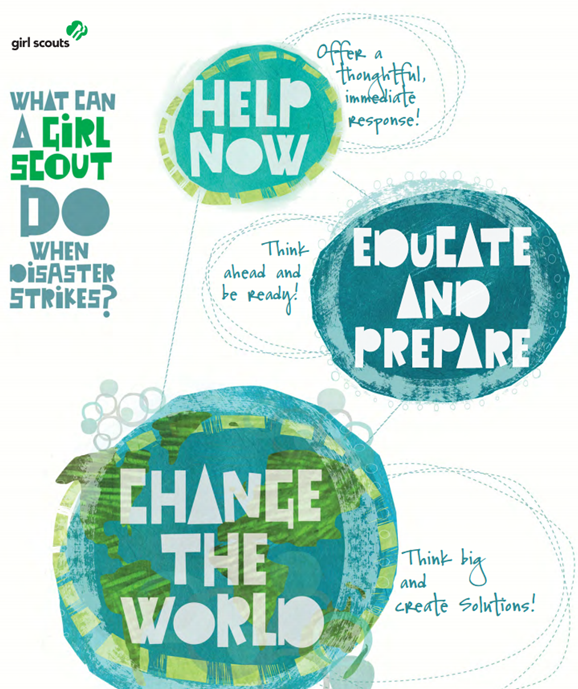
The more someone practices calming techniques and positive self-talk, the more it becomes second nature in times of stress. That takes us back to the Girl Scouts (of course). On the Girl Scouts web site, they explain their motto by quoting from the 1947 handbook: “A Girl Scout is ready to help out wherever she is needed. Willingness to serve is not enough; you must know how to do the job well, even in an emergency.

What-can-a-Girl-Scout-do-when-Disaster1In other words, being prepared isn’t just about equipment and supplies, or even intention; it’s about preparing yourself – being ready and able to deal with what life throws at you, both practically and emotionally. You can prepare yourself for those emotional hooks by checking your story on a regular basis. What’s bothering you today? What’s hard for you? Once you’ve answered that, think about what you’re telling yourself about it. Is there anger in your story? Self-pity? Sadness? If so, maybe it’s time for a re-write. Can you turn the story into something more positive by changing the words you are using about it?

Yeats said that “Life is a long preparation for something that never happens.” We always hope that the worst never happens, but a Girl Scout would say be prepared anyway.

Step away from the edge

When did we become such an extremist culture? If the word extremist sounds, well, extreme, consider the word moderate and you’ll know what I mean. No one wants to be moderate anymore, or to do anything in moderation. As a culture, we seek out the biggest, the newest, the richest, the edgiest, the most dangerous experience or position we can find.

On reality TV, we see people competing to lose the most weight or be the best chef. Marketers tell us we’ll be left behind if we don’t have the newest phone, and we line up to buy it. College students accept binge drinking as the norm, putting their health, safety and studies in danger. Congressmen put the nation at risk to score points and avoid compromise at all costs. And in our daily lives, our fear of not having every bit of the latest information makes us obsessively check texts and email.

Isn’t the competition exhausting, though? We often talk about managing our time, but not so much about managing our energy. In fact, our energy is a finite commodity too, and we would do well to think about how we want to use it. It’s very stressful be constantly competing, or fighting, or worrying about the meaning of a text message, or subjecting our bodies to excessive amounts of food, drink or even exercise.

Most of us are naturally somewhat competitive, and of course it’s nice to be the best at something, or to set goals for ourselves. But I’m reminded of the saying, “Don’t let the perfect be the enemy of the good.” In some areas of our lives, maybe we’d be happier to not have the best or be the best. Bruno Bettelheim’s famous book, A Good Enough Parent, espoused this philosophy. Instead of striving to be the perfect parent of the perfect child, he advised that parents should be more attuned emotionally to their children so they could understand their relational needs. Instead of trying to mold a child into the one we want, help the child develop into the person he or she wants to be.

A focus on emotional awareness can serve us too, as we try to manage our energy. What do you need for yourself, in body, mind and spirit? Is it the newest phone or the most principled stance on an issue? Or are those things that you could let go? Do you need to lose more weight than your co-worker, or would losing a smaller amount be sufficient for you?

A recent study conducted at the University of Copenhagen showed that moderate exercise was actually more motivating than hard training was. The people who did 30 minutes a day of moderate exercise lost more weight than those who did 60 minutes of hard fitness training. The moderate group said they had more energy and were more motivated to make other healthy lifestyle changes, but those in the vigorous group were exhausted after their workout and less open to altering other habits. They had drained the energy they had for changing.

“Moderate” doesn’t have to mean boring or mediocre. It could just mean that you are using your energy within reasonable limits, for you, at this moment. At some other time, or in some other space, the choice might be different. How can you feel your best right now? Not the best of something or the best at something, but just the best and most content you?

Benjamin Disraeli once said that, “The choicest pleasures of life lie within the ring of moderation.” They’re not always at the edge.

People on the margins

Another mass shooting, this time in my home, Washington DC., has generated another round of shock, sorrow and seeking of answers. The issues are complex, and we will never know what was in the mind of a shooter who is now dead. But one aspect to consider is the problem of people who are socially isolated.

I’ve written in this space before about the work of Nicholas Christakis and others, who analyze social networks and the interconnections of people to see what influence we have on  each other. They have come up with some surprising findings about just how much we can impact other people in our network, whether we know them personally or not.Hand Reaching

Today, Nicholas and Erika Christakis have a thoughtful op-Ed in The Washington Post about the position of the loners on the periphery of our social networks, and how the loneliness and/or isolation of those people can have a negative effect on all of us, whether they turn to violence or not. Read it, and reach out.


Time flies, but it’s a lovely ride

Every time I have to wash and dry my hair, I think, “This again, already?” Each week when we put out the trash, I ask, “How can it be Friday again, so soon?” Paying the phone bill always makes me think, “How can a month have passed so quickly?” And whenever I celebrate a birthday, I wonder, “Where did the year go?”

Mundane tasks and rituals can be comforting because they provide order to our days and a sense that some things do not change, but they can also be disturbing because they remind us that life seems to be inexorably speeding past, with nothing to slow it down. The fear that time is slipping away, combined with the tediousness of some of our days is enough to bring anyone down.

But, as James Taylor reminds us:

“The secret of life is enjoying the passage of time

Any fool can do it

There ain’t nothing to it….

It’s just a lovely ride.”

Maybe the secret to enjoying the passage of time is to bring more mindfulness to the chores and more awareness to the celebrations. Can I up my level of engagement? Paying closer attention might imbue activities with more of the pleasure that James Taylor sings about so beautifully.

For instance, my first act upon waking is to start making coffee. But I usually do it by rote, not stopping to appreciate the smell of the coffee or the clarity of the water going into the pot. Though my attention snaps back when I take my first sip, my challenge is to bring awareness to the entire process. “I have measured out my life with coffee spoons,” wrote T.S. Eliot. If this is literally true of my life, shouldn’t I at least smell the coffee?

Jon Kabat-Zinn says that, “If we are to grasp the reality of our life while we have it, we will need to wake up to our moments. Otherwise, whole days, even a whole life, could slip past unnoticed.” In his book, Wherever You Go, There You Are, he has a wonderful entry called “Cleaning the stove while listening to Bobby McFerrin,” about using the process of cleaning the stove as a mindfulness practice, and the accompanying music as a way to engage the whole body in the task. It is a good lesson for me to remember when I reluctantly approach the job of drying my hair – can I engage both my mind and body while doing it, can I be more fully aware of the transition from wet to dry?

So maybe you’re saying “Sure, I zone out when I’m doing boring jobs, but I always pay attention when it’s something important like lunch with my mom, or playing a game with my kids.” Really? Kabat-Zinn suggests that one way to wake up “is to look at other people and ask yourself if you are really seeing them or just your thoughts about them. Sometimes our thoughts act like dream glasses…Without knowing it, we are coloring everything, putting our spin on it all.” Am I fully IMG2present at the birthday party, soaking it in with all my senses, or just going through the motions of enjoyment while planning the story I will tell about it later?

As I write this, it strikes me that everyday mindfulness can’t help but be connected to a sense of gratitude. How can I smell the coffee beans or acknowledge the clean water that goes into making the coffee without being grateful that I have both those things available to me? How can I pay my bills every month without gratitude that I have the money to pay them? How can I observe my birthday, and those of others, without giving thanks that we’re all here together to celebrate? Yes, time flies, but the ride is lovely even when it’s fast.


Rising above

Have you ever laughed when someone fell down? Have you ever resented someone who has success that you want for yourself? Is it hard to feel joy for someone to whom you compare yourself? One of the premises of a new book by Richard H. Smith, The Joy of Pain, is that these feelings are part of what makes us human. Often referred to as schadenfreude – a German term meaning both harm and joy – the emotion we experience in that situation allows us to feel better about ourselves.

One of my husband’s favorite movie quotes is from a scene in “The African Queen,” starring Katharine Hepburn and Humphrey Bogart. Bogart plays Charlie, a hard-living, cynical riverboat captain, and Hepburn’s character is Rose, a prim and proper missionary. At one point during their many arguments, Rose says to Charlie, “Human nature is what God put us on earth to rise above.

When my kids were little, I told them countless times that it was wrong to “laugh at the misfortunes of others.” Even at a young age, we compare ourselves to other people, and maybe the laughter comes from nervous relief that the embarrassment happened to someone else. But even if it is human nature to take pleasure in someone else’s downfall, I don’t think it comes without another distinctly human emotion: shame.

In the novel, Major Pettigrew’s Last Stand, the main character says, “I know something of shame…How can we not all feel it? We are all small-minded people, creeping about the earth grubbing for our own advantage and making the very mistakes for which we want to humiliate our neighbors.” At some point, the experience of schadenfreude has to make us feel hypocritical, knowing that we are playing a mental game of one-upmanship. The neighbor or co-worker’s failure somehow makes us more likely to succeed, or at least to feel superior, no matter how temporary that might be, or how undeserved.

Is human nature something we can rise above? Even Smith admits that humans are also wired for compassion. And practicing compassion can probably help us downplay those feelings of glee when something bad happens to someone we don’t like or with whom we compete. What is infinitely harder, I think, is actually being able to feel glad when something good happens for the person we don’t like. How can I summon genuine feelings of happiness for the kid who was mean to my child, or for the person who made a cutting remark to me, or for the politician who betrayed the public’s trust?

Among the Buddhist meditation practices known as brahmaviharas is one called mudita. Mudita is essentially a practice of sympathetic joy. It helps to counter feelings of jealousy and envy, and increases one’s capacity to feel joy and happiness for others’ good fortune. Practicing mudita calls for bringing to mind various people, and then mentally wishing them continued happiness. Since this feeling needs to be actively cultivated in most people, it helps to start the practice of mudita by calling to mind your own goodness and happiness, followed by people you love, and finally, the people who are difficult for you.OLYMPUS DIGITAL CAMERA

The Yoga Journal web site has a very thorough article that explains mudita and how to practice it. The concluding wishes go like this:

“May your happiness and joy increase. May the joy in your life continue and grow. May you be successful and met with appreciation.”

Mudita asks that we stop thinking of life as a zero-sum game, and recognize that our own happiness increases when others are happy too, even our enemies. That’s how the human spirit rises above the human nature.

My summer reading club

The local library was one of my favorite places during childhood. Even today, when I enter a library and get a whiff of that familiar smell of books, glue, and something undefined, I feel at home. It was, and is, a place of quiet discovery.

During every summer growing up, I was an avid member of the library’s summer reading program. The end of the school year didn’t signify a break from books to me – instead, it meant that I could dive into even more. I loved going into the cool, silent library (so different from the heat and noise outside!) and coming out filled with anticipation of what awaited me between the covers I held in my arms. Whatever the program entailed – number of books, stamps or stickers, charts or check-offs, I didn’t hesitate to sign up. Not only did I love the reading, my competitive nature kicked in as my book count got higher each week.books3

Those lazy days of reading for hours on end are mostly gone from my summers now, except for a few days at the beach each year. My reading takes place at odd moments here and there – subway rides, waiting rooms, or the time it takes me to fall asleep at night. Nobody but me is tracking the number of books I read – I’m in a book club of one. I’ll receive no stickers or prizes. My name won’t go on any list. Nevertheless, I feel richly rewarded.

The characters I’ve met this summer have invited me into their lives and made me care about what happens to them. Their stories are sometimes funny, but often sad; some of them are clever, others bizarre; most of them end with hopefulness, others with just a bleak sense of resignation. But all of them teach me something about life.

archerThe importance of breath came into play in two novels I read. In The Garden of Evening Mists, a damaged young woman is learning archery, while in The Sojourn, a teenager becomes a sharpshooter during World War I. Both learn to “Feel your body expanding as you breathe: that is where we live, in the moments between inhalation and exhalation.” I loved the images of connecting breath and movement, just like yoga. No matter what we are aiming for, the breath is what takes us there, and the space between breaths is like a doorway.

My passion for books was affirmed by reading Will Schwalbe’s  The End of Your Life Book Club. Schwalbe and his mother, both keen readers all their lives, formed an informal book “club” while she was undergoing treatment for cancer. They would read and discuss books as they sat in waiting or treatment rooms. Schwalbe’s loving memoir chronicles the time by connecting it to the books. He remembers his mother’s friendships with people she had met around the world, and her insistence “that books are the most powerful tool in the human arsenal.” She was passionate about getting a library built in Afghanistan before she died. About one novel, she said, “That’s one of the amazing things great books like this do – they don’t just get you to see the world differently, they get you to look at people, the people all around you, differently.”

I may never visit Malaysia or Sri Lanka, settings for three of this summer’s books, and I can’t relive the World Wars which featured in others, but reading about them has given me an expanded view of what those places and times are all about. I’m so grateful that reading has given me eyes to see the world, increasing my compassion for and connection with people everywhere. That’s the power of summer reading!