Vacation days

First day of vacation: The monkey mind is still alive and well, jumping from thought to thought. I wake with an undercurrent of dis-ease. What am I “supposed” to be doing today? My mind isn’t yet allowing me to surrender to the idea of slowing down and doing nothing.
 
So I get up and make a list of things to do. I write some emails. I find something to clean. I sit in the sun and try to read. I start to doze off, the first moment of the day that feels lazy and luxurious. But soon I’m up again, going off to exercise. I believe in working out on vacation, but today it feels like part of my “organized” life, something I’ve scheduled, not something that says “vacation”.
 
Did you know that the majority of Americans don’t use all of their vacation days in the year, leaving billions of dollars of benefits on the table? Many don’t take vacation because they can’t afford a trip, but others are afraid for their job security if they ask for time off.
 
While most employers recognize the value when employees come back rested, refreshed, and more productive, many also expect their employees to answer emails while on vacation. In fact, more than half of the people in one survey said that they are expected to have email access on vacation. So while vacations usually enhance family relationships, work interruptions can actually impede that benefit.
 
Second day of vacation: I’m up early to walk the beach checking sea turtle nests. It’s light, but the sun isn’t up over the horizon yet, and the moon is still visible high in the sky. The shrimp boats are out on the water, and a group of deer graze on the dunes. They let me get amazingly close to them. I’m reminded that the only important things to do today are eating and spending time in nature.Kiawah 003

 
Psychology Today says that “Vacations have the potential to break into the stress cycle,” getting us off the merry-go-round of chronic stress, sleep deprivation and unquiet minds. Vacations are also good times to establish new health habits, especially around exercise.
 
Third day of vacation: I wake in the pre-dawn to the sound of rain beating on the roof. I drift back to sleep thinking about a day spent reading and watching movies indoors. But by 7:00 the storm clouds have moved out to sea and people start to wander onto the beach for morning runs and walks. What will the day ahead hold for me? Beach? Yoga? Biking? All three? Kiawah 006

 
While the joy of vacation wears off quickly when we return to work, people still say they are happiest having spent money on an experience rather than a material possession. Most of that positive feeling comes from being able to share the experience with friends or family. The vacation becomes part of the story of the social network.
 
Fourth day of vacation: Here’s the beauty of it — I don’t need to know what tomorrow will bring. Yes, there are are many more things to do, but there are also all the remaining vacation days on which to do them. It’s time to disconnect……

Daydream believing

My daydreams aren’t what they used to be. I’m pretty sure that’s a good thing, though. It all depends on what we mean by daydream.

Type “daydream” into Google, and this pops up: “Pleasant thoughts that distract one’s attention from the present.” That’s the way I mostly daydreamed for many years. I would use my daydreams as a tool for imagining some future event – usually something that was definitely going to happen, like a vacation. Fantasizing about the future event got me out of the mundane day-to-day life and into something happy and pleasant. After all, who doesn’t like to think about vacation?

But I realized recently that I don’t daydream like that much anymore. I think it’s because I discovered that life is better when I find something satisfying to experience each day that I awake, rather than off in the future. As Daniel Gilbert has written, “When we imagine the future, we often do so in the blind spot of our mind’s eye.” We don’t really know how the future will turn out, and over-fantasizing about it can make it disappointing when it finally arrives.

The dictionary.com definition of daydream is “a reverie indulged in while awake,” a reverie being a “state of dreamy meditation.” This seems like a better way to describe the kind of daydreaming that leads to creativity, problem-solving and fulfilling goals. There’s a saying that ‘where your thoughts go, your energy flows’. In that sense, daydreaming can be uniquely valuable as a way to come up with new ideas, figure out what to do with your life, create a piece of art or music, or imagine a different world.

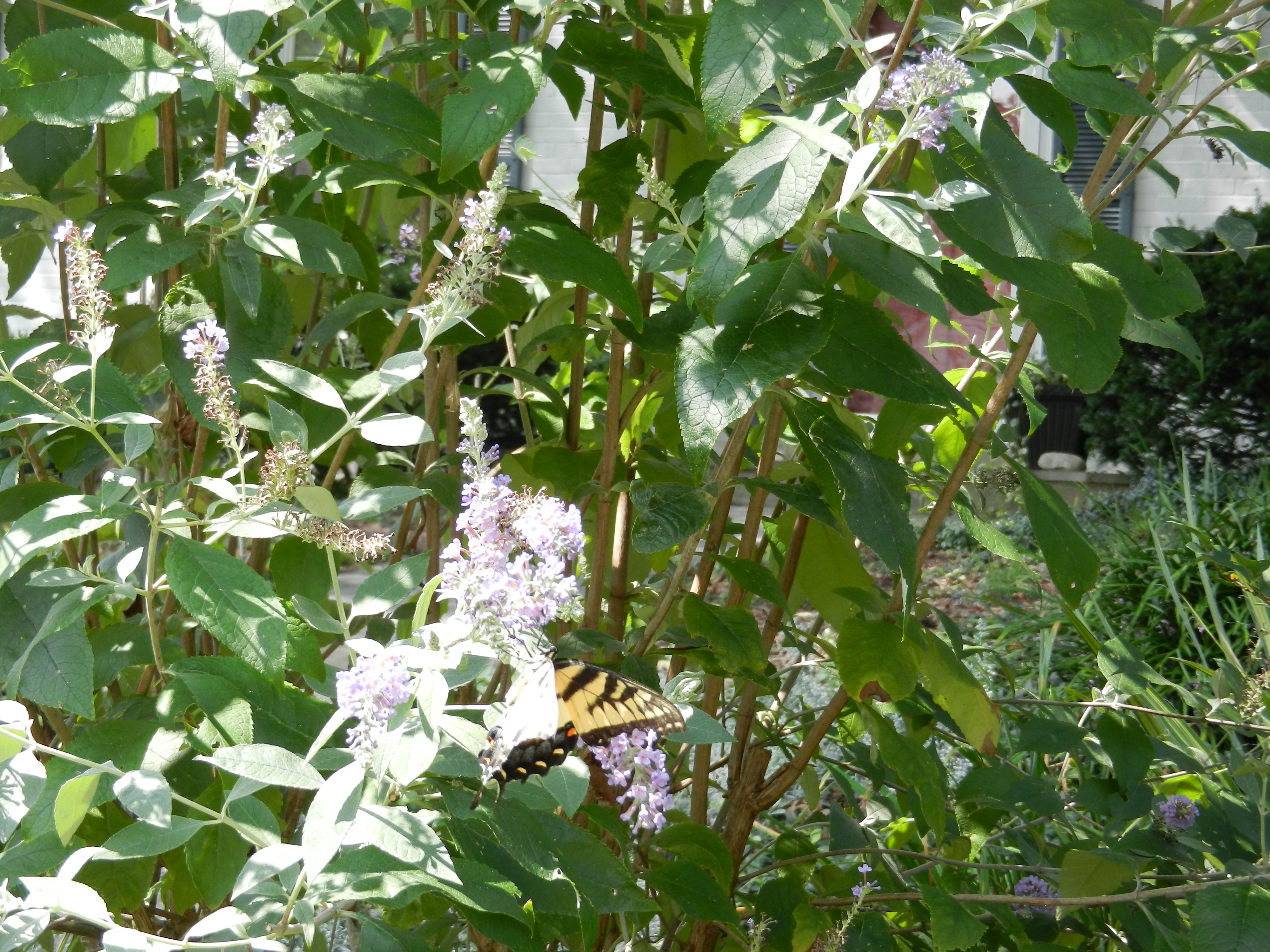
Sitting in my backyard listening to the birds chirping, watching the butterflies flit around the flowers and losing myself in watching clouds, is the kind of daydreaming that occupies me more now. That “dreamy meditation” invites ideas and images into the conscious mind. It’s the daydreaming that leads to new blog posts, and poems, and learning about nature. It’s the daydreaming that allows me to act on what I imagine.Butterflies_03

On the Psychology Today website, there’s an article by Amy Fries called “The Power of Daydreaming.” It’s an extensive overview of all the ways in which daydreaming is good for us, as well as the ways that daydreaming can be negative, such as if it is too “worry-based”. While it’s helpful to use daydreaming as a way to role-play a situation ahead of time, or assess its risk, it becomes maladaptive if it causes anxiety or obsessive negative thinking.

Daydreaming is essentially what we are engaging in when we use positive visualization or guided imagery to relax. We take ourselves away from the present moment (which might be stressful) and into another place that is beautiful and calm, a place that has meaning for us. Daydreaming becomes a short-term tool for getting through a difficult moment.

Does it seem like there’s a disconnect between present moment awareness and daydreaming, which takes us out of the present moment? Fries doesn’t believe the two have to be in conflict, but thinks that we can find the balance that gives us the right amount of each. She says that we need to be able to imagine art, philosophy, spirituality and progress in order to bring them into existence for ourselves.

So I welcome my daydreams as a respite, and try to be present to the serendipitous ideas that come up in them. Who’s to say what the difference is between daydreaming and just thinking? Albert Einstein once said that, “The secret to creativity is knowing how to hide your sources.” Could he have been talking about daydreams?

Go out and play!

Plato wrote, “You can discover more about a person in an hour of play than in a year of conversation.” Playing allows us to take risks, to laugh at ourselves, to fall down, and to get back up. We discover truths about ourselves, as well as others.

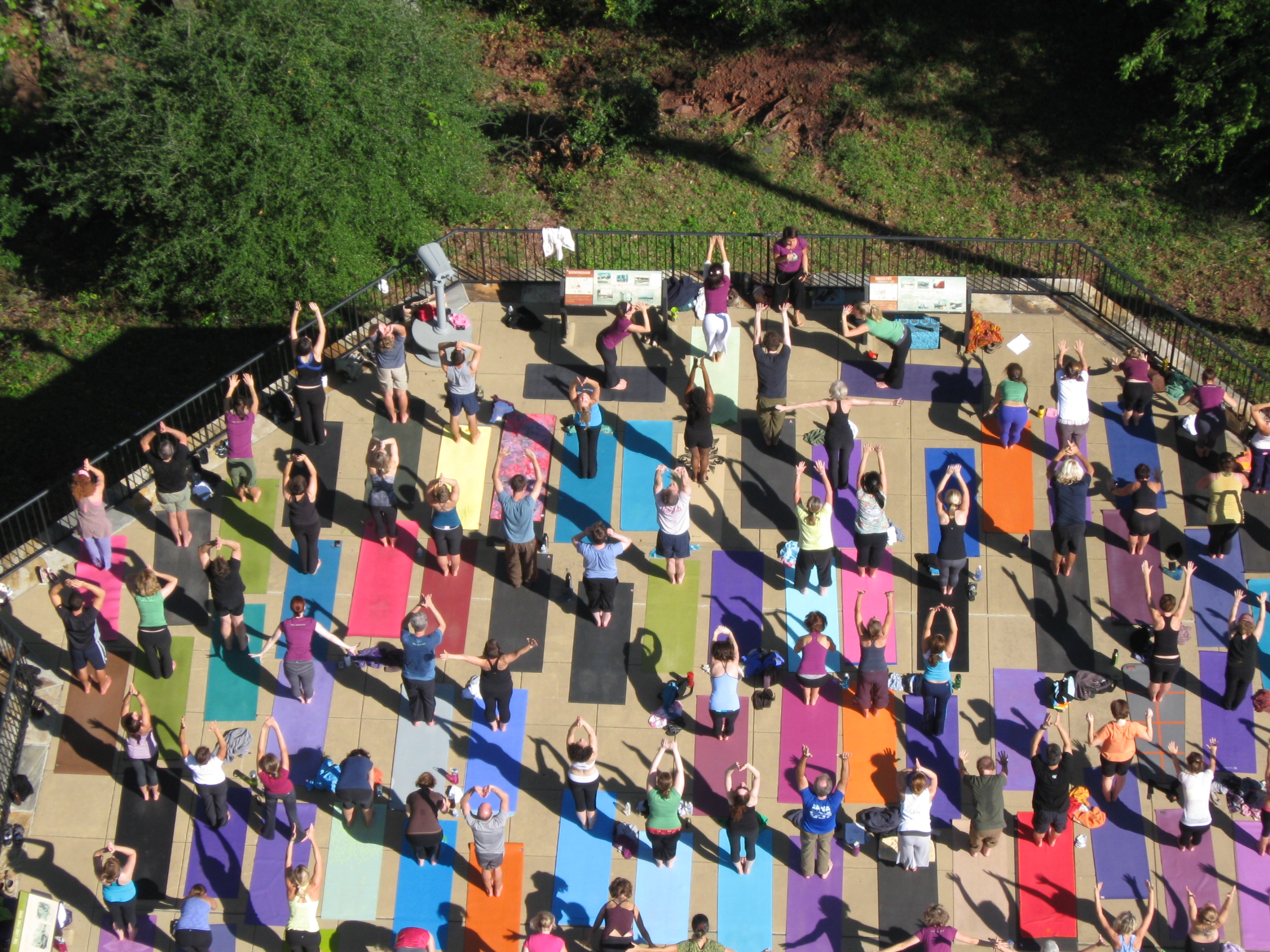
Earlier this week, my yoga teacher announced at the beginning of class, “We’re just going to play today.” It was the last class there for most of us, since the yoga studio was closing at the end of the week. We all felt a little bittersweet about it, and by making the class more playful, our teacher helped us focus on the sweetness and joy rather than the sadness at the ending.

We went on to practice a lot of partner postures, flying postures and other fun stuff. We had to trust each other and give up some control in order to balance in the air on someone’s feet. Some of us found that easier than others, but there was laughter all around as we played together. And yes, I did learn more about my flying partner in that hour than I ever had by practicing yoga next to her.

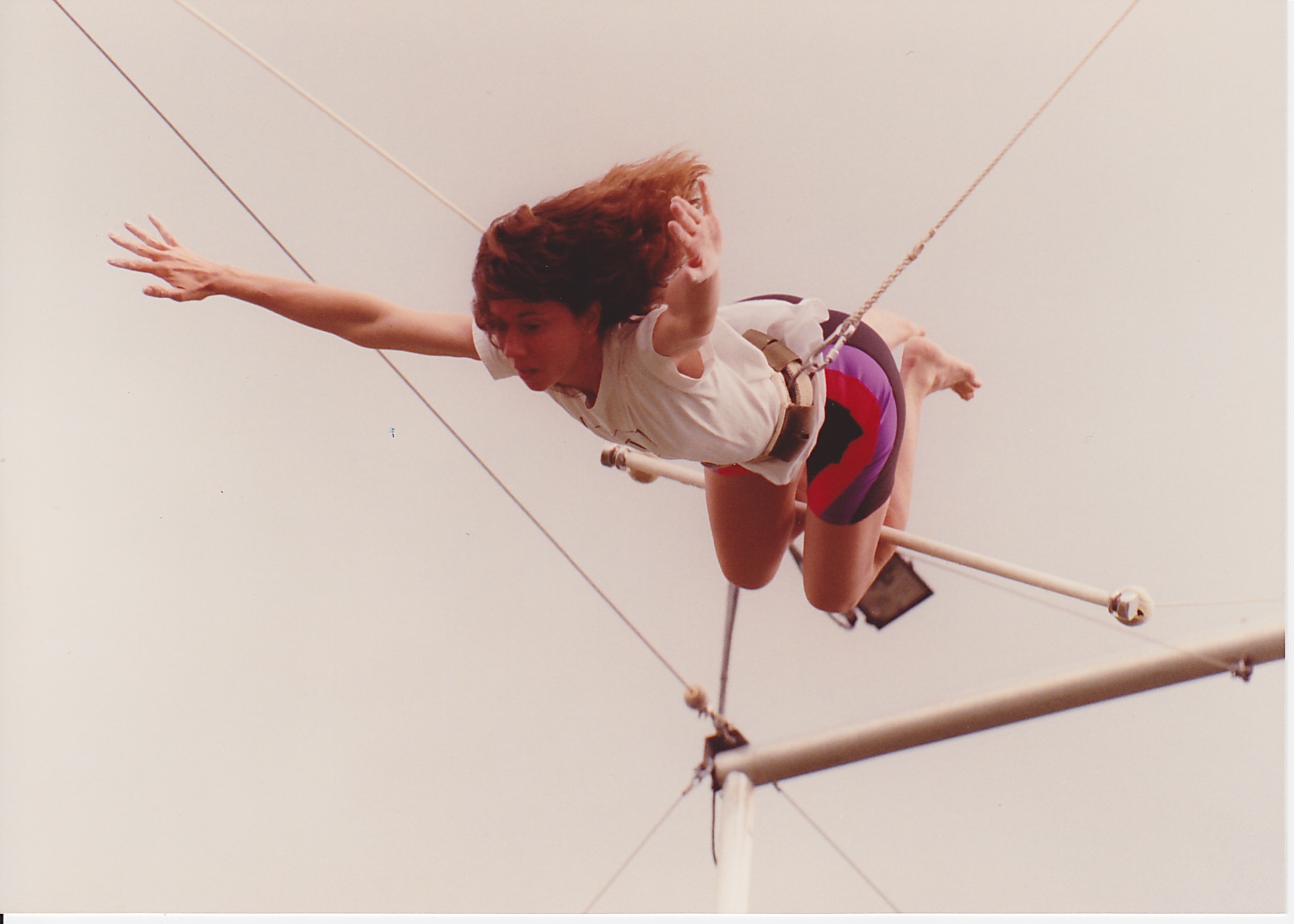
Playing helps take us away from the stresses of “real” life, but it also prepares us for them. The first time I tried the trapeze, years ago, I was terrified. You have to stand with your toes hanging off the edge of a platform, high in the air, and lean forward to grab the swing with the assistant only holding onto your harness with a finger. I had to trust myself to reach for the swing as I stepped into the void, and know that there were only two possible outcomes. Either I would be successful, get a grip on the swing, pull my legs up over it, and fly through the air (with the greatest of ease?). Or I would miss the bar, fall into the safety net, and..….be okay. The only thing at risk was my ego.

Why do you think we use terms like “take the plunge” and “leap of faith” to describe life’s risk-taking? Those physical chances we take during play – diving into the deep end of the pool, and jumping off the trapeze — teach us that we will probably be okay even if we fail. By continuing to play as adults, we keep ourselves flexible (mentally and emotionally, as well as physically) and more able to deal with changes that come along.OLYMPUS DIGITAL CAMERA

Do we play enough? NO! Even kids don’t play in the traditional sense nearly as much as they used to. And adults are often so oriented to work and worried about the future that we forget to incorporate play into our lives. Deep down, though, we all want and need to play.

How can you start playing again? Try a Laughter Yoga class, where you can just be goofy and creative for an hour or two. If you’re near Washington D.C., check out an organization called “Spacious” that connects people around fun and play. Bring the Instant Recess program to your workplace. Play in the snow, dance in the street, go on a roller-coaster, ride a wave, or even try the trapeze. Re-discover that baseline joy that comes from letting go and trusting that everything will be okay.

Thanks, I’ll walk

Walking meditation, says Thich Nhat Hanh, “is really to enjoy the walking – walking not in order to arrive, but just to walk. The purpose is to be in the present moment and, aware of our breathing and our walking, to enjoy each step.” Instead of being on the way to someplace, it is the act of walking itself that is the purpose.

I’m in the middle of a book that inspires me to contemplate walking as meditation. The Unlikely Pilgrimage of Harold Fry, by Rachel Joyce, is about a recently retired man who gets a letter from a friend he hasn’t seen in 20 years, telling him that she is dying of cancer. The letter disrupts the unhappy inertia of his life, and on the spur of the moment, he decides to walk hundreds of miles across England to see her before she dies.

When I started reading, I thought that this book would be just a lighthearted, quirky story. But it has turned out to be engaging, thought-provoking and touching. Harold changes on the journey, not only from being physically unprepared to being fit and able; but also in the way he views his life. At first he is tortured by memories of the past, and he doubts what he is doing; but the walk transforms him into someone who has hope.Pt Reyes Natl _03

Walking is the most recommended physical activity in the world, because it is accessible to almost everyone, and offers many health benefits. Among them is an increase in “well-being” in people who walk regularly. Walking promotes clear thinking, and gives people an opportunity to notice their thoughts and feelings. Its ability to integrate sensory experience, motor skills and brain activity make it a part of psychotherapy for some mental health practitioners.

While it is possible to walk mindfully as you walk for exercise, walking meditation means paying attention to the walking itself: the sound your feet make as they touch the ground, the rhythm of your steps, the sound of your breath. Gradually you might find that your breath becomes regular and paces itself with your footsteps, for example 3 steps for each inhale and 4 steps for each exhale. Jon Kabat-Zinn says about walking meditation, “The challenge is, can you be fully with this step, with this breath?”Labyrinth-with-Pilgrim

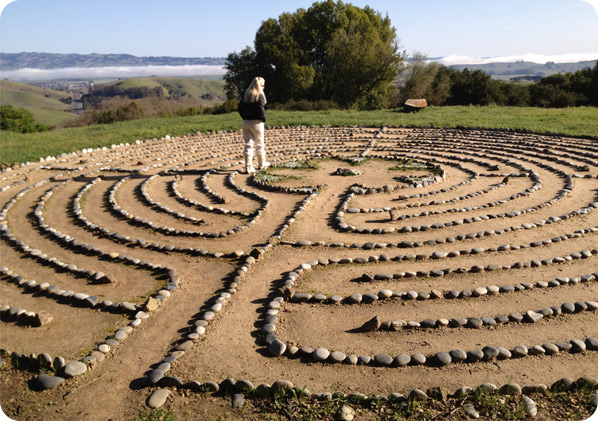
Another way to do a walking meditation is to walk in a labyrinth. Labyrinths have been used for thousands of years as a way to clear the mind and find answers to questions. They are often found on the grounds of churches or other religious centers, or in places of health and healing. A labyrinth consists of concentric circles leading to a center; you walk around the spiral to the center and then retrace your steps on the way out. It is a metaphor for the spiritual journey inward. At the labyrinth near my house, there is a quote from St. Augustine: “It is solved by walking.”

I don’t know yet if Harold Fry will solve the unhappiness of his life by the end of his journey, or the end of the book. While I wonder what will happen, I’m savoring each chapter as I go. I do know that what he has learned already is this: He doesn’t need to be in a hurry to arrive at his destination, because at each moment of the journey he is arriving somewhere.

Teach your children well

The public conversation has been a swirl of questions since the unspeakable mass shooting in Newtown, Connecticut last week. How can we prevent these kinds of events? What does mental illness have to do with it? Can we control it by banning certain weapons? How will these child survivors handle it? How can we best protect our children?

Kids_0003We could buy our children bulletproof backpacks, as many parents are apparently doing in the aftermath. Or we can teach them lifelong skills that will not only build resilience for dealing with stressful events, but perhaps help schools and communities become environments where young people will not feel isolated, marginalized and desperate.

The American Psychological Association has tips for parents on how to help children build resilience. Their suggestions include things like “make connections”, “teach self-care”, and “nurture a positive self-view”. This is great advice, but a little vague. Even if a few parents look at the APA web site, how many have the skills to implement the ideas? Children, teachers and communities would be better-served by school-based programs:

  • Mindfulness programs in school. Congressman Tim Ryan of Ohio was so affected by a mindfulness retreat he experienced a few years ago that he wrote a book about it (A Mindful Nation) and worked to get funding for “Skills for Life”, a social and emotional learning program, in Youngstown, OH schools. Teachers receive training, which helps them with their personal stressors, and then they bring the program into the classroom. The children have responded enthusiastically, teachers have found that their classes are better-behaved, and academic performance has even improved. Goldie Hawn, through her Hawn Foundation, has supported a similar program called “MindUP” in the Miami-Dade schools. The program helps develop emotional resilience skills, as well as “helping children function in their environments in a more mindful and less stressful way”.
  • Teaching Tolerance, a program of The Southern Poverty Law Center which aims to foster “school environments that are inclusive and nurturing”. They have developed many anti-bias education resources, including teaching kits, curricula and professional development programs. While their program was initially focused on building tolerance for people of different races and ethnicities, it is applicable to fostering acceptance for children with any kind of differences. One of their initiatives is the “Mix It Up at Lunch Day” which has been held every November since 2002. On that day, kids are encouraged to sit with someone new, someone outside of their “group”, at lunch. These kind of interactions help reduce bias and misconceptions about others.Hand Reaching
  • Compassion training. Dr. James R. Doty, Director and Founder of Project Compassion and Clinical Professor of Neurosurgery at Stanford University, has written, “Why, in a country that consumes 25% of the world’s resources (the U.S.), is there an epidemic of loneliness, depression, and anxiety…Our poverty in the West is not that of the wallet but rather that of social connectedness.” Neuroscience research, at Stanford and elsewhere, has shown that people can train themselves to be more compassionate and to feel greater empathy. This is vital for all of us to cultivate, no matter how old we are. As long as people do not feel connected to each other, it is too easy to forget about the people on the margins.

Will we ever eliminate all acts of violence? Probably not. But I would argue that time and money spent on building mindfulness, peace and compassion in schools are equally as important as resources for math and reading.  Thich Nhat Hanh has written, “A fresh way of being peace, of making peace, is needed…We rely on each other. Our children are relying on us in order for them to have a future.”

Living with uncertainty

“Stress levels increased since 1983,” read the headline in USA Today last week. Not surprised? What’s interesting is why stress is higher for some people than others.

Sheldon Cohen and Denise Janicki-Deverts analyzed three national surveys (1983, 2006 and 2009) that used the same measure of stress. In all three, women’s stress was consistently higher than men’s, younger people had more stress than older people, people with less education reported higher stress than those with more, and people with lower incomes showed more stress than people with higher incomes.

What was different between 2006 and 2009 was that the increase in stress after the economic downturn was almost totally driven by middle-aged, college-educated, white men who were employed full-time. Cohen and Janicki-Deverts theorize that this finding could be related to the “threat of job loss, actual job loss, or loss of retirement funds.”

But what I see is that this could also be about loss of power and control. It’s not news that people who are lower in a hierarchy have more stress than those on top. And since it’s also still true that most of the power in our society is held by white middle-aged men with college degrees and full-time jobs, in some senses those people had the most to lose when the economy turned sour.

The stress levels of women, the young and the poor didn’t increase significantly because their position in the hierarchy didn’t change much. But for white, middle-aged men, the downturn may have been the first time they felt themselves to be on shaky ground. All of a sudden, there were no guarantees.

The Company Men”, a film about the economic downturn, portrays this theme convincingly. The main characters, who thought they had it made, suddenly were experiencing the uncertainty that other groups have traditionally lived with. Depending on their access to coping strategies, they either weathered the storm or were destroyed by it.

Our new reality is that many of us will be living with uncertainty for a long time. So how do we inhabit that reality in a way that doesn’t wear us down and make us sick?

  • Recognize what you can control and what you cannot. The stock market is out of our control. So are the actions of other people. But we can control how we react to events. Focus on what’s present right now instead of worrying about what can’t be predicted or controlled.
  • Be careful of how you talk to yourself. Too often, we limit ourselves by having a negative narrative going on in our minds (I’m not good enough, I’m too old, I’ll be next to lose my job). Practice replacing those negative thoughts with positive statements.
  • Believe in yourself. Easier said than done, right? It takes practice to change how you think of yourself. But if you remind yourself of the way you’ve handled situations in the past, and all the things that you are capable of, your ability to believe and trust in yourself will increase.
  • Write about it. James Pennebaker and others have shown that people who write about their feelings every day for several days can improve their moods and feel better emotionally.
  • Have a sense of humor. It helps us change our perspective on life events and sometimes even turns a potential stressor into something less threatening. Know what kinds of jokes, movies or comics are sure to make you laugh, so that you can turn to them when necessary.
  • Consider the idea of change as opportunity. As Claude Bernard once said, “Man can learn nothing unless he proceeds from the known to the unknown.”


Stories we tell

Every family has stories – usually a mix of the good, the bad and the ugly. Some stories are told over and over, and others get hidden away like skeletons in the closet. But all the stories shape us and our life stories.

Sometimes I stare at the old photos of my great-grandparents, or my dad with his army buddies, and try to figure out who they were. Were their lives mostly hard work and disappointment, or did they experience joy and possibility? How does the answer to that question explain who I am? Did I just inherit my blue eyes and brown hair from them, or does their legacy also include patterns of behavior and ways of looking at the world?

Carl Jung wrote that, “The more intensively the family has stamped its character upon the child, the more it will tend to feel and see its earlier miniature world again in the bigger world of adult life.” In other words, our perspective can be profoundly shaped by our early experience.

People in my family have been farmers, miners, autoworkers, soldiers, teachers and cooks. One was a blacksmith, one a postmaster, and another a mayor. One person has a library named for him, while others lived and died in anonymity. Their stories include poverty, abandonment, infidelity and suicide, as well as pioneering spirit, public service, loyalty and courage.

While I want to embrace many of the values I inherited from them, such as a strong work ethic and sense of responsibility, I sometimes find myself stuck with some of the others, such as a tendency to think small and play it safe – characteristics that probably result from generations who always had to struggle. Can we change our lives enough as adults to establish a broader legacy for our own children? Is it possible to get past the negative self-talk, the family dysfunction, and the habitual patterns of behavior to grow into a more satisfying life while still building on the positive aspects of the past?

Just tuning in and becoming aware of our thoughts and feelings, then being able to label them, are good first steps. In their book Emotional Intelligence 2.0, Travis Bradberry and Jean Greaves define emotional intelligence as “your ability to recognize and understand emotions in yourself and others, and your ability to use this awareness to manage your behavior and relationships.”

Understanding emotions and managing behavior require us to pay attention to them. Sometimes we are so caught up in daily life that we act and react without thought. Keeping a journal (or writing a blog) can help focus the attention on what we are doing and feeling.  Formally practicing mindfulness can also help develop the ability to slow down and pay more attention to our emotional lives. A mindfulness practice can be as simple as sitting quietly and observing the breath for a little while each day. In his book, Peace is Every Step, Thich Nhat Hanh writes about mindfulness that it “enables us to be in touch with life, which is wonderful in the present moment.”

So perhaps that is the legacy I can give my children: a consciousness of my actions, a smile shared in joy, an awareness of how awesome life is right now. If I can do that for myself, and for them, what stories will they tell?


Knowing when to surrender

While doing child’s pose yesterday in yoga, our teacher said that the pose is also called “wisdom pose”. I had never heard this before, but as I thought about it, it made sense. In child’s pose, we need to relax and surrender to gravity, to make ourselves vulnerable like children. And in life, it often requires a lot of wisdom for us to fully surrender and let things be.

Do you ever think about how much energy you use up fighting things? From the mundane fights (traffic, kids’ bedtimes, the cable company) to more important fights (interpersonal conflict, problems at work, health issues), so much of our time is taken up with struggling against things that we sometimes feel like we’re not moving to anything.

Part of what drives us is the need to have and keep control of things in our lives. A feeling of control is important to managing stress; but so is realizing when something is out of our control, or deciding that control just isn’t worth the price it requires. So there might be times when it’s appropriate to “give in”, such as when maintaining a relationship is more important than winning an argument, or when the outcome is clearly more important to the other person than it is to you.

Exercising control is often a response to fear as well. Fear of change, fear of failure, fear of success, fear of facing difficult emotions – all can lead us to fiercely hold onto positions that really aren’t serving us. Bertrand Russell said that “to conquer fear is the beginning of wisdom.” And sometimes surrendering control, allowing events to happen and feelings to rise, is the beginning of conquering fear.

Sometimes when we are over-efforting, micromanaging every detail, too focused on the outcome, it’s easy to lose sight of the big picture. If we take a step back to see things as they are, and just stop trying so hard, we might be more successful in reaching our goals. Soren Gordhamer writes that “we can often make more progress and with less stress not by trying harder but by trying softer. By doing so, there is an ease to our effort…”

Top athletes and other types of performers know how to try “softer”, although they may call it by a different name. They train and practice for hours, but when called upon to perform, they have to let go of thinking through every move, step, or note and just let things flow through them. They have the wisdom to surrender, and to trust what is inside of them.

I just read about a study of centenarians showing that the people who live longest are the most optimistic and carefree, relaxed and upbeat, and notably non-neurotic. They are the people who let go of their stress rather than internalizing it. I don’t know if they are practicing child’s pose, but something tells me that they are also people who have learned the value of surrendering.

Transition Time

I’m getting ready to leave on a trip out of the country, and I find myself looking forward to the airplane flight. Is it perverse to look forward to 8 hours stuck on a plane, with uncomfortable seats, so-so food and potentially irritating fellow passengers? Maybe, but the reason I’m anticipating it is because of the time it will give me to shift my perspective from the hustle and bustle of home/work/pre-trip preparation to the rhythm of days spent seeing new things and mastering unfamiliar cities.

Skipping transition time can make it more difficult to change tasks. From the toddler who has a tantrum when a play date abruptly ends, to the adult who has to go from meeting to meeting all day, everyone needs space to process change. When we don’t leave enough time before and after each activity, stress is often the result, either because we can’t stick to our hectic schedules, or because we just don’t have time to think.

When we experience stress in the emotional center of the brain, other executive functions of the brain are affected almost immediately. It’s harder to focus, we have trouble making decisions, and our ability to engage in abstract thinking is compromised. Some people can recover more quickly if they are psychologically resilient, but that usually is a result of a temperament you’re born with, or practicing stress management.

That brings me back to transition time as part of a stress management plan. It provides a psychological break between one thing and another that can allow us to process what just happened and to organize our thinking for what’s about to happen. It can also nurture our creativity. The Japanese chef and restaurateur Nobu Matsuhisa travels all over the world regularly. He said in a recent interview that, “I actually prefer a longer flight to a short one. That way I have time to read a book, watch movies, and think about new dishes.” If he didn’t have that time to just relax and think, would his restaurants be as successful as they are?

In this era of 24/7 availability, it is also welcome to have time on planes to be quiet. Although the advent of WiFi on planes has made it easier (and perhaps expected) that people will work during a flight, at least there are still no ringing and buzzing cell phones. We can all have a short break from immediate access.

My time during the flight will be spent with a book, maybe a game of Sudoku, and I hope, some sleep. I will enjoy hearing the accents of the Scandinavian flight attendants, adjusting my ear to the voices I will hear when I arrive. I’ll have time to breathe, to re-set my brain, and get ready to discover what the days ahead hold for me.

My Perfect Day

The warm weather this week has everyone excited. Everywhere I go, people have something to say about it (80 degrees in March!) and a smile on their faces when they talk about it. When I wake up in the morning now, I hear the birds chirping through my open window, indicating another glorious day. I get out of bed with a lightness that is missing in the cold, dark days of winter.

All of that leads me to think about my perfect day. This is a tool that I use with students as a starting point to figuring out their values. If you can make a list of things that constitute a good day for you, it gives you an idea of what is most important to you. What I’ve seen this week is that warm, sunny weather is very valuable to me!

Here are some other things that would make up a perfect (or very good) day:

  • Time spent with friends or family. Whether I reach out to someone, or they make contact with me, it feels good to talk (in person or on the phone) with someone I’ve known a long time. It is a reminder that I have a support system out there.
  • A really yummy meal that isn’t too unhealthy. I love to cook and I love to eat, so this is a significant part of the day. Having healthy food is a bonus because I can feel both satisfied and virtuous about the meal.
  • Some work to do, but not too much. I like the challenge of work and feeling like I make a contribution to something bigger than myself. On the other hand, I like to have choices about how I spend my time.
  • Some physical activity that I enjoy. There’s that good feeling of exhaustion that comes with working my body hard, but not too hard. I don’t need to run a marathon, but I like to get out and move. Running, hiking or yoga all fit the bill.
  • A good book to read. I’ve written before about the important role books have played in my life, along with curiosity and learning. Whether I’m reading novels or non-fiction, I always take something from the books I read.
  • Words of love or encouragement. This could be my kids saying, “I love you, Mom”; a student saying he was helped by my class; a co-worker praising my work; or even a stranger complimenting me on what I’m wearing. Affirmation always brightens my day.
  • Physical contact with someone I love. The skin is the body’s largest organ, and the sense of touch an important way to communicate. Hugs and kisses are a necessity on a perfect day!

When I look at my list of “perfect day” requirements, I see that they correspond very closely to the six dimensions of wellnessPhysical (the exercise and eating); Social (time spent with friends); Emotional (physical contact and words of love); Intellectual (reading); Occupational (working a little bit); and Spiritual (appreciating that warm, sunny day with the birds chirping). Without consciously thinking about it, my desires are reflecting my core values.

Do we know the perfect day when we are living it, or does it exist only in retrospect? Can we wake up every morning with the desire to live it well?

The Indian poet Rabindranath Tagore wrote, Do not say, ‘It is morning,’ and dismiss it with a name of yesterday. See it for the first time as a newborn child that has no name.”