Go out and play!

Plato wrote, “You can discover more about a person in an hour of play than in a year of conversation.” Playing allows us to take risks, to laugh at ourselves, to fall down, and to get back up. We discover truths about ourselves, as well as others.

Earlier this week, my yoga teacher announced at the beginning of class, “We’re just going to play today.” It was the last class there for most of us, since the yoga studio was closing at the end of the week. We all felt a little bittersweet about it, and by making the class more playful, our teacher helped us focus on the sweetness and joy rather than the sadness at the ending.

We went on to practice a lot of partner postures, flying postures and other fun stuff. We had to trust each other and give up some control in order to balance in the air on someone’s feet. Some of us found that easier than others, but there was laughter all around as we played together. And yes, I did learn more about my flying partner in that hour than I ever had by practicing yoga next to her.

Playing helps take us away from the stresses of “real” life, but it also prepares us for them. The first time I tried the trapeze, years ago, I was terrified. You have to stand with your toes hanging off the edge of a platform, high in the air, and lean forward to grab the swing with the assistant only holding onto your harness with a finger. I had to trust myself to reach for the swing as I stepped into the void, and know that there were only two possible outcomes. Either I would be successful, get a grip on the swing, pull my legs up over it, and fly through the air (with the greatest of ease?). Or I would miss the bar, fall into the safety net, and..….be okay. The only thing at risk was my ego.

Why do you think we use terms like “take the plunge” and “leap of faith” to describe life’s risk-taking? Those physical chances we take during play – diving into the deep end of the pool, and jumping off the trapeze — teach us that we will probably be okay even if we fail. By continuing to play as adults, we keep ourselves flexible (mentally and emotionally, as well as physically) and more able to deal with changes that come along.OLYMPUS DIGITAL CAMERA

Do we play enough? NO! Even kids don’t play in the traditional sense nearly as much as they used to. And adults are often so oriented to work and worried about the future that we forget to incorporate play into our lives. Deep down, though, we all want and need to play.

How can you start playing again? Try a Laughter Yoga class, where you can just be goofy and creative for an hour or two. If you’re near Washington D.C., check out an organization called “Spacious” that connects people around fun and play. Bring the Instant Recess program to your workplace. Play in the snow, dance in the street, go on a roller-coaster, ride a wave, or even try the trapeze. Re-discover that baseline joy that comes from letting go and trusting that everything will be okay.

Lessons from “30 Rock”

Toward the end of the “30 Rock” finale, Liz Lemon is explaining to Tracy Jordan how difficult he has been to work with, and how hard he made her job, but she says “because the human heart isn’t properly connected to the human brain,” she loves him anyway.

The “30 Rock” characters have change thrust upon them as the show ends; they experience love and loss, see dreams fulfilled and have wishes granted. Above all, the last episode is about how sometimes our hearts and our brains are at cross purposes. We think we want one thing, but when we get it, we find out it doesn’t make us happy. Or we discover that the thing that makes us happiest has been right in front of us all along.

Psychologist Daniel Gilbert has written, “We cannot feel good about an imaginary future when we are busy feeling bad about an actual present…We assume that what we feel as we imagine the future is what we’ll feel when we get there, but in fact, what we feel as we imagine the future is often a response to what’s happening in the present.”

The question is whether instead of always using the present to project a rosier future, can you stay focused on the here and now, the reality of what is?

In “30 Rock”, Liz gets the children she wanted and becomes a stay-at-home mom, only to realize that she misses work terribly. Her husband gets a new job, and is miserable because he desperately wants to be at home with the kids. Jack gets his dream job as head of G.E. and immediately starts questioning whether he is truly happy. Jenna and Tracy struggle to figure out their identities now that their show is over.

The only character who doesn’t seem to experience any angst in the face of change is Kenneth. As the intern who becomes the head of the network, he is the only person completely comfortable in his new role. Perhaps he was the only one who had stayed present-focused all along. With his sunny optimism and his homespun wisdom, he never lost touch with his inner compass.

In an article in Yoga Journal, Kate Holcombe wrote about the idea of getting to know your true self, and how we often mistake some external attribute for who we really are. The Sanskrit word “asmita” refers to this misidentification which “happens when you identify with the parts of yourself that change – everything from your mind to your body, appearance, or job title – instead of with the quiet place within you that does not change.”

It’s easier to accept change on the outside if we are more connected to our unchanging self, says Holcombe, and not identifying “too closely with the changeable aspects” of ourselves. That requires a great deal of self-acceptance because the answer to the question, “Who am I?” doesn’t change.IMG_0271

Accepting and connecting with the unchanging self makes it easier to see when you’ve gotten off course, easier to see what it is that serves your needs at any given moment. So, like Liz Lemon, you might realize that being a stay-at-home mom isn’t right for you; or like Jack Donaghy, you might see that it’s not getting the dream job that makes you happy, it’s what you can do in the job.

Sometimes you get your heart’s desire; sometimes you don’t. But “because the human heart isn’t properly connected to the human brain,” you might find that you’re very happy anyway, just because of who you are.

Change: always hard, never too late, start now

The good news this week came from a study showing that if you stop smoking by age 40, you get back all the years of life that you had lost by smoking. Even if you stop smoking after 40, some of your longevity deficit is made up.

The bad news is that it is still just as hard as ever to quit smoking.

We can hear and believe all of the benefits of eating healthy, exercising, getting a new job or ending a relationship, and still find ourselves unable to make the changes we need. Sometimes change is too frightening, and sometimes it’s just overwhelming; either way, we stay stuck where we are. Changes on the outside come more easily – we might change the color of our hair, the way we dress, or the car we drive on a whim. But making changes to our habits of mind, belief and behavior is so much harder.

So we swat away the thoughts about changing, as if they were gnats buzzing around our heads. “It’s too late for me”, “I’m too busy right now”, “Maybe I’ll think about it tomorrow, or next week, or next month.”

You know what? The time to change is now, and it always has been.  The promise of a longer, healthier, happier life might seem like a distant dream, but what about the certainty that the action you take today is your first, necessary step? You cannot be different in the future if you never start. Henry David Thoreau wrote, “You must live in the present, launch yourself on every wave, find your eternity in each moment.” Close your eyes, visualize launching yourself on that wave, and start believing that you can change.IMG_0851

I attended an amazing concert a few nights ago, called “Sing the Truth,” featuring singers Dianne Reeves, Angelique Kidjo and Lizz Wright. They sang songs of empowerment, freedom, truth and love, by great female artists. Their rendition of “Both Sides Now” brought me to tears. At one point, Kidjo spoke to the audience about peace and freedom in the world, reminding us that it is up to each of us to do one small thing every day to make the world a better place for each other. In that moment, I know that everyone believed that possible.sing the truth

That’s how change will come – little by little, with one small choice each day. That’s how change happens for us as individuals, and for the world we live in. So whether it’s the choice to skip one cigarette today, or the choice to be kind today to someone you dislike, or the choice to speak out today about injustice you’ve ignored, look to today. Today is when we change.

Being grateful for January

By the time I was 18, I really hated winter. I spent my last cold season in my home state of Michigan just grumbling about how much I didn’t want to be there. Then I left for good.

Even now that I live in the Mid-Atlantic region, winter is my least-favorite season. By the time January arrives, I know it’s going to be cold for three more months, I’m already sick of my winter clothes, and don’t even get me started about all the kale I see on restaurant menus! (I’m sorry, I just don’t like it.)

But this year, I’m resolved not to be the winter grinch, so I searched for the silver lining and came up with ten things to like about January:

  1. The world didn’t end on 12/21/12. The misinterpretation of the Mayan prediction was not true, and I am grateful to be alive in January 2013. (That “2012” movie was pretty fun, though.)
  2. Inaugurations. Every four years, we have a reason to continue celebrating in January. In Washington, where I live, a party spirit pervades the air this week.IMG_0740
  3. The start of the new semester in my teaching job. I look forward to meeting my new group of students and feeling like I have a clean slate with them.
  4. Eating comfort food is okay. Even the healthy eating columns are full of recipes for stews, soups and pasta. We can enjoy the warmth and savoriness of heavier food and find it richly satisfying.Comfort food_109
  5. Catching up on books and movies. With outdoor activities curtailed, and holiday craziness winding down, it’s a good time to curl up with a novel, or have a marathon viewing of Pride & Prejudice.
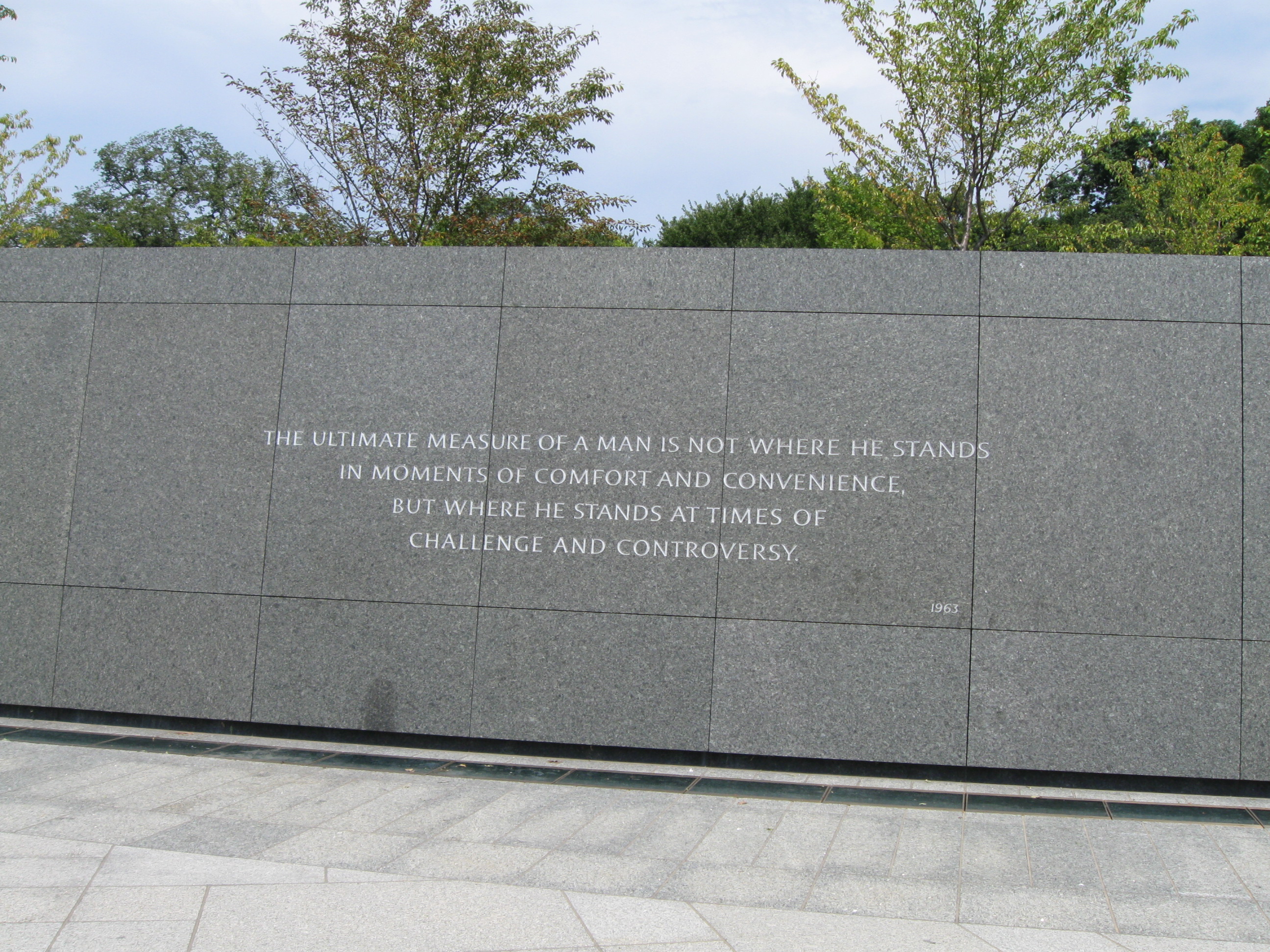
  6. Martin Luther King, Jr. Day. More than just another day off, this is a day to try to give back and be of service to the community.IMG_2315
  7. Starting my new calendar. I still like to keep a paper engagement calendar where I write with ink or pencil. I love the feel of cracking open the new book each year and starting to enter birthdays and appointments.
  8. There’s no one at the beach. January is great time to walk along the shore and have the entire beach all to yourself. Just bundle up!OLYMPUS DIGITAL CAMERA
  9. The days are getting longer. Yes, the mornings are still pretty dark, but we’ve crossed over the hump of the shortest day and the light will increase bit by bit from now until June.
  10. Snow days. There’s no guarantee of snow days where I live. Sometimes two years can go by without one, but that makes it all the more special to wake up to that awesome quiet that comes with a huge snowstorm. I may not like winter, but I enjoy the way all my neighbors talk and laugh while shoveling snow together. There’s a great feeling of camraderie and community at those times.IMG_1052

The month of January is named for the Roman god, Janus, who had two faces. That way, he could look back to the year just finished, and forward to the year just beginning. “Janus” is actually the Latin word for arch, which makes the month of January a kind of doorway for us. Knowing that, I can begin to appreciate how we need to pass through January if we are going to reach the balmier days of spring.

What was your first social network? (Hint: Not Facebook)

A baby in the arms of her father – with her mom looking on – is forming her first and most important social network. Her network expands day by day, babybecoming more complex, as she is introduced to siblings, babysitters, aunts, uncles, and cousins. Soon, she starts forming networks separate from the family – friends, neighbors, teachers and coaches. Eventually she has networks that encompass jobs, community and the entire digital world.

Traditional social networks give us several kinds of support.  Tangible support includes things like money, a place to live or help with chores; informational support includes advice and instruction; emotional support covers love, trust, a listening ear, a shoulder to cry on. When we’re young, we rely on our parents for all three kinds of support; but as we mature, we look to other people in our network to provide some or most of these things, and we learn not to rely on any one person for everything.

Social connection is vitally important for health and well-being, but “connect” may be one of the most overused words of the last decade. We connect on Facebook, Linked In,Twitter and blogs; we connect with old friends, strangers, and people around the world; we connect at home, at work, on the subway and as we walk. But in our rush to connect with everyone, all the time, everywhere we go, do we make it all seem too facile? Do we forget the effort that goes into forging strong and lasting bonds?

It’s easy to click the “Like” button, but not so easy to engage with people day after day, through good times and bad, in the face of disagreements and hurts. It’s easy to send a text or an email, but it takes time to pick up the phone or meet in person to iron out differences. As our digital networks expand, are our in-person networks contracting?

The family network – our first – in many ways bears the brunt of our relational laziness. Maybe it’s because we don’t have the same fear of losing the people in that network. We learned early that we could rely on them, so we don’t worry about paying attention to them and cultivating the relationships. We take them for granted. Worse, we don’t mend the little tears and breaks in the fabric of the relationships, because we don’t think we need to.

OLYMPUS DIGITAL CAMERAIn the past two weeks, I’ve been both to a family funeral and on a family vacation. Each one reminded me that families are messy and complicated organisms! At the funeral, a sister stood on one side of the room not speaking to her siblings. No one even knows for sure why she’s not speaking to them. On every family vacation, I see how hard it is for everyone not to slip back into their habitual roles: good child, bad child; provocateur, peacemaker; the bossy one, the passive one. No wonder we want to be with our “easier” social networks instead!

The novelist Doug Coupland has written, “People are pretty forgiving when it comes to other people’s families. The only family that ever horrifies you is your own.” The truth is, though, that unless you have a truly terrible family, they are the people who will be there for you over the long haul, the ones you’ll be able to call in the middle of the night with a crisis, and the ones you’ll want to share your successes with. Sometimes you feel like you can’t live with them, but it’s almost always better than living without them.

My intention for the new year? To pay attention to my family, to give and forgive, to listen more patiently, to judge less often and to share more meaningfully.

Teach your children well

The public conversation has been a swirl of questions since the unspeakable mass shooting in Newtown, Connecticut last week. How can we prevent these kinds of events? What does mental illness have to do with it? Can we control it by banning certain weapons? How will these child survivors handle it? How can we best protect our children?

Kids_0003We could buy our children bulletproof backpacks, as many parents are apparently doing in the aftermath. Or we can teach them lifelong skills that will not only build resilience for dealing with stressful events, but perhaps help schools and communities become environments where young people will not feel isolated, marginalized and desperate.

The American Psychological Association has tips for parents on how to help children build resilience. Their suggestions include things like “make connections”, “teach self-care”, and “nurture a positive self-view”. This is great advice, but a little vague. Even if a few parents look at the APA web site, how many have the skills to implement the ideas? Children, teachers and communities would be better-served by school-based programs:

  • Mindfulness programs in school. Congressman Tim Ryan of Ohio was so affected by a mindfulness retreat he experienced a few years ago that he wrote a book about it (A Mindful Nation) and worked to get funding for “Skills for Life”, a social and emotional learning program, in Youngstown, OH schools. Teachers receive training, which helps them with their personal stressors, and then they bring the program into the classroom. The children have responded enthusiastically, teachers have found that their classes are better-behaved, and academic performance has even improved. Goldie Hawn, through her Hawn Foundation, has supported a similar program called “MindUP” in the Miami-Dade schools. The program helps develop emotional resilience skills, as well as “helping children function in their environments in a more mindful and less stressful way”.
  • Teaching Tolerance, a program of The Southern Poverty Law Center which aims to foster “school environments that are inclusive and nurturing”. They have developed many anti-bias education resources, including teaching kits, curricula and professional development programs. While their program was initially focused on building tolerance for people of different races and ethnicities, it is applicable to fostering acceptance for children with any kind of differences. One of their initiatives is the “Mix It Up at Lunch Day” which has been held every November since 2002. On that day, kids are encouraged to sit with someone new, someone outside of their “group”, at lunch. These kind of interactions help reduce bias and misconceptions about others.Hand Reaching
  • Compassion training. Dr. James R. Doty, Director and Founder of Project Compassion and Clinical Professor of Neurosurgery at Stanford University, has written, “Why, in a country that consumes 25% of the world’s resources (the U.S.), is there an epidemic of loneliness, depression, and anxiety…Our poverty in the West is not that of the wallet but rather that of social connectedness.” Neuroscience research, at Stanford and elsewhere, has shown that people can train themselves to be more compassionate and to feel greater empathy. This is vital for all of us to cultivate, no matter how old we are. As long as people do not feel connected to each other, it is too easy to forget about the people on the margins.

Will we ever eliminate all acts of violence? Probably not. But I would argue that time and money spent on building mindfulness, peace and compassion in schools are equally as important as resources for math and reading.  Thich Nhat Hanh has written, “A fresh way of being peace, of making peace, is needed…We rely on each other. Our children are relying on us in order for them to have a future.”

Shouldn’t “holiday stress” be an oxymoron?

The emails are starting to arrive. “Holidays Stressing You Out?” says one. “Staying Healthy During the Holidays“, with managing stress as the first topic, reads another. What’s wrong with this picture? The word holiday suggests festivity, recreation, and a vacation mentality. The word stress suggests discomfort, a lack of balance, perhaps even unhappiness. These two words do not belong together.shiny tree

Someone once suggested to me that managing stress is all about managing expectations. While I don’t agree with that 100%, I do think it applies to holiday stress. Much of the stress around holidays comes from what might be considered unreasonable or unnecessary expectations:

  • The expectations we have about  spending time with family and friends.
  • The expectation that we have to give gifts to a specified list of people, and/or the expectation that  we have to spend a certain amount of money.
  • The expectation that we will eat and drink too much.
  • The expectation that we will hold on to traditions, even ones that aren’t serving us anymore.

Another way of putting this?  Too many shoulds, musts, oughts, have tos.

Tips for managing holiday stress are useful, but only as a second step. Like any kind of stress, managing stress around holidays has to start with values clarification, with doing some of the inner work.One of my yoga teachers has observed that for many of us, the default is to do as much as we possibly can, without asking ourselves if it is appropriate, or if we are suffering because of it.

What is values clarification? It could start with questions such as these:

  • What is most meaningful to me about this holiday?
  • What are the things or activities that bring me joy? Which cause me or others to suffer?
  • What do I need in order to be most fully present for the people I love?

When we do this kind of inquiry, we might be able to change our interaction with the holiday for the better. But like coping with any stress, that can’t happen unless we’re willing to make changes, and even rock the boat a little. Doing all the same things in the same old way won’t lead to any significant improvement.

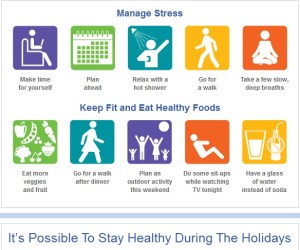
Advice from healthfinder.gov

Once you’ve clarified what’s important to you, and what is going to bring the most happiness to you and those you love, that’s the time to turn to techniques like the planning calendar, keeping up your exercise, and drinking more water. If you start with those things, without stopping to examine your values, you’ll find yourself returning to the default — just using prioritizing and planning as a way to cram more into each day. Even if one of those things you eke out time for is “relaxing”, it might not be as beneficial as it could be if you knew you were living each day in alignment with what’s truly important to you.

Can you wake up each morning during the holiday season knowing that the day will bring you something good? I know of someone who takes a moment before getting out of bed each morning to remember something positive about the day before, and something joyful to look forward to in the day ahead. Stress hormones are typically at a cyclical peak when we first wake up in the morning — so you could do yourself a lot of good by starting each day with a smile instead of a feeling of dread. That’s easier if you’re clear on what you value.

Let’s make “holiday stress” a thing of the past.

What is contentment?

My daughter gave me a little book for my birthday called “Contentment Is…” The book is a compilation of quotes about contentment and happiness that was first published in 1968. I keep flipping through this little gem, finding nuggets of inspiration on almost every page.

If I’m content with a little, enough is as good as a feast.” I should have read this advice, courtesy of Isaac Bickerstaff, before the Thanksgiving holiday. It’s the only time of the year that my own cooking makes me feel sick. Why do we feel the need to stuff ourselves silly on this one day when having just enough would still be a feast? Isn’t the first taste of something always the best?

Thanksgiving_23Contentment is a pearl of great price, and whoever procures it at the expense of ten thousand desires makes a wise and happy purchase.” This wisdom comes from John Balguy, a philosopher who never heard of Black Friday, but seems to know something about the relative value of happiness compared to possessions. It seems kind of crazy to spend one day counting our blessings, and then the next one acting as if none of our desires have been met.

When we cannot find contentment in ourselves, it is useless to seek it elsewhere.” Francois de La Rochefoucauld was a French nobleman who probably had a lot of experience with people seeking happiness in fancy clothes, partying and illicit affairs. He clearly was a keen observer of those around him, and used his insight to write books of maxims like this one.

What makes many persons discontented with their own condition, is the absurd idea which they form of the happiness of others.” Ah, envy – it’s a sower of discontent if there ever was one. We look at those around us and make judgments about their houses, their cars, their jobs, their children and their money – and decide that they must be happier than we are. In truth, we have no idea if the house is mortgaged to the max, the spouse is about to file for divorce, or the children are brats. The grass is not always greener on the other side.

And finally, there is this observation: “Contentment is a matter of hoping for the best, then making the best of what you get.” Our ability to see the silver linings, to be optimistic, and to be grateful for what we have, determines the level of contentment we can achieve. It doesn’t mean we stop dreaming, but perhaps it means we stop grasping.

I realized after reading through my little book that it doesn’t contain one single definition of contentment. Some of the quotes tell me what it’s not; some tell me how it feels; some tell me where to look for it; and others tell me where I won’t find it. We have to create our own definition within ourselves.

The word ‘santosha’ means contentment, or satisfaction, in Sanskrit. The reason I use the word ‘discover’ in my blog’s name is because I do believe it is something that we each can find, or uncover, on our own life path. When we were babies, contentment was simple: to be fed, to be held, to be warm and dry. What is our baseline for happiness and satisfaction as we get older? Can we establish it and then always find our way back as life bounces us around?

Don’t just be thankful – say it!

I’ll never forget the boss I once had who told me that he preferred to have employees who didn’t need to be praised. That’s right – he didn’t ever want to say “Good job!” The only positive feedback I ever received from him came after I had organized a huge (and successful) event for major clients. He said quietly, “That went well.”

Needless to say, that job was not a highlight of my life. Don’t get me wrong – it’s not that I needed a pep talk every day, or wanted to be told how great I was all the time. It’s just that it helps to know that people appreciate you and believe in you.

It turns out that my boss’ managerial style was not in the best interests of the business either. Some recent research reported on Inc.com shows a strong correlation between employee recognition and good business results. Companies that place importance on recognizing and rewarding their employees measure significantly better in productivity, employee engagement and customer service. The most successful companies tie employee recognition to the organization’s values, and also make sure that people are acknowledged by their peers as wells as their superiors.

I’m sure there are workers who don’t need or want to be praised, publicly or privately; but words of gratitude, a simple thank-you, can never be wrong. Expressions of gratitude can be powerful for their giver and their recipient, as well as the people around them. Just because you were doing your job doesn’t mean gratitude is out of order.

Writing a letter of gratitude to a previously unrecognized benefactor is an assignment I give my stress management students each semester. I can’t take credit for the idea; I got it from Martin Seligman. (Thank you, Dr. Seligman!) For most students, this is a deeply meaningful exercise; many write letters of appreciation to former teachers, parents, coaches and friends. Some write to public figures who have influenced them. For everyone, the letter is an opportunity to say “thank you”, either for the first time, or in a more formal way than they ever have before.

There is a great deal of research around the health benefits of practicing gratitude, much of it by Robert Emmons at U.C. Davis. But the rewards go beyond physical health. For some people, practicing gratitude means they are more likely to be making progress on achieving their personal goals; for others, daily gratitude practice leads to increases in energy, enthusiasm and attentiveness; and for children, thinking gratefully leads to more positive attitudes about school.

If you are curious about how the practice of gratitude might improve your life, you can be a part of a new project spearheaded by U.C. Berkeley and U.C. Davis. “Expanding the Science and Practice of Gratitude” is a 3-year, $5.6 million endeavor that includes as one component,  an interactive, on-line gratitude journal. At the website Thnx4.org, you can register and start keeping a 2-week journal, which will be shared with others on the site and become part of the larger research project.

In the meantime, perhaps we can all expand our practice of gratitude on Thanksgiving Day. In addition to expressing thanks for our food, our many blessings and our families, maybe we can each take a moment to remember and thank someone who helped set us on the right path, or was there for us at a crucial time, or just showed kindness when we needed it most.

At times our own light goes out and is rekindled by a spark from another person. Each of us has cause to think with deep gratitude of those who have lighted the flame within us.” — Albert Schweitzer